Wróblewska Małgorzata, Gil Lidia A, Komarnicki Mieczysław A
Students' Scientific Society, Poznan University of Medical Sciences, Poznan, Poland.
Department of Haematology and Bone Marrow Transplantation, Poznan University of Medical Sciences, Poznan, Poland.
Cent Eur J Immunol. 2015;40(1):122-5. doi: 10.5114/ceji.2015.50845. Epub 2015 Apr 22.
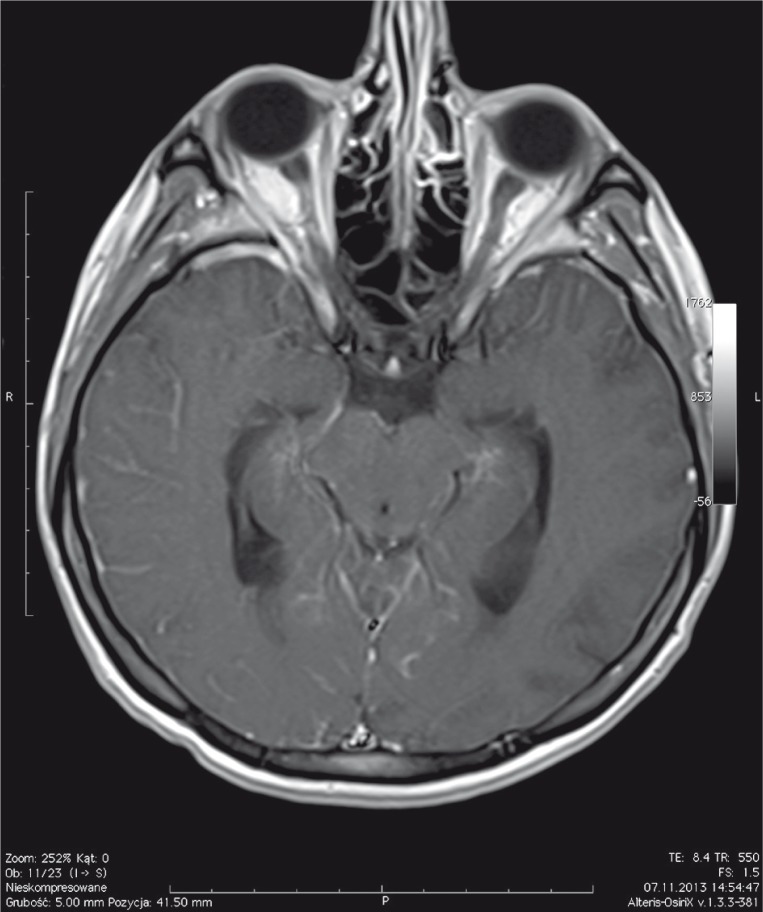
Post-transplant lymphoproliferative disease (PTLD) is a rare but severe form of Epstein-Barr virus (EBV)-driven complication that develops in patients after haematopoietic stem cell transplantation. In rare cases it manifests as primary central nervous system (CNS) involvement, which is thought to be the most unfavourable localisation with respect to outcome. Disease confined to the CNS is much more challenging than systemic PTLD, and one of the contributing factors is the limited drug penetration across the blood-brain barrier. We describe the case of a 29-year-old woman who was successfully treated for PTLD with CNS involvement. The patient was diagnosed with T-cell lymphoblastic lymphoma and underwent the procedure of haematopoietic stem cell transplantation from an unrelated donor. Two months after transplantation she manifested severe headache and progressive mental deterioration accompanied by enlargement of the lymph nodes. Magnetic resonance imaging (MRI) scan revealed segmental, asymmetrical thickening of the meninges. Based on the clinical picture and the laboratory findings diagnosis of PTLD was made. The patient was effectively treated with reduction of immunosuppressive therapy and intravenous rituximab. Initially started intrathecal chemotherapy was stopped due to iatrogenic complications. We conclude that in this case the involvement of meninges in the course of the lymphoproliferative process might have compromised the blood-brain barrier. This factor probably improved rituximab's penetration to CNS, contributing to our patient's recovery.
移植后淋巴细胞增生性疾病(PTLD)是一种罕见但严重的由 Epstein-Barr 病毒(EBV)驱动的并发症,发生于造血干细胞移植后的患者。在罕见情况下,它表现为原发性中枢神经系统(CNS)受累,这被认为是对预后最不利的定位。局限于 CNS 的疾病比系统性 PTLD 更具挑战性,其中一个促成因素是药物穿过血脑屏障的能力有限。我们描述了一名 29 岁女性成功治疗 CNS 受累的 PTLD 的病例。该患者被诊断为 T 细胞淋巴母细胞淋巴瘤,并接受了来自无关供体的造血干细胞移植手术。移植后两个月,她出现严重头痛和进行性精神衰退,并伴有淋巴结肿大。磁共振成像(MRI)扫描显示脑膜节段性、不对称增厚。根据临床表现和实验室检查结果,诊断为 PTLD。患者通过减少免疫抑制治疗和静脉注射利妥昔单抗得到有效治疗。最初开始的鞘内化疗因医源性并发症而停止。我们得出结论,在这种情况下,脑膜在淋巴增生过程中的受累可能损害了血脑屏障。这个因素可能改善了利妥昔单抗对 CNS 的渗透,有助于我们患者的康复。