Mouchet Maud, Levers Christian, Zupan Laure, Kuemmerle Tobias, Plutzar Christoph, Erb Karlheinz, Lavorel Sandra, Thuiller Wilfried, Haberl Helmut
Univ. Grenoble Alpes, Laboratoire d'Ecologie Alpine (LECA), F-38000, Grenoble, France; CNRS, Laboratoire d'Ecologie Alpine (LECA), F-38000, Grenoble, France.
Geography Department, Humboldt-Universität zu Berlin, Unter den Linden 6, 10099, Berlin, Germany.
PLoS One. 2015 Jul 10;10(7):e0131924. doi: 10.1371/journal.pone.0131924. eCollection 2015.
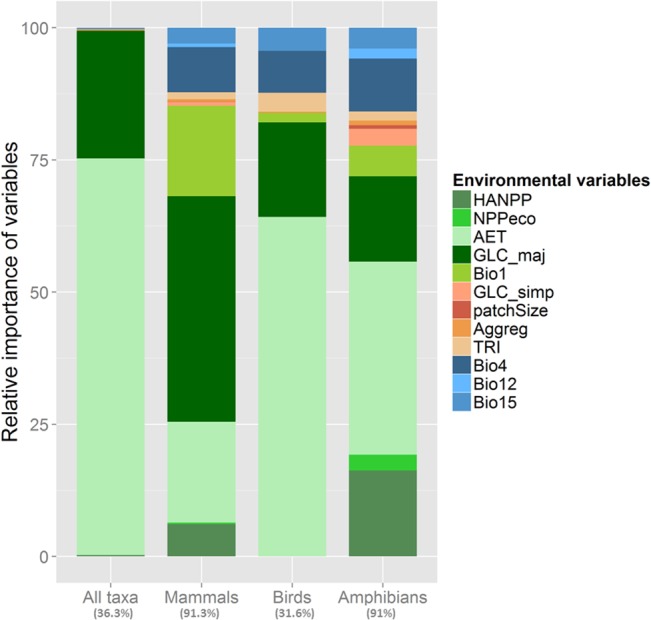
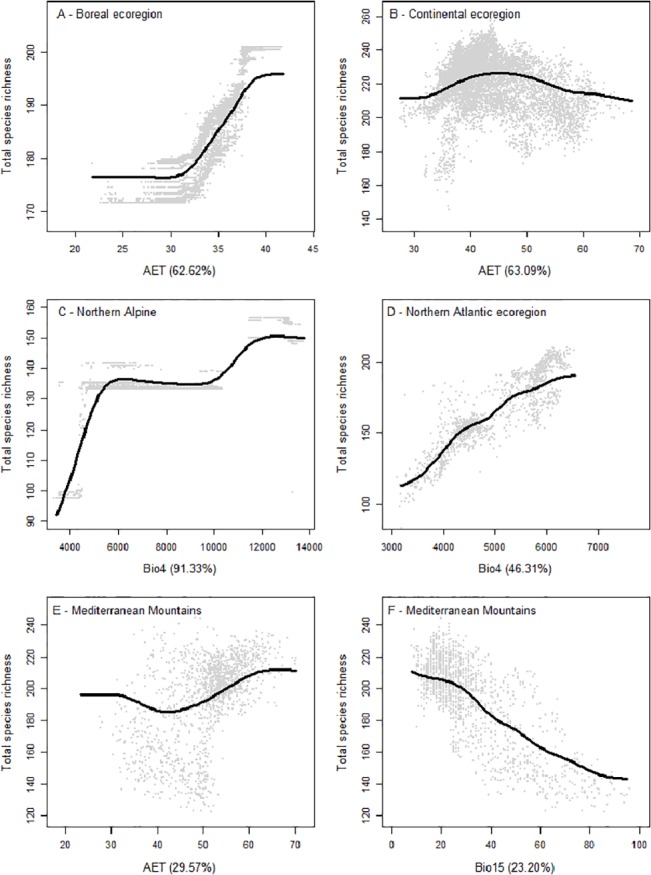
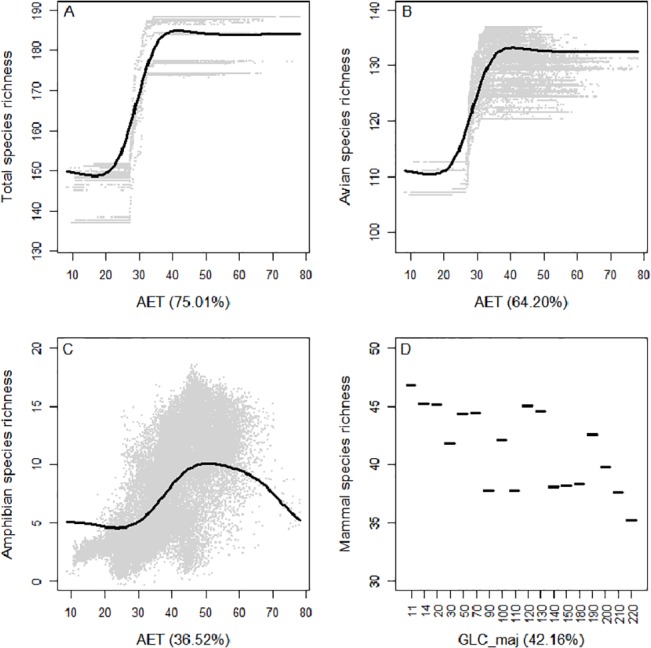
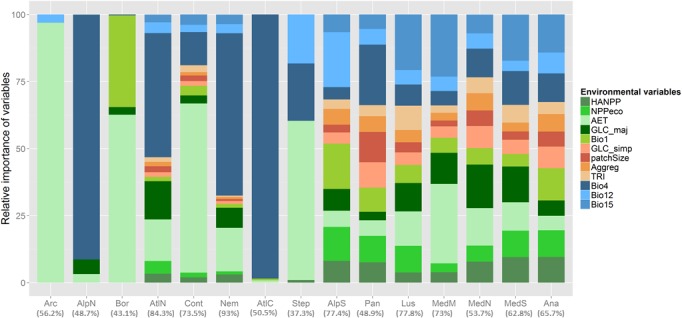
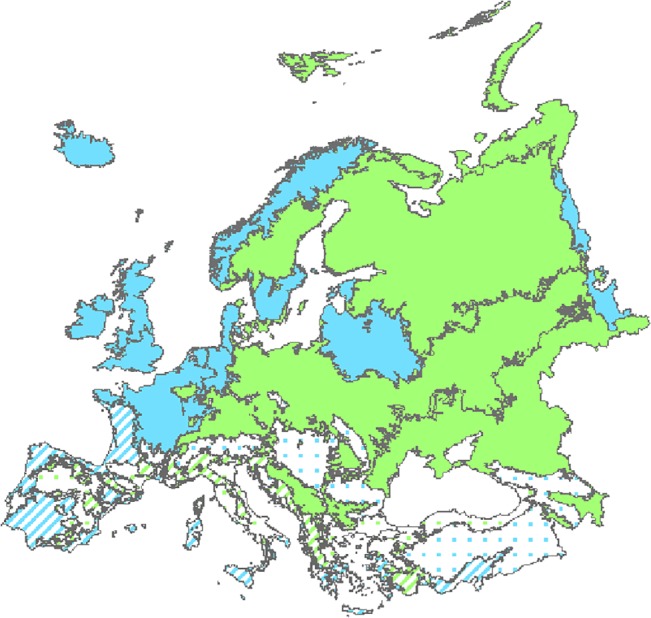
We compared the effectiveness of environmental variables, and in particular of land-use indicators, to explain species richness patterns across taxonomic groups and biogeographical scales (i.e. overall pan-Europe and ecoregions within pan-Europe). Using boosted regression trees that handle non-linear relationships, we compared the relative influence (as a measure of effectiveness) of environmental variables related to climate, landscape (or habitat heterogeneity), land-use intensity or energy availability to explain European vertebrate species richness (birds, amphibians, and mammals) at the continental and ecoregion scales. We found that dominant land cover and actual evapotranspiration that relate to energy availability were the main correlates of vertebrate species richness over Europe. At the ecoregion scale, we identified four distinct groups of ecoregions where species richness was essentially associated to (i) seasonality of temperature, (ii) actual evapotranspiration and/or mean annual temperature, (iii) seasonality of precipitation, actual evapotranspiration and land cover) and (iv) and an even combination of the environmental variables. This typology of ecoregions remained valid for total vertebrate richness and the three vertebrate groups taken separately. Despite the overwhelming influence of land cover and actual evapotranspiration to explain vertebrate species richness patterns at European scale, the ranking of the main correlates of species richness varied between regions. Interestingly, landscape and land-use indicators did not stand out at the continental scale but their influence greatly increased in southern ecoregions, revealing the long-lasting human footprint on land-use-land-cover changes. Our study provides one of the first multi-scale descriptions of the variability in the ranking of correlates across several taxa.
我们比较了环境变量,特别是土地利用指标,以解释不同分类群和生物地理尺度(即整个泛欧洲地区以及泛欧洲地区内的生态区域)的物种丰富度模式。使用能够处理非线性关系的增强回归树,我们比较了与气候、景观(或栖息地异质性)、土地利用强度或能源可用性相关的环境变量在大陆和生态区域尺度上对欧洲脊椎动物物种丰富度(鸟类、两栖动物和哺乳动物)的相对影响(作为有效性的一种衡量)。我们发现,与能源可用性相关的主要土地覆盖类型和实际蒸散量是欧洲脊椎动物物种丰富度的主要相关因素。在生态区域尺度上,我们确定了四类不同的生态区域,其物种丰富度主要与以下因素相关:(i)温度季节性,(ii)实际蒸散量和/或年平均温度,(iii)降水季节性、实际蒸散量和土地覆盖类型,以及(iv)环境变量的均匀组合。这种生态区域类型对于总脊椎动物丰富度以及分别考虑的三个脊椎动物类群均有效。尽管土地覆盖类型和实际蒸散量在解释欧洲尺度上的脊椎动物物种丰富度模式方面具有压倒性影响,但物种丰富度的主要相关因素排名在不同区域之间有所不同。有趣的是,景观和土地利用指标在大陆尺度上并不突出,但其影响在南部生态区域显著增加,揭示了人类对土地利用和土地覆盖变化的长期影响。我们的研究首次提供了多尺度描述,说明了多个分类群相关因素排名的变异性。