Zhou Qiongxiu, Wang Jue, He Zhi, Li Xiaojuan, Mao Song, Huang Shu, Bian Guohui, Ma Feng
Center for Stem Cell Research and Application, Institute of Blood Transfusion, Chinese Academy of Medical Sciences and Peking Union Medical College (CAMS and PUMC), 26 Huacai Road, Longtan Industry Park, Chenghua District, Chengdu, 610052, China.
Urumqi Blood Center, Urumqi, China.
J Transl Med. 2015 Jul 11;13:221. doi: 10.1186/s12967-015-0544-7.
Killer cell immunoglobulin-like receptors (KIRs) show extensive variation in genetic content and allelic polymorphi sms among different populations.
We analyzed the distribution of KIR genes in the Tibetan ethnic minority of Lhasa city, the Uyghur and Kazakh ethnic minorities of Urumqi city populations in China. Genotyping of 16 KIR genes was tested in 479 randomly selected individuals using the multiple PCR-SSP method.
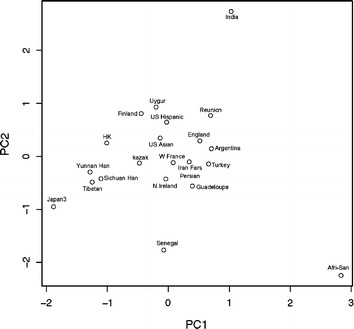
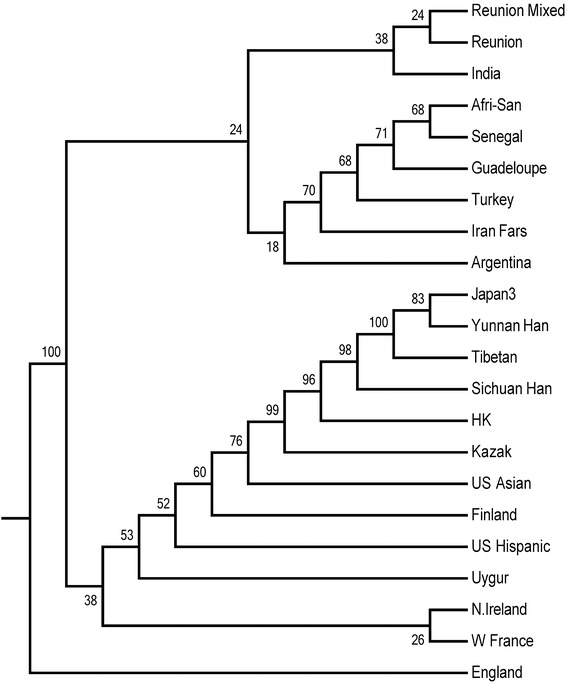
A total of 42 KIR genotypes were detected, of which, 29 were predicted to be AB genotypes, 12 were BB genotypes and one was AA genotypes. 27 KIR genotypes were identified in Kazakhs, 30 KIR genotypes were identified in Uyghurs and 20 KIR genotypes were identified in Tibetans. The predominant genotype 1(AA genotypes) occurred most frequently in Tibetans (52.7%, 118/224), Kazakhs (43.2%, 54/125) and Uyghurs (34.9%, 45/130). Not only the four framework genes were present in all individuals, but the pseudogene 2DP1 could also be detected in all Uyghur individuals. Tibetans were different from Kazakh and Uyghur groups in KIR genetic content and KIR allelic variation. Intriguingly, Tibetans (29.5%, 66/224) had lower frequencies of 2DS4-v when compared with Uyghurs (60.8%, 79/130) and Kazakh s (59.2%, 74/125). Uyghurs (25.4%, 33/130) displayed higher frequencies of Bx genotypes with C4Tx (absence of KIR3DS1-2DL5-2DS5-2DS1) than both Kazakhs (11.2%, 14/125) and Tibetans (3.6%, 8/224).
The study showed that profile of KIR genotypes in three ethnic minority populations in China displayed ethnic diversity. It could be valuable for enriching the ethnical information resources for KIR gene, as well as facilitating further research on KIR-related diseases.
杀伤细胞免疫球蛋白样受体(KIRs)在不同人群中的基因含量和等位基因多态性存在广泛差异。
我们分析了中国拉萨市藏族、乌鲁木齐市维吾尔族和哈萨克族人群中KIR基因的分布情况。采用多重PCR-SSP方法对479名随机选取个体的16个KIR基因进行基因分型检测。
共检测到42种KIR基因型,其中29种预测为AB基因型,12种为BB基因型,1种为AA基因型。在哈萨克族中鉴定出27种KIR基因型,维吾尔族中鉴定出30种KIR基因型,藏族中鉴定出20种KIR基因型。优势基因型1(AA基因型)在藏族(52.7%,118/224)、哈萨克族(43.2%,54/125)和维吾尔族(34.9%,45/130)中出现频率最高。不仅所有个体中都存在四个框架基因,而且在所有维吾尔族个体中也能检测到假基因2DP1。藏族在KIR基因含量和KIR等位基因变异方面与哈萨克族和维吾尔族群体不同。有趣的是,与维吾尔族(60.8%,79/130)和哈萨克族(59.2%,74/125)相比,藏族(29.5%,66/224)中2DS4-v的频率较低。维吾尔族(25.4%,33/130)中具有C4Tx(缺乏KIR3DS1-2DL5-2DS5-2DS1)的Bx基因型频率高于哈萨克族(11.2%,14/125)和藏族(3.6%,8/224)。
该研究表明中国三个少数民族群体的KIR基因型谱呈现出民族多样性。这对于丰富KIR基因的民族信息资源以及促进KIR相关疾病的进一步研究具有重要价值。