Ingadottir Brynja, Thylén Ingela, Jaarsma Tiny
Department of Social and Welfare Studies, Linköping University, Norrköping, Sweden ; Landspitali-The National University Hospital of Iceland, Reykjavik, Iceland.
Department of Cardiology and Department of Medical and Health Sciences, Linköping University, Linköping, Sweden.
Patient Prefer Adherence. 2015 Jul 2;9:913-21. doi: 10.2147/PPA.S83069. eCollection 2015.
To describe what knowledge heart failure patients expect to acquire in relation to their upcoming cardiac resynchronization therapy (CRT) device implantation, to describe their self-care and health complaints, and to explore the relationship between knowledge expectations and self-care, health complaints, and background factors.
Cross-sectional multicenter study with 104 patients scheduled for a first-time, elective CRT implantation in Swedish and Icelandic hospitals. Data were collected with the Knowledge Expectations of hospital patient Scale, European Heart Failure Self-care Behavior Scale, and Adjusted Postoperative Recovery Profile.
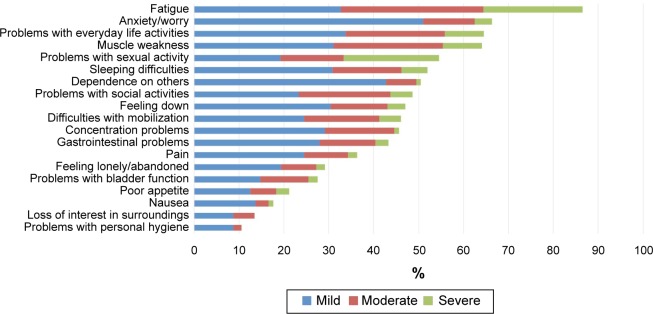
Patients expected most knowledge related to their disease and its treatment (median 4.0, interquartile range 0.13) and least on social issues (median 3.5, interquartile range 0.83). Their self-care was average (standardized mean 51.0±19.6) before the procedure. Patients had on average 8.2 (±4.7) health complaints and rated fatigue and sexual problems as the most severe. Age was independently associated with knowledge expectations (Expβ 0.049, P=0.033).
Heart failure patients waiting for a CRT device implantation have high expectations for multiple aspects of knowledge, including self-care issues, before their procedure. These expectations are similar to those of other surgical patients and they increase with age.
描述心力衰竭患者期望在即将进行的心脏再同步治疗(CRT)设备植入方面获得哪些知识,描述他们的自我护理和健康问题,并探讨知识期望与自我护理、健康问题及背景因素之间的关系。
对瑞典和冰岛医院计划首次择期进行CRT植入的104例患者开展横断面多中心研究。采用医院患者知识期望量表、欧洲心力衰竭自我护理行为量表和调整后的术后恢复概况收集数据。
患者期望获得的关于其疾病及其治疗的知识最多(中位数为4.0,四分位间距为0.13),而对社会问题的期望最少(中位数为3.5,四分位间距为0.83)。术前他们的自我护理处于平均水平(标准化均值为51.0±19.6)。患者平均有8.2(±4.7)个健康问题,其中疲劳和性功能问题最为严重。年龄与知识期望独立相关(Expβ 0.049,P = 0.033)。
等待CRT设备植入的心力衰竭患者在术前对包括自我护理问题在内的多个知识方面有较高期望。这些期望与其他手术患者的期望相似,且随年龄增长而增加。