Leino-Kilpi Helena, Inkeroinen Saija, Cabrera Esther, Charalambous Andreas, Fatkulina Natalja, Katajisto Jouko, Sigurðardóttir Árún K, Sourtzi Panayota, Suhonen Riitta, Zabalegui Adelaida, Valkeapää Kirsi
Department of Nursing Science, University of Turku, Turku, Finland.
Turku University Hospital, Turku, Finland.
J Multidiscip Healthc. 2020 Nov 10;13:1481-1505. doi: 10.2147/JMDH.S271043. eCollection 2020.
In patient education, there is a need for valid and reliable instruments to assess and tailor empowering educational activities. In this study, we summarize the process of producing two parallel instruments for analyzing hospital patients' expectations (Expected Knowledge of Hospital Patients, EKhp) and received knowledge (Received Knowledge of Hospital Patients, RKhp) and evaluate the psychometrics of the instruments based on international data. In the instruments, six elements of empowering knowledge are included (bio-physiological, functional, experiential, ethical, social, and financial).
The original Finnish versions of EKhp and RKhp were tested for the first time in 2003, after which they have been used in several national studies. For international purposes, the instruments were first translated into English, then to languages of the seven participating European countries, using double-checking procedure in each one, and subsequently evaluated and confirmed by local researchers and language experts. International data collection was performed in 2009-2012 with a total sample of 1,595 orthopedic patients. Orthopedic patients were selected due to the increase in their numbers, and need for educational activities. Here we report the psychometrics of the instruments for potential international use and future development.
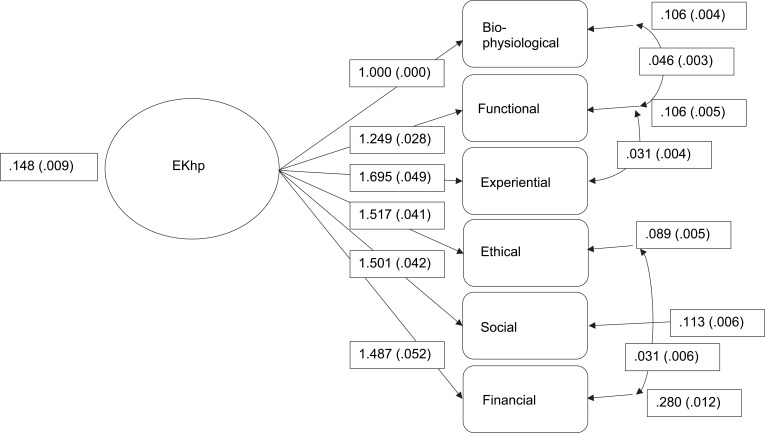
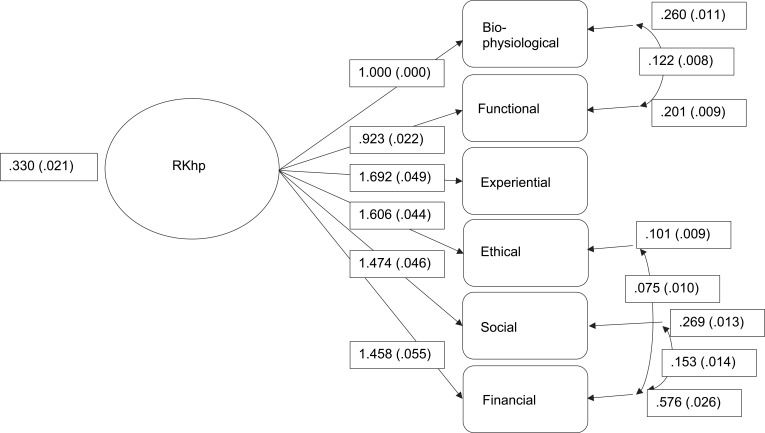
Content validities were confirmed by each participating country. Confirmatory factor analyses supported the original theoretical, six-dimensional structure of the instruments. For some subscales, however, there is a need for further clarification. The summative factors, based on the dimensions, have a satisfactory internal consistency. The results support the use of the instruments in patient education in orthopedic nursing, and preferably also in other fields of surgical nursing care.
EKhp and RKhp have potential for international use in the evaluation of empowering patient education. In the future, testing of the structure is needed, and validation in other fields of clinical care besides surgical nursing is especially warranted.
在患者教育中,需要有效且可靠的工具来评估和定制赋权教育活动。在本研究中,我们总结了制作两份平行工具的过程,这两份工具用于分析医院患者的期望(《医院患者的期望知识》,EKhp)和所获知识(《医院患者的所获知识》,RKhp),并基于国际数据评估这些工具的心理测量学特性。这些工具包含了赋权知识的六个要素(生物生理、功能、经验、伦理、社会和财务)。
EKhp和RKhp的原始芬兰语版本于2003年首次进行测试,此后它们被用于多项全国性研究。出于国际使用目的,这些工具首先被翻译成英语,然后再翻译成七个参与研究的欧洲国家的语言,在每个国家都采用了双重检查程序,随后由当地研究人员和语言专家进行评估和确认。2009 - 2012年进行了国际数据收集,总样本为1595名骨科患者。选择骨科患者是因为其数量增加以及对教育活动的需求。在此我们报告这些工具在潜在国际使用和未来发展方面的心理测量学特性。
每个参与国家都确认了内容效度。验证性因素分析支持了这些工具最初的理论六维结构。然而,对于一些子量表,仍需要进一步澄清。基于这些维度的汇总因素具有令人满意的内部一致性。结果支持在骨科护理的患者教育中使用这些工具,最好也能在外科护理的其他领域使用。
EKhp和RKhp在评估赋权患者教育方面具有国际使用潜力。未来,需要对结构进行测试,尤其有必要在外科护理之外的其他临床护理领域进行验证。