Ma Qingguo, Pei Guanxiong, Jin Jia
School of Management, Zhejiang University, Hangzhou, China; Neuromanagement Lab, Zhejiang University, Hangzhou, China.
Business School, Ningbo University, Ningbo, China.
PLoS One. 2015 Jul 14;10(7):e0133078. doi: 10.1371/journal.pone.0133078. eCollection 2015.
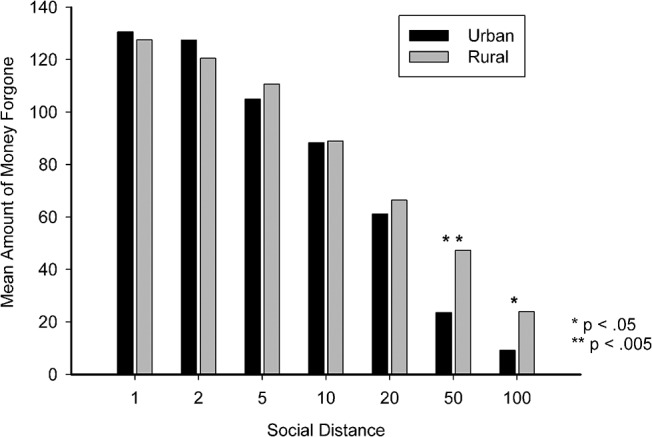
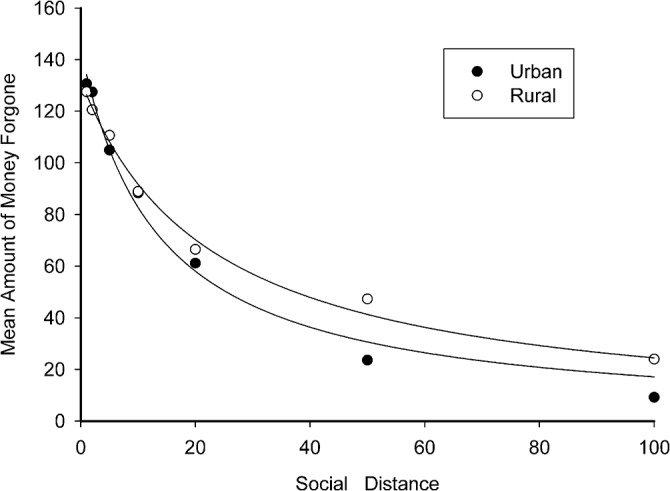
An individual's willingness to share resources declines as the social distance between the decision maker and the recipient increases, which is known as social discounting. This social-distance-dependent prosocial behavior is likely to be influenced by the region in which individuals were raised. Based on previous studies on social discounting, this research focuses on the differing social distance-dependent prosocial behaviors between rural- and urban-reared participants in China. Our data showed that both groups' behaviors conform to the social discounting function and fit the hyperbolic model, as reported in previous studies about social discounting. Interestingly, individuals who were raised in rural areas yielded a smaller discount rate than those who were raised in urban areas, which indicated that a rural upbringing produced people who were more generous than those with an urban upbringing. Furthermore, this distinct type of generosity occurred notably among individuals with greater social distance, such as strangers or distant acquaintances. The reason may be due to the difference in dominant culture, production mode and lifestyle between rural and urban people.
随着决策者与接受者之间的社会距离增加,个体分享资源的意愿会下降,这被称为社会折扣。这种依赖社会距离的亲社会行为可能会受到个体成长地区的影响。基于以往关于社会折扣的研究,本研究聚焦于中国农村和城市成长的参与者之间不同的依赖社会距离的亲社会行为。我们的数据表明,两组的行为都符合社会折扣函数并拟合双曲线模型,正如之前关于社会折扣的研究所报道的那样。有趣的是,在农村长大的个体的折扣率低于在城市长大的个体,这表明农村成长环境培养出的人比城市成长环境培养出的人更慷慨。此外,这种独特的慷慨尤其体现在社会距离较大的个体之间,比如陌生人或远亲。原因可能在于农村和城市人群在主流文化、生产方式和生活方式上的差异。