López-Aguilar Celeste, Romero-López Cristina, Espinosa Manuel, Berzal-Herranz Alfredo, Del Solar Gloria
Molecular Microbiology and Infection Biology Department, Centro de Investigaciones Biológicas (CIB-CSIC) Madrid, Spain.
Molecular Biology Department, Instituto de Parasitología y Biomedicina López-Neyra (IPBLN-CSIC) Granada, Spain.
Front Genet. 2015 Jun 30;6:225. doi: 10.3389/fgene.2015.00225. eCollection 2015.
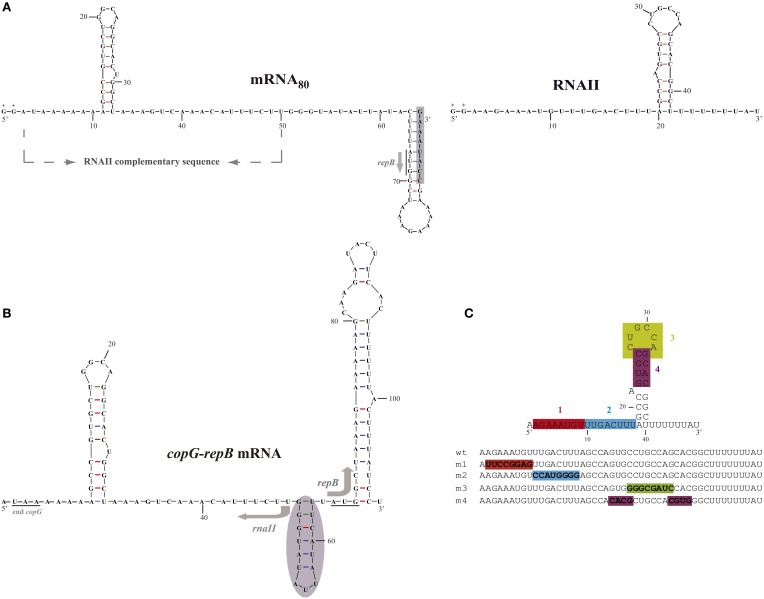
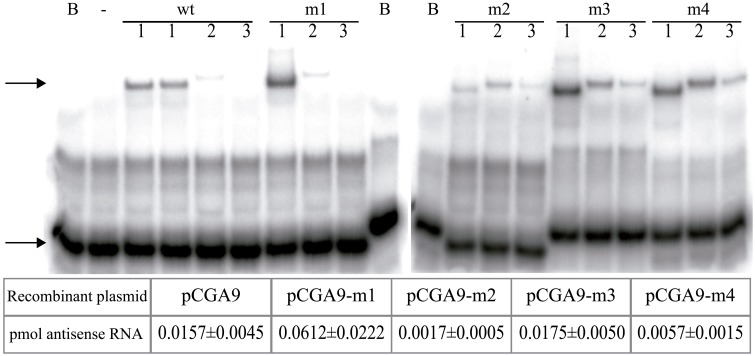
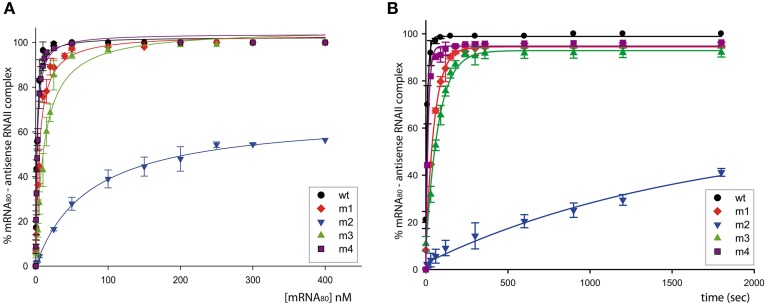
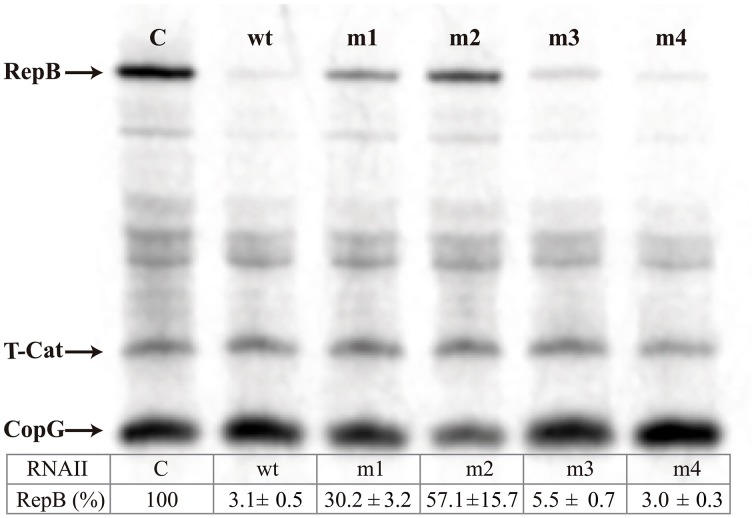
Rolling-circle replication of streptococcal plasmid pMV158 is controlled by the concerted action of two trans-acting elements, namely transcriptional repressor CopG and antisense RNAII, which inhibit expression of the repB gene encoding the replication initiator protein. The pMV158-encoded antisense RNAII exerts its activity of replication control by inhibiting translation of the essential repB gene. RNAII is the smallest and simplest among the characterized antisense RNAs involved in control of plasmid replication. Structure analysis of RNAII revealed that it folds into an 8-bp-long stem containing a 1-nt bulge and closed by a 6-nt apical loop. This hairpin is flanked by a 17-nt-long single-stranded 5'-tail and an 8-nt-long 3'-terminal U-rich stretch. Here, the 3' and 5' regions of the 5'-tail of RNAII are shown to play a critical role in the binding to the target mRNA and in the inhibition of repB translation, respectively. In contrast, the apical loop of the single hairpin of RNAII plays a rather secondary role and the upper stem region hardly contributes to the binding or inhibition processes. The entire 5'-tail is required for efficient inhibition of repB translation, though only the 8-nt-long region adjacent to the hairpin seems to be essential for rapid binding to the mRNA. These results show that a "kissing" interaction involving base-pairing between complementary hairpin loops in RNAII and mRNA is not critical for efficient RNA/RNA binding or repB translation inhibition. A singular binding mechanism is envisaged whereby initial pairing between complementary single-stranded regions in the antisense and sense RNAs progresses upwards into the corresponding hairpin stems to form the intermolecular duplex.
链球菌质粒pMV158的滚环复制受两个反式作用元件协同作用的控制,即转录阻遏物CopG和反义RNAII,它们抑制编码复制起始蛋白的repB基因的表达。pMV158编码的反义RNAII通过抑制必需的repB基因的翻译发挥其复制控制活性。RNAII是参与质粒复制控制的已鉴定反义RNA中最小且最简单的。RNAII的结构分析表明,它折叠成一个8个碱基对长的茎,包含一个1个核苷酸的凸起,并由一个6个核苷酸的顶端环封闭。这个发夹两侧是一个17个核苷酸长的单链5'尾巴和一个8个核苷酸长的富含3'末端U的延伸段。在这里,RNAII的5'尾巴的3'和5'区域分别在与靶mRNA的结合和repB翻译的抑制中起关键作用。相比之下,RNAII单发卡的顶端环起次要作用,上部茎区域对结合或抑制过程几乎没有贡献。整个5'尾巴是有效抑制repB翻译所必需的,尽管只有与发夹相邻的8个核苷酸长的区域似乎对快速结合mRNA至关重要。这些结果表明,涉及RNAII和mRNA中互补发夹环之间碱基配对的“亲吻”相互作用对于有效的RNA/RNA结合或repB翻译抑制并不关键。设想了一种独特的结合机制,即反义RNA和有义RNA中互补单链区域之间的初始配对向上延伸到相应的发夹茎中以形成分子间双链体。