Hatzistergos Konstantinos E, Paulino Ellena C, Dulce Raul A, Takeuchi Lauro M, Bellio Michael A, Kulandavelu Shathiyah, Cao Yenong, Balkan Wayne, Kanashiro-Takeuchi Rosemeire M, Hare Joshua M
Interdisciplinary Stem Cell Institute, University of Miami, FL (K.E.H., E.C.P., R.A.D., L.M.T., M.A.B., S.K., Y.C., W.B., R.M.K.T., J.M.H.).
Interdisciplinary Stem Cell Institute, University of Miami, FL (K.E.H., E.C.P., R.A.D., L.M.T., M.A.B., S.K., Y.C., W.B., R.M.K.T., J.M.H.) Department of Molecular and Cellular Pharmacology, University of Miami Miller School of Medicine, Miami, FL (M.A.B., R.M.K.T., J.M.H.).
J Am Heart Assoc. 2015 Jul 15;4(7):e001974. doi: 10.1161/JAHA.115.001974.
Mammalian heart regenerative activity is lost before adulthood but increases after cardiac injury. Cardiac repair mechanisms, which involve both endogenous cardiac stem cells (CSCs) and cardiomyocyte cell-cycle reentry, are inadequate to achieve full recovery after myocardial infarction (MI). Mice deficient in S-nitrosoglutathione reductase (GSNOR(-⁄-)), an enzyme regulating S-nitrosothiol turnover, have preserved cardiac function after MI. Here, we tested the hypothesis that GSNOR activity modulates cardiac cell proliferation in the post-MI adult heart.
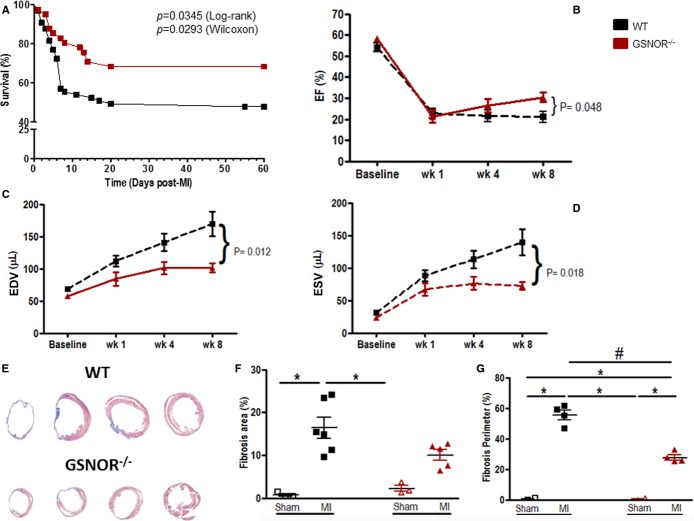
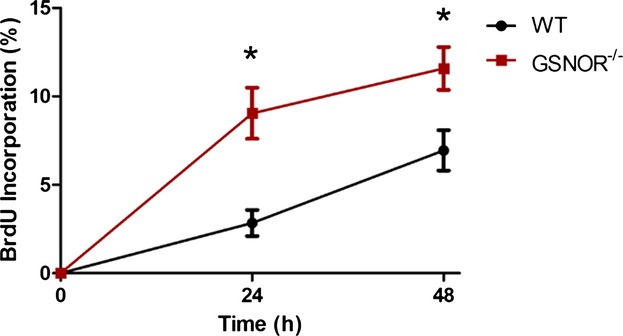
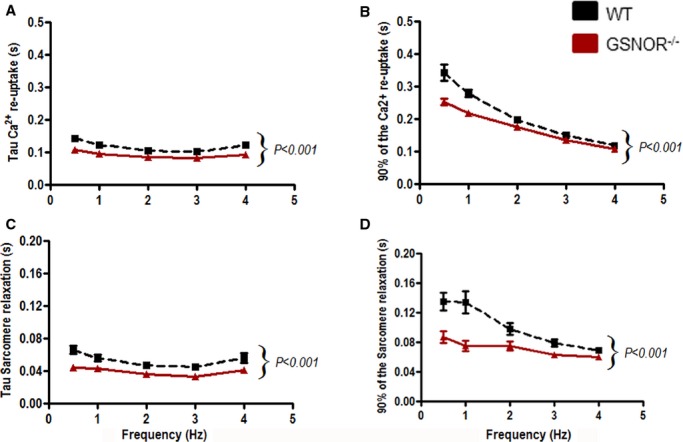
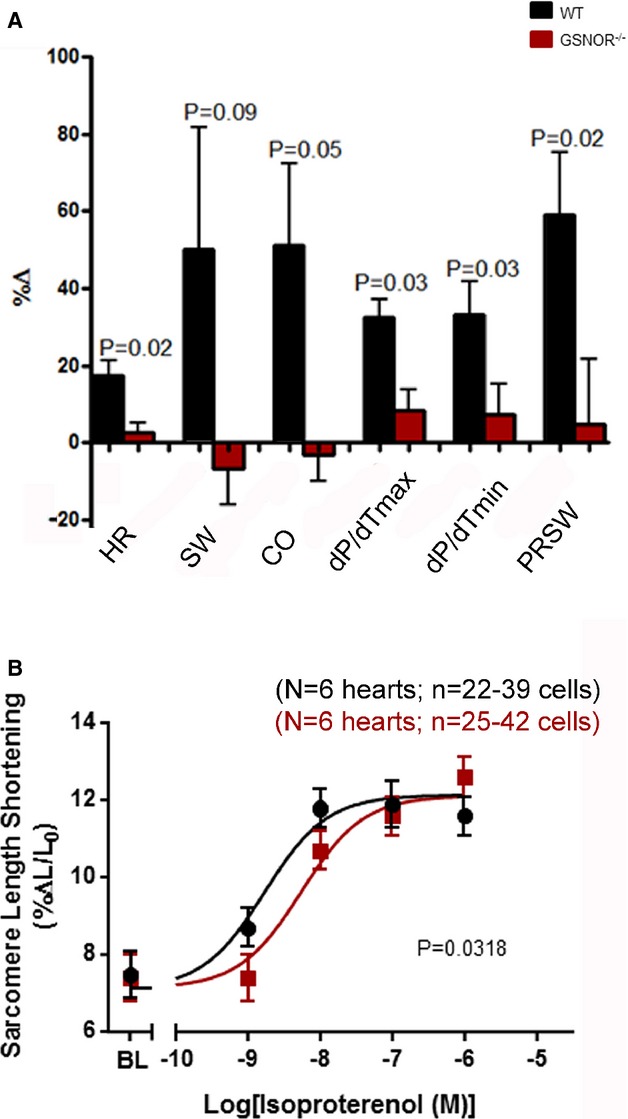
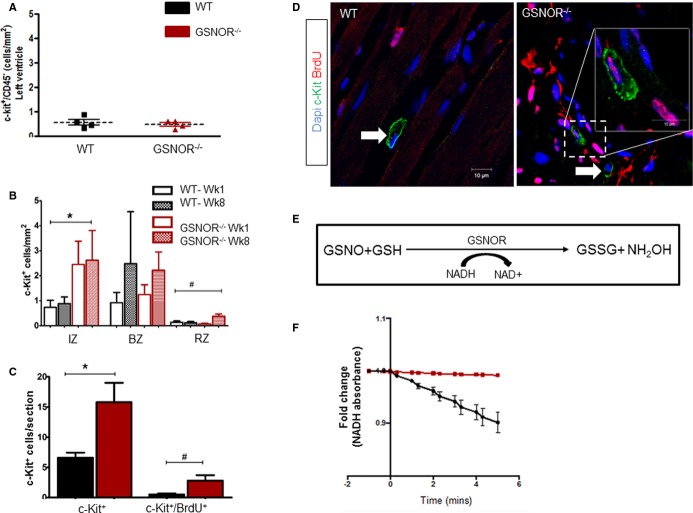
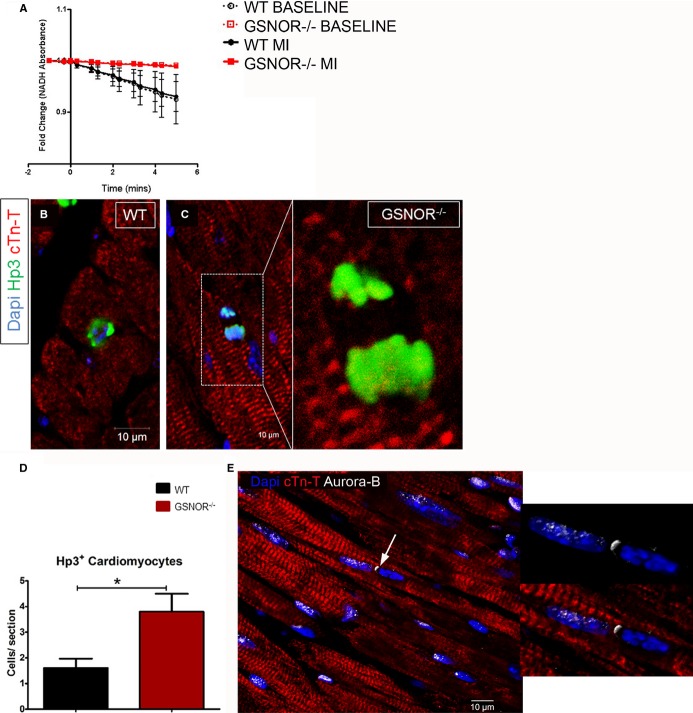
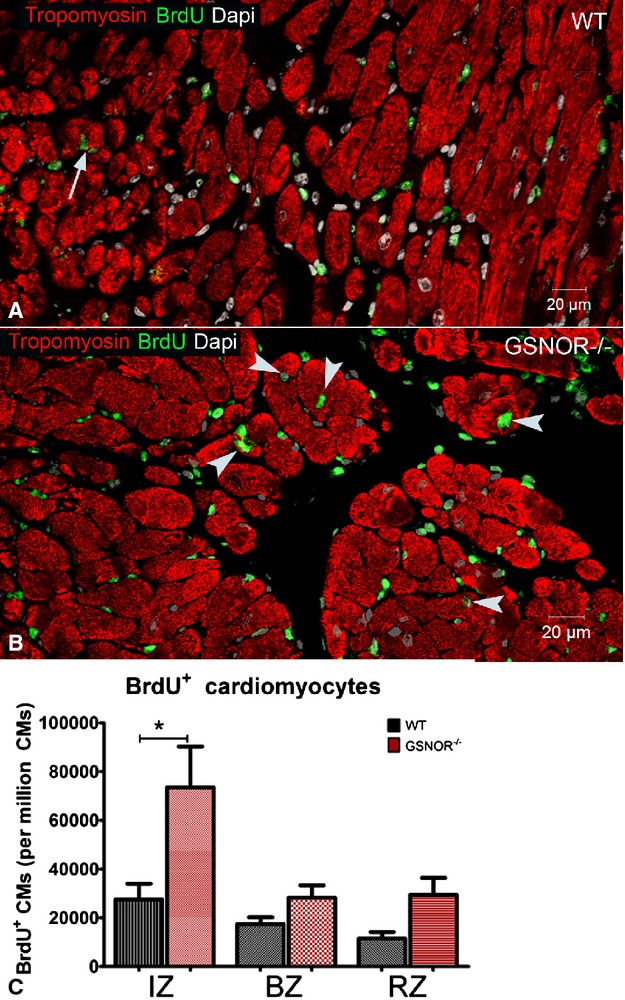
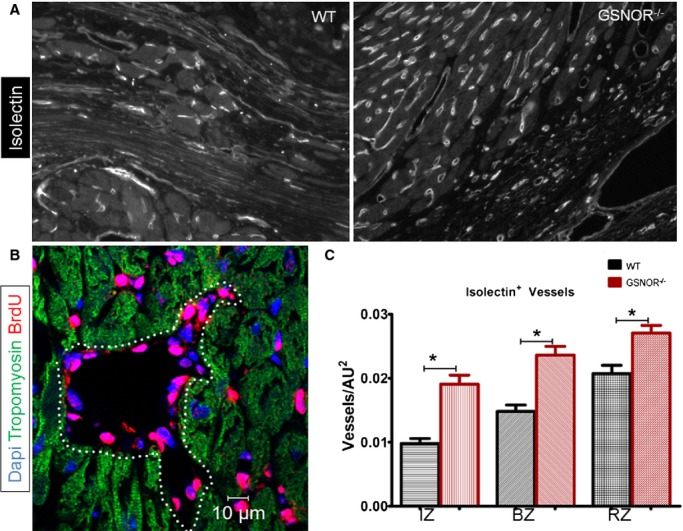
GSNOR(-⁄-) and C57Bl6/J (wild-type [WT]) mice were subjected to sham operation (n=3 GSNOR(-⁄-); n=3 WT) or MI (n=41 GSNOR(-⁄-); n=65 WT). Compared with WT, GSNOR(-⁄-) mice exhibited improved survival, cardiac performance, and architecture after MI, as demonstrated by higher ejection fraction (P<0.05), lower endocardial volumes (P<0.001), and diminished scar size (P<0.05). In addition, cardiomyocytes from post-MI GSNOR(-⁄-) hearts exhibited faster calcium decay and sarcomeric relaxation times (P<0.001). Immunophenotypic analysis illustrated that post-MI GSNOR(-⁄-) hearts demonstrated enhanced neovascularization (P<0.001), c-kit(+) CSC abundance (P=0.013), and a ≈3-fold increase in proliferation of adult cardiomyocytes and c-kit(+)/CD45(-) CSCs (P<0.0001 and P=0.023, respectively) as measured by using 5-bromodeoxyuridine.
Loss of GSNOR confers enhanced post-MI cardiac regenerative activity, characterized by enhanced turnover of cardiomyocytes and CSCs. Endogenous denitrosylases exert an inhibitory effect over cardiac repair mechanisms and therefore represents a potential novel therapeutic target.
哺乳动物心脏的再生活性在成年前丧失,但在心脏损伤后会增强。心脏修复机制涉及内源性心脏干细胞(CSCs)和心肌细胞的细胞周期重新进入,在心肌梗死(MI)后不足以实现完全恢复。缺乏S-亚硝基谷胱甘肽还原酶(GSNOR(-/-))的小鼠,该酶调节S-亚硝基硫醇的周转,在MI后心脏功能得以保留。在此,我们检验了GSNOR活性调节MI后成年心脏中心脏细胞增殖的假说。
将GSNOR(-/-)和C57Bl6/J(野生型[WT])小鼠进行假手术(n = 3只GSNOR(-/-);n = 3只WT)或MI(n = 41只GSNOR(-/-);n = 65只WT)。与WT相比,GSNOR(-/-)小鼠在MI后表现出更好的存活率、心脏性能和结构,表现为更高的射血分数(P < 0.05)、更低的心内膜容积(P < 0.001)和更小的疤痕大小(P < 0.05)。此外,MI后GSNOR(-/-)心脏的心肌细胞表现出更快的钙衰减和肌节松弛时间(P < 0.001)。免疫表型分析表明,MI后GSNOR(-/-)心脏显示出增强的新生血管形成(P < 0.001)、c-kit(+) CSCs丰度(P = 0.013),并且通过使用5-溴脱氧尿苷测量,成年心肌细胞和c-kit(+)/CD45(-) CSCs的增殖增加了约3倍(分别为P < 0.0001和P = 0.023)。
GSNOR的缺失赋予MI后增强的心脏再生活性,其特征是心肌细胞和CSCs的周转增强。内源性去亚硝基化酶对心脏修复机制发挥抑制作用,因此代表了一个潜在的新型治疗靶点。