Cheng Peng, Shi Hai, Zhang Yanjie, Zhou Huabang, Dong Jinhua, Cai Yiting, Hu Xing, Dai Qiang, Yang Wenyan
From the Digestive Department (PC, YC, QD), Oncology Department (YZ), Endoscopy Center (JD, WY), and Radiology Department (XH), Shanghai Ninth People's Hospital, Shanghai Jiao Tong University School of Medicine, Shanghai, China; Digestive Department (HS), The First Affiliated Hospital, Anhui Medical University, Hefei, Anhui Province, China; and Digestive Department (HZ), Eastern Hepatobiliary Surgery Hospital, Second Military Medical University, Shanghai, China.
Medicine (Baltimore). 2015 Jul;94(28):e1193. doi: 10.1097/MD.0000000000001193.
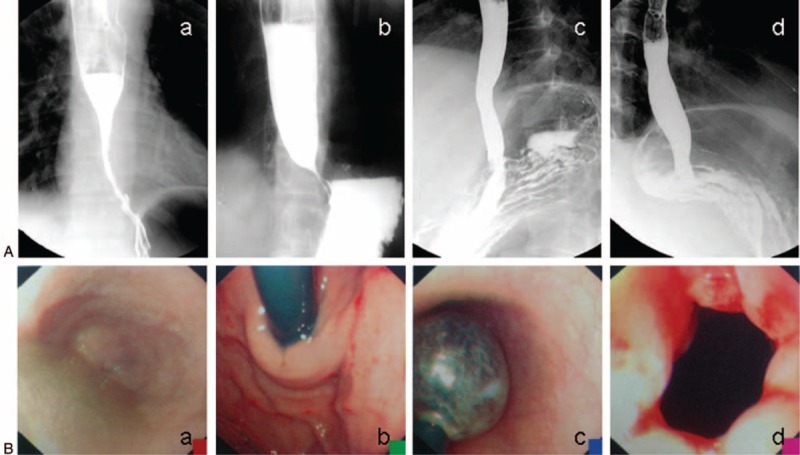
Although pneumatic dilation is an accepted method for the treatment of achalasia, this therapy has high recurrence and complication rates, and prolonged follow-up studies on the parameters associated with various outcomes are rare. In this prospective 10-year follow-up study, a satisfactory therapeutic effect was achieved without serious complications. We report the therapeutic experience with pneumatic dilation, having aimed to evaluate the long-term clinical safety and efficacy of pneumatic dilation. In total, 35 consecutive patients with idiopathic achalasia who underwent pneumatic dilation were followed up at regular intervals in person or by a phone interview over a 10-year period. The mean duration of the follow-up was 43.03 ± 26.34 months (range 6-120 months). Remission was assessed by the dysphagia classification and symptom scores. Patients' clinical symptom scores were calculated before and at 6 to 36 months, 37 to 60 months, and >60 months after therapy. The influence of the patients' age, gender, and disease duration on the therapeutic effect was analyzed. The success rate of the operation was 97.2% (35/36), without massive hemorrhaging, perforation or other serious complications. Dysphagia after the therapy was significantly eased (P < 0.01). In total, 35 patients have been followed up for 6 to 36 months after therapy, 21 cases for 37 to 60 months, and 5 cases for >60 months, and the patients' symptom scores separately decreased significantly compared with the pretherapy scores (P < 0.01). For these patients, the 6 to 36 months remission rate was 85.7% (30/35), the 37 to 60 months rate was 61.9% (13/21), and the >60 months rate was 40% (2/5). The dilation effect had no relationship to the patient's age, gender, and disease duration (P > 0.05). The patients in 30 cases (85.7%) were successfully treated with a single dilation, in 4 cases (11.4%) with 2 dilations, and in 1 case (2.9%) with 3 dilations. These results suggest that endoscopic pneumatic dilation is an achalasia therapy with a good response; it is a simple and safe procedure with long-term clinical effectiveness. It is a preferred method in the treatment of achalasia.
尽管气囊扩张术是治疗贲门失弛缓症的一种公认方法,但该疗法具有较高的复发率和并发症发生率,且关于各种预后相关参数的长期随访研究较少。在这项为期10年的前瞻性随访研究中,取得了满意的治疗效果,且无严重并发症。我们报告了气囊扩张术的治疗经验,旨在评估气囊扩张术的长期临床安全性和疗效。总共35例连续接受气囊扩张术的特发性贲门失弛缓症患者在10年期间接受了定期的亲自随访或电话访谈。随访的平均时长为43.03±26.34个月(范围6 - 120个月)。通过吞咽困难分级和症状评分评估缓解情况。在治疗前以及治疗后6至36个月、37至60个月和>60个月时计算患者的临床症状评分。分析了患者的年龄、性别和病程对治疗效果的影响。手术成功率为97.2%(35/36),无大出血、穿孔或其他严重并发症。治疗后吞咽困难明显缓解(P<0.01)。总共35例患者在治疗后分别进行了6至36个月的随访(21例)、37至60个月的随访(5例)以及>60个月的随访(5例),与治疗前评分相比,患者的症状评分均显著降低(P<0.01)。对于这些患者,6至36个月的缓解率为85.7%(30/35),37至60个月的缓解率为61.9%(13/21),>60个月的缓解率为40%(2/5)。扩张效果与患者的年龄、性别和病程无关(P>0.05)。30例患者(85.7%)单次扩张治疗成功,4例患者(11.4%)进行了2次扩张,1例患者(2.9%)进行了3次扩张。这些结果表明,内镜下气囊扩张术是一种对贲门失弛缓症反应良好的治疗方法;它是一种简单安全的手术,具有长期临床疗效。它是治疗贲门失弛缓症的首选方法。