Department of Gastroenterology and Hepatology, Academic Medical Center, Amsterdam, The Netherlands.
Neurogastroenterol Motil. 2019 Jul;31(7):e13548. doi: 10.1111/nmo.13548. Epub 2019 Jan 30.
One of the most used treatments for achalasia is pneumatic dilation of the lower esophageal sphincter to improve esophageal emptying. Multiple treatment protocols have been described with a varying balloon size, number of dilations, inflation pressure, and duration. We aimed to identify the most efficient and safe treatment protocol.
We performed a systematic review and meta-analysis of studies on pneumatic dilation in patients with primary achalasia. Clinical remission was defined as an Eckardt score ≤3 or adequate symptom reduction measured with a similar validated questionnaire. We compared the clinical remission rates and occurrence of complications between different treatment protocols.
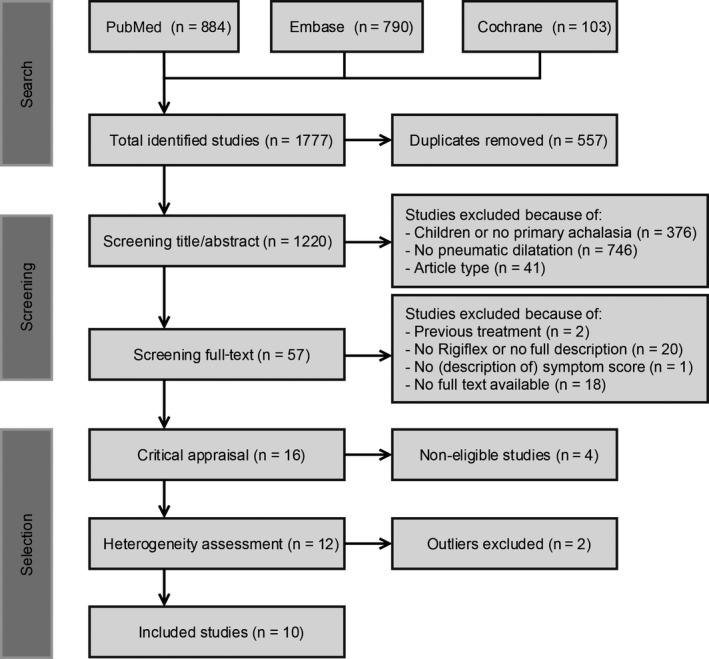
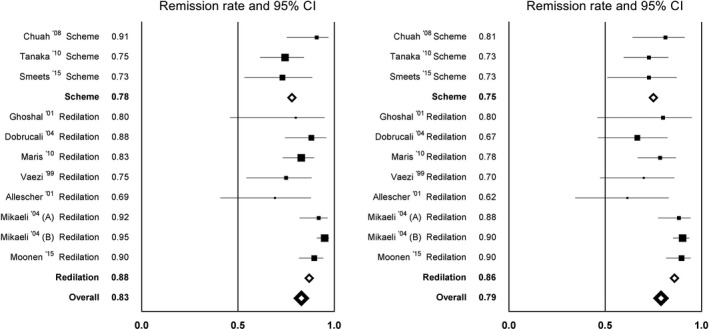
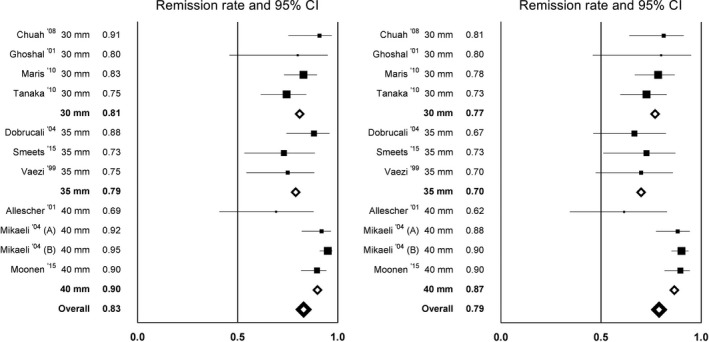
We included 10 studies with 643 patients. After 6 months, dilation with a 30-mm or 35-mm balloon gave comparable mean success rates (81% and 79%, respectively), whereas a series of dilations up to 40 mm had a higher success rate of 90%. Elective additional dilation in patients with insufficient symptom resolution was somewhat more effective than performing a predefined series of dilations: 86% versus 75% after 12 months. Perforations occurred most often during initial dilations, and significantly more often using a 35-mm balloon than a 30-mm balloon (3.2 vs 1.0%); P = 0.027. A subsequent 35-mm dilation was safer than an initial dilation with 35 mm (0.97% vs 9.3% perforations), P = 0.0017.
The most efficient and safe method of dilating achalasia patients is a graded approach starting with a 30-mm dilation, followed by an elective 35-mm dilation and 40 mm when there is insufficient symptom relief.
治疗贲门失弛缓症最常用的方法之一是对食管下括约肌进行气动扩张,以改善食管排空。已经描述了多种治疗方案,其球囊大小、扩张次数、充气压力和持续时间各不相同。我们旨在确定最有效和安全的治疗方案。
我们对原发性贲门失弛缓症患者的气动扩张研究进行了系统回顾和荟萃分析。临床缓解定义为 Eckardt 评分≤3 或使用类似的经过验证的问卷测量有足够的症状缓解。我们比较了不同治疗方案的临床缓解率和并发症发生率。
我们纳入了 10 项研究,共 643 例患者。6 个月后,使用 30mm 或 35mm 球囊扩张的平均成功率相当(分别为 81%和 79%),而一系列扩张至 40mm 的成功率更高,为 90%。对于症状缓解不足的患者,选择性进行额外的扩张比进行预设的一系列扩张更有效:12 个月后分别为 86%和 75%。穿孔最常发生在初始扩张时,使用 35mm 球囊比使用 30mm 球囊穿孔的发生率显著更高(3.2%比 1.0%;P=0.027)。随后的 35mm 扩张比初始扩张更安全(35mm 球囊穿孔率为 0.97%,而初始扩张为 9.3%;P=0.0017)。
扩张贲门失弛缓症患者最有效和安全的方法是采用分级方法,从 30mm 扩张开始,然后进行选择性 35mm 扩张,如果症状缓解不足,则进行 40mm 扩张。