van Breugel Floris, Riffell Jeff, Fairhall Adrienne, Dickinson Michael H
Division of Biology and Bioengineering, California Institute of Technology, 1200 East California Boulevard, Pasadena, CA 91125, USA.
Department of Biology, University of Washington, Box 351800, Seattle, WA 98195, USA.
Curr Biol. 2015 Aug 17;25(16):2123-9. doi: 10.1016/j.cub.2015.06.046. Epub 2015 Jul 16.
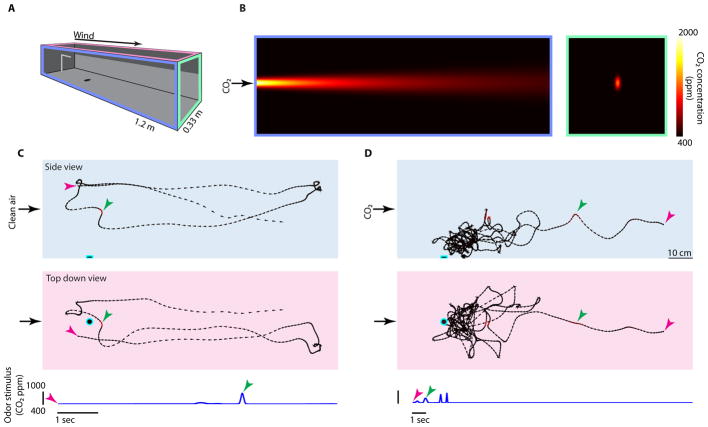
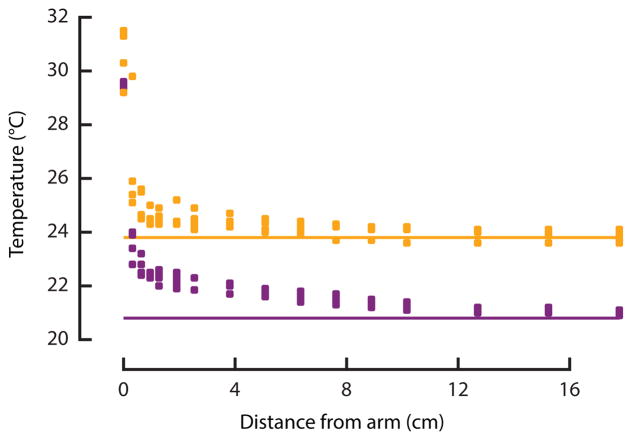
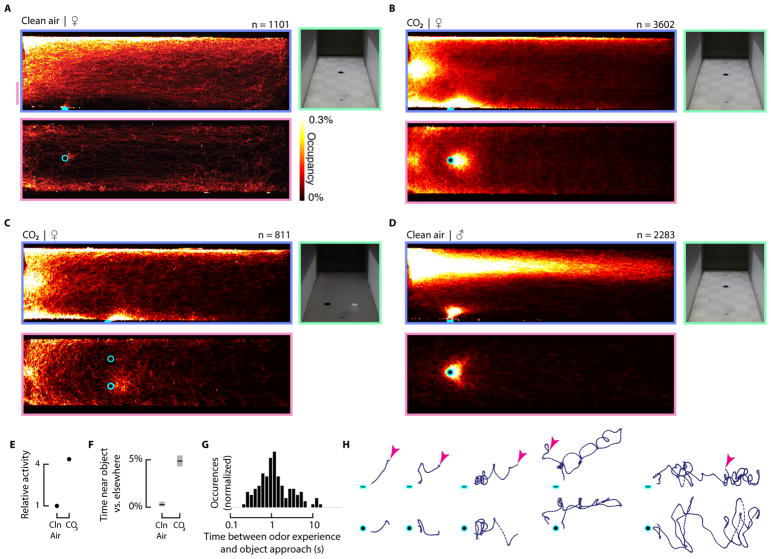
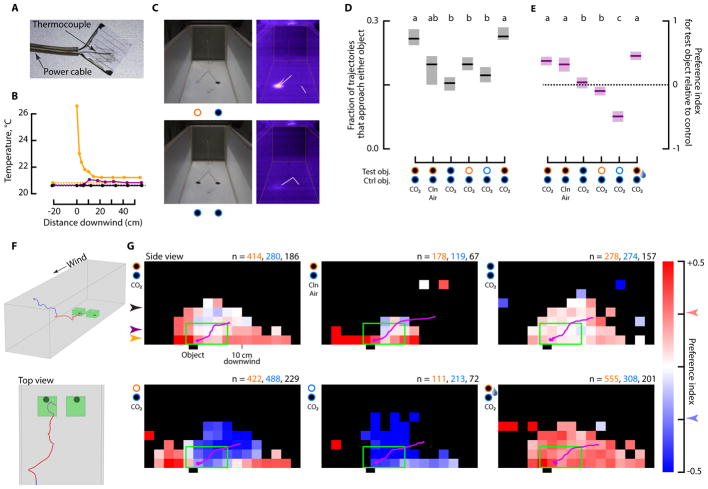
All moving animals, including flies, sharks, and humans, experience a dynamic sensory landscape that is a function of both their trajectory through space and the distribution of stimuli in the environment. This is particularly apparent for mosquitoes, which use a combination of olfactory, visual, and thermal cues to locate hosts. Mosquitoes are thought to detect suitable hosts by the presence of a sparse CO₂ plume, which they track by surging upwind and casting crosswind. Upon approach, local cues such as heat and skin volatiles help them identify a landing site. Recent evidence suggests that thermal attraction is gated by the presence of CO₂, although this conclusion was based experiments in which the actual flight trajectories of the animals were unknown and visual cues were not studied. Using a three-dimensional tracking system, we show that rather than gating heat sensing, the detection of CO₂ actually activates a strong attraction to visual features. This visual reflex guides the mosquitoes to potential hosts where they are close enough to detect thermal cues. By experimentally decoupling the olfactory, visual, and thermal cues, we show that the motor reactions to these stimuli are independently controlled. Given that humans become visible to mosquitoes at a distance of 5-15 m, visual cues play a critical intermediate role in host localization by coupling long-range plume tracking to behaviors that require short-range cues. Rather than direct neural coupling, the separate sensory-motor reflexes are linked as a result of the interaction between the animal's reactions and the spatial structure of the stimuli in the environment.
所有移动的动物,包括苍蝇、鲨鱼和人类,都会经历一种动态的感官环境,这种环境是它们在空间中的轨迹和环境中刺激分布的函数。这在蚊子身上尤为明显,蚊子利用嗅觉、视觉和热线索的组合来定位宿主。人们认为蚊子通过稀疏的二氧化碳羽流来检测合适的宿主,它们通过逆风涌动和侧风飞行来追踪。接近宿主时,热和皮肤挥发物等局部线索帮助它们确定着陆点。最近的证据表明,热吸引力受二氧化碳的存在影响,尽管这一结论是基于动物实际飞行轨迹未知且未研究视觉线索的实验得出的。使用三维跟踪系统,我们发现二氧化碳的检测实际上激活了对视觉特征的强烈吸引力,而不是影响热感知。这种视觉反射引导蚊子找到潜在宿主,在那里它们距离足够近以检测热线索。通过实验分离嗅觉、视觉和热线索,我们表明对这些刺激的运动反应是独立控制的。鉴于人类在5 - 15米的距离对蚊子可见,视觉线索通过将远程羽流跟踪与需要近距离线索的行为相耦合,在宿主定位中起着关键的中间作用。这些独立的感觉运动反射不是通过直接的神经耦合,而是由于动物反应与环境中刺激的空间结构之间的相互作用而联系在一起的。