Moher Jeff, Anderson Brian A, Song Joo-Hyun
Cognitive, Linguistic & Psychological Sciences, Brown University, 190 Thayer Street, Providence, RI 02912, USA; Psychology Department, Williams College, 18 Hoxsey Street, Williamstown, MA 01267, USA.
Psychological & Brain Sciences, Johns Hopkins University, 3400 N. Charles Street, Baltimore, MD 21218, USA.
Curr Biol. 2015 Aug 3;25(15):2040-6. doi: 10.1016/j.cub.2015.06.029. Epub 2015 Jul 16.
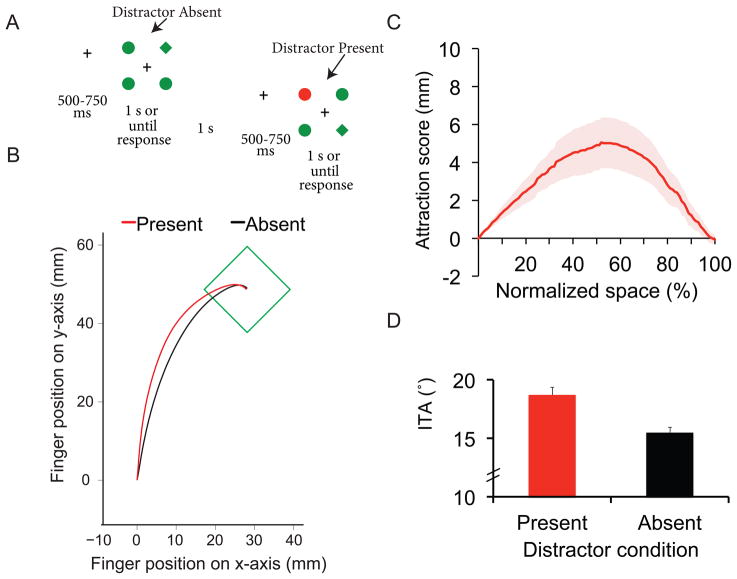
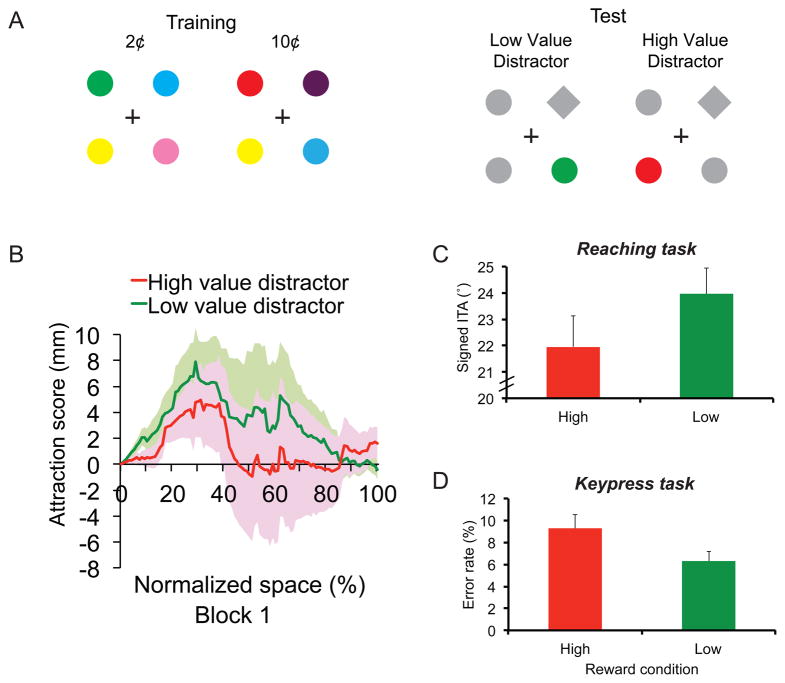
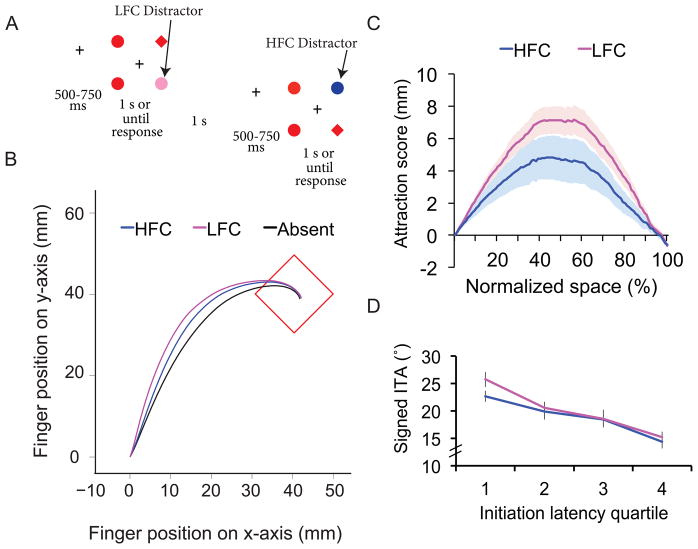
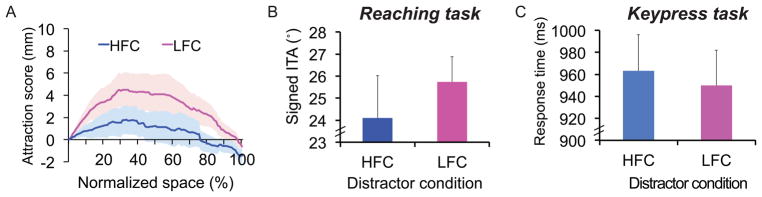
Everyday behavior frequently involves encounters with multiple objects that compete for selection. For example, driving a car requires constant shifts of attention between oncoming traffic, rearview mirrors, and traffic signs and signals, among other objects. Behavioral goals often drive this selection process [1, 2]; however, they are not the sole determinant of selection. Physically salient objects, such as flashing, brightly colored hazard signs, or objects that are salient by virtue of learned associations with reward, such as pictures of food on a billboard, often capture attention regardless of the individual's goals [3-6]. It is typically thought that strongly salient distractor objects capture more attention and are more disruptive than weakly salient distractors [7, 8]. Counterintuitively, though, we found that this is true for perception, but not for goal-directed action. In a visually guided reaching task [9-11], we required participants to reach to a shape-defined target while trying to ignore salient distractors. We observed that strongly salient distractors produced less disruption in goal-directed action than weakly salient distractors. Thus, a strongly salient distractor triggers suppression during goal-directed action, resulting in enhanced efficiency and accuracy of target selection relative to when weakly salient distractors are present. In contrast, in a task requiring no goal-directed action, we found greater attentional interference from strongly salient distractors. Thus, while highly salient stimuli interfere strongly with perceptual processing, increased physical salience or associated value attenuates action-related interference.
日常行为常常涉及与多个相互竞争以被选中的物体的接触。例如,驾驶汽车需要在迎面而来的车辆、后视镜以及交通标志和信号等物体之间不断转移注意力。行为目标常常驱动这一选择过程[1,2];然而,它们并非选择的唯一决定因素。物理上显著的物体,如闪烁的、颜色鲜艳的危险标志,或者由于与奖励的习得关联而显著的物体,如广告牌上的食物图片,往往会吸引注意力,而不管个体的目标如何[3-6]。通常认为,强烈显著的干扰物比微弱显著的干扰物更能吸引注意力且更具干扰性[7,8]。然而,与直觉相反的是,我们发现对于感知而言确实如此,但对于目标导向的行动并非如此。在一项视觉引导的伸手任务[9-11]中,我们要求参与者伸手去够一个形状定义的目标,同时试图忽略显著的干扰物。我们观察到,强烈显著的干扰物在目标导向行动中产生的干扰比微弱显著的干扰物要小。因此,一个强烈显著的干扰物在目标导向行动中会触发抑制,相对于存在微弱显著干扰物时,从而提高目标选择的效率和准确性。相比之下,在一项不需要目标导向行动的任务中,我们发现强烈显著的干扰物会产生更大的注意力干扰。因此,虽然高度显著的刺激会强烈干扰感知处理,但增加的物理显著性或相关价值会减弱与行动相关的干扰。