Mullon Charles, Wright Alison E, Reuter Max, Pomiankowski Andrew, Mank Judith E
1] Department of Genetics, Evolution and Environment, University College London, Gower Street, London WC1E 6BT, UK [2] CoMPLEX, University College London, Gower Street, London WC1E 6BT, UK [3] Department of Ecology and Evolution, Biophore, University of Lausanne, Ch-1015 Lausanne, Switzerland.
1] Department of Genetics, Evolution and Environment, University College London, Gower Street, London WC1E 6BT, UK [2] Department of Zoology, University of Oxford, The Tinbergen Building, South Parks Road, Oxford OX1 3PS, UK.
Nat Commun. 2015 Jul 27;6:7720. doi: 10.1038/ncomms8720.
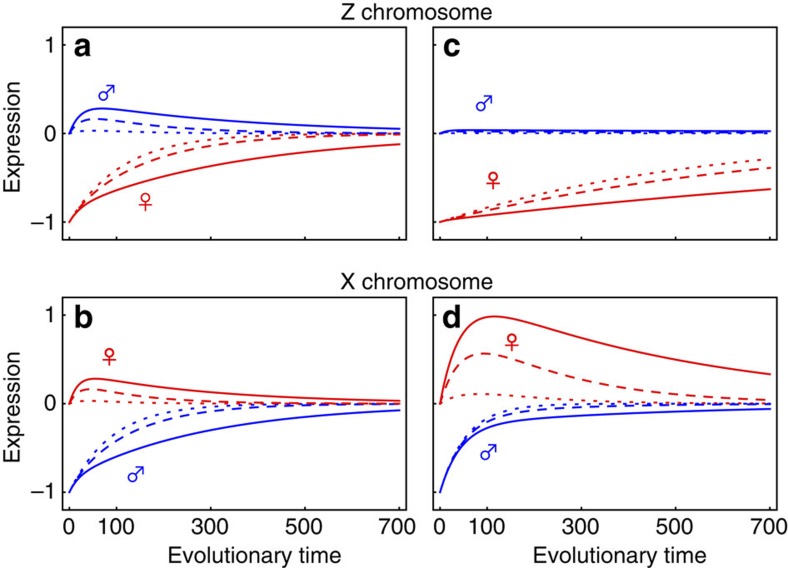
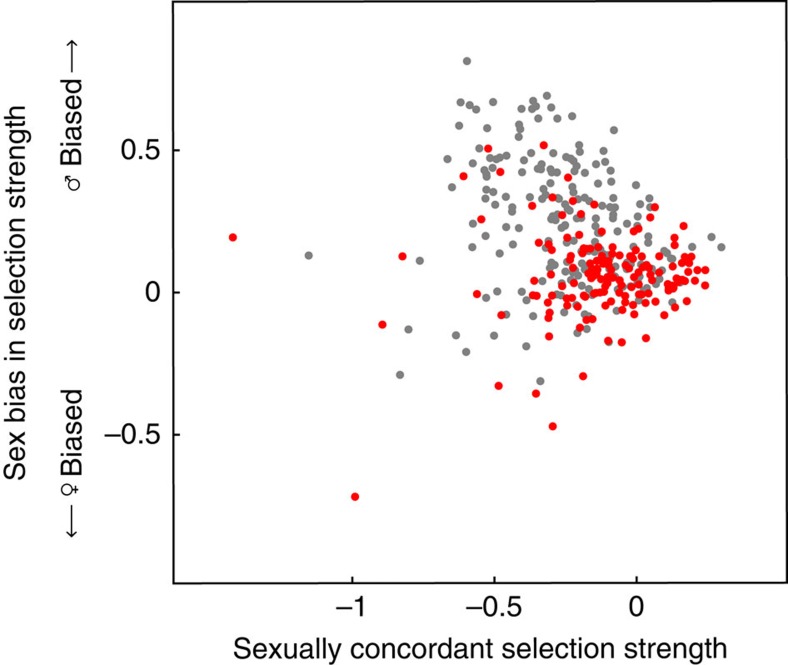
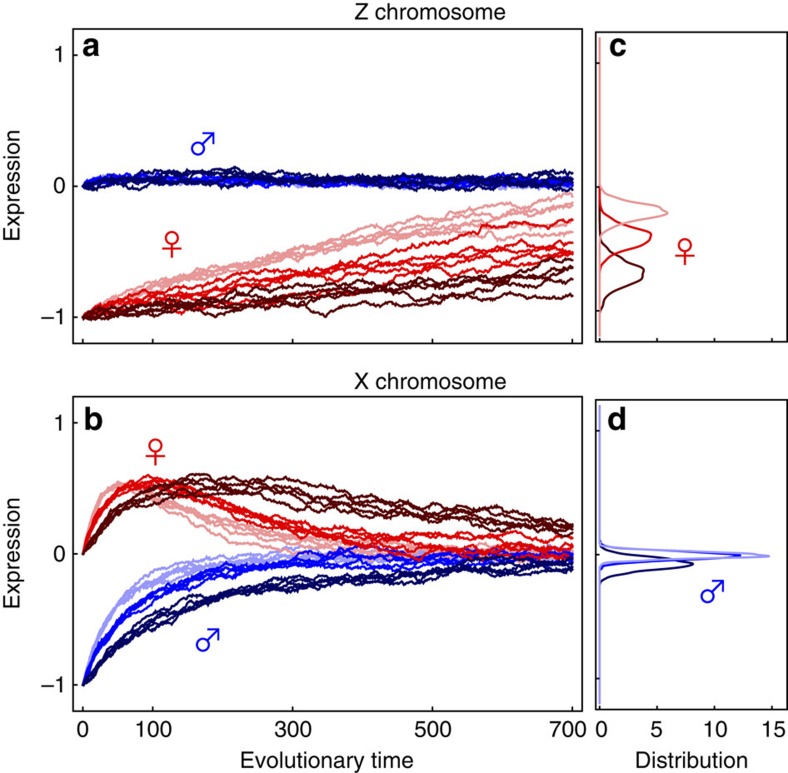
Complete sex chromosome dosage compensation has more often been observed in XY than ZW species. In this study, using a population genetic model and the chicken transcriptome, we assess whether sexual conflict can account for this difference. Sexual conflict over expression is inevitable when mutation effects are correlated across the sexes, as compensatory mutations in the heterogametic sex lead to hyperexpression in the homogametic sex. Coupled with stronger selection and greater reproductive variance in males, this results in slower and less complete evolution of Z compared with X dosage compensation. Using expression variance as a measure of selection strength, we find that, as predicted by the model, dosage compensation in the chicken is most pronounced in genes that are under strong selection biased towards females. Our study explains the pattern of weak dosage compensation in ZW systems, and suggests that sexual selection plays a major role in shaping sex chromosome dosage compensation.
相较于ZW型物种,XY型物种中更常观察到完全的性染色体剂量补偿。在本研究中,我们使用群体遗传模型和鸡的转录组,评估性冲突是否能够解释这种差异。当突变效应在两性间相关时,表达上的性冲突是不可避免的,因为异配性别的补偿性突变会导致同配性别中的基因超表达。再加上雄性中更强的选择作用和更大的繁殖差异,这导致与X染色体剂量补偿相比,Z染色体的进化更慢且更不完全。使用表达差异作为选择强度的衡量指标,我们发现,正如模型所预测的那样,鸡中的剂量补偿在受到偏向雌性的强烈选择的基因中最为明显。我们的研究解释了ZW系统中剂量补偿较弱的模式,并表明性选择在塑造性染色体剂量补偿中起主要作用。