Institute of Science and Technology Austria, Klosterneuburg 3400, Austria.
Department of Chromosome Biology, Max Perutz Labs, University of Vienna, Vienna 1030, Austria.
Genetics. 2022 Sep 30;222(2). doi: 10.1093/genetics/iyac123.
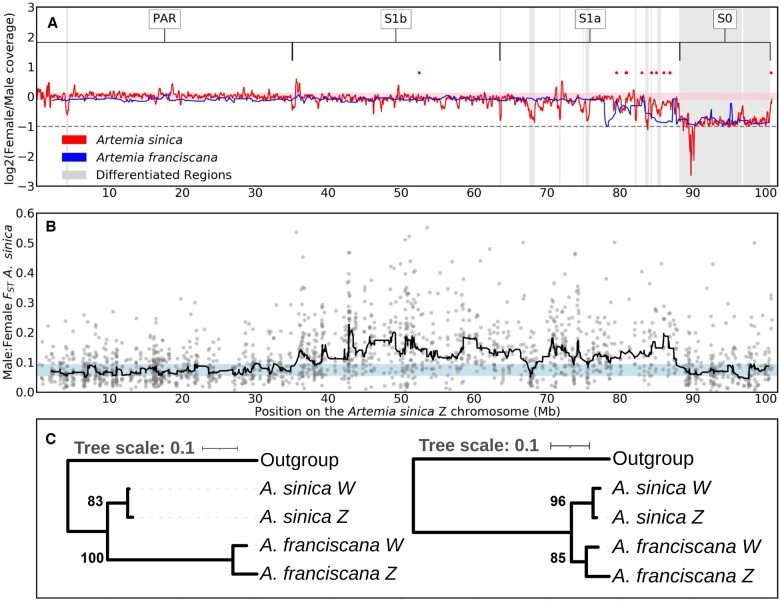
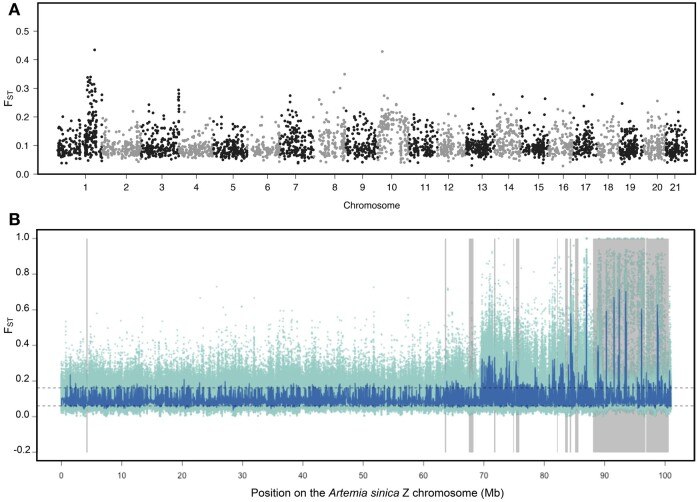
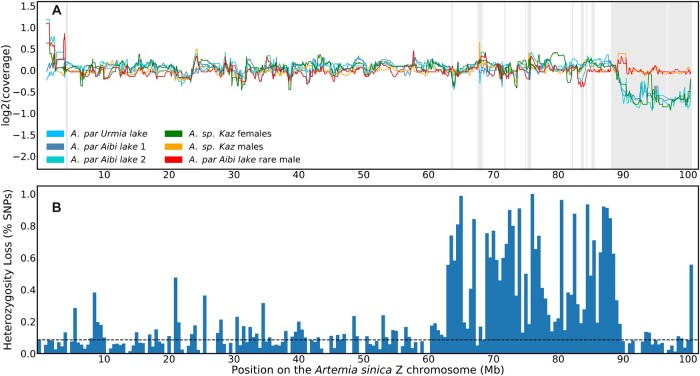
Eurasian brine shrimp (genus Artemia) have closely related sexual and asexual lineages of parthenogenetic females, which produce rare males at low frequencies. Although they are known to have ZW chromosomes, these are not well characterized, and it is unclear whether they are shared across the clade. Furthermore, the underlying genetic architecture of the transmission of asexuality, which can occur when rare males mate with closely related sexual females, is not well understood. We produced a chromosome-level assembly for the sexual Eurasian species Artemia sinica and characterized in detail the pair of sex chromosomes of this species. We combined this new assembly with short-read genomic data for the sexual species Artemia sp. Kazakhstan and several asexual lineages of Artemia parthenogenetica, allowing us to perform an in-depth characterization of sex-chromosome evolution across the genus. We identified a small differentiated region of the ZW pair that is shared by all sexual and asexual lineages, supporting the shared ancestry of the sex chromosomes. We also inferred that recombination suppression has spread to larger sections of the chromosome independently in the American and Eurasian lineages. Finally, we took advantage of a rare male, which we backcrossed to sexual females, to explore the genetic basis of asexuality. Our results suggest that parthenogenesis is likely partly controlled by a locus on the Z chromosome, highlighting the interplay between sex determination and asexuality.
欧亚卤虫(Artemia 属)具有密切相关的有性和无性雌性单性生殖系,它们以低频率产生罕见的雄性。尽管它们被认为具有 ZW 染色体,但这些染色体尚未得到很好的描述,也不清楚它们是否在整个进化枝中共享。此外,当罕见的雄性与密切相关的有性雌性交配时,单性生殖的遗传结构也尚未得到很好的理解。我们为有性的中国卤虫(Artemia sinica)生成了一个染色体水平的组装,并详细描述了该物种的一对性染色体。我们将这个新的组装与来自哈萨克斯坦的有性 Artemia sp. 和几个 Artemia parthenogenetica 的无性系的短读基因组数据相结合,使我们能够深入研究整个属的性染色体进化。我们鉴定了 ZW 对共享的一个小的分化区域,该区域存在于所有有性和无性系中,支持性染色体的共同祖先。我们还推断,重组抑制在美洲和欧亚系中独立地扩展到染色体的更大区域。最后,我们利用罕见的雄性进行回交实验,探索了单性生殖的遗传基础。我们的结果表明,单性生殖可能部分由 Z 染色体上的一个基因座控制,这突出了性别决定和单性生殖之间的相互作用。