Khamnuan Patcharin, Chongruksut Wilaiwan, Jearwattanakanok Kijja, Patumanond Jayanton, Tantraworasin Apichat
Clinical Epidemiology Program, Faculty of Medicine, Chiang Mai University, Chiang Mai, Thailand ; Department of Nursing, Phayao Hospital, Phayao, Thailand.
Department of Surgery, Faculty of Medicine, Chiang Mai University, Chiang Mai, Thailand.
Infect Drug Resist. 2015 Jul 16;8:207-16. doi: 10.2147/IDR.S85249. eCollection 2015.
Necrotizing fasciitis (NF) is a life-threatening infection of skin and fascia. Its progress is extremely fast, with extensive necrosis. Delay in treatment, with subsequent huge soft tissue loss and associated severe sepsis, remains a major cause of death in the management of NF.
The aim of this study was to explore clinical characteristics that may be used to predict severe sepsis in patients with NF, in the context of routine clinical practice in northern Thailand.
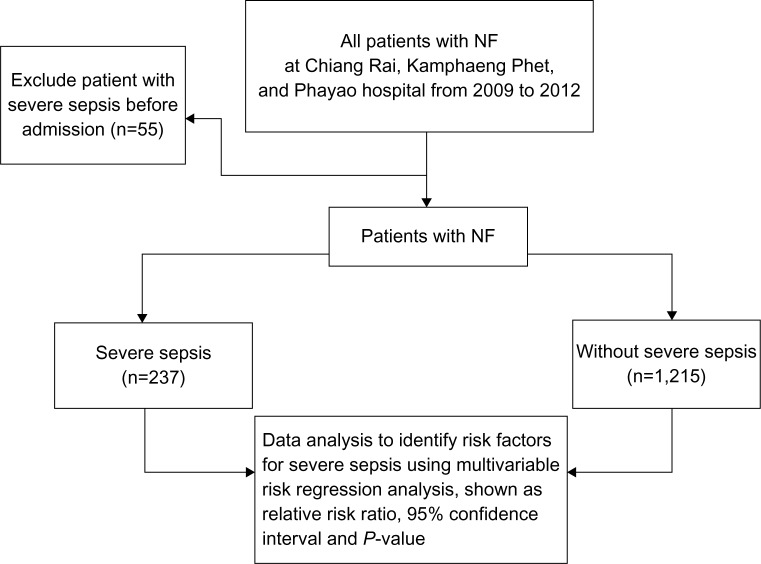
A retrospective observational cohort study was conducted. The patient cohort in this study consisted of all patients who were diagnosed with NF by surgical or pathological confirmation. The follow-up period started with the admission date and ended with the discharge date. The clinical variables were collected from patients registered at three provincial hospitals in northern Thailand from 2009 to 2012. The clinical predictors for severe sepsis were analyzed using multivariable risk regression.
A total of 1,452 patients were diagnosed with NF, either with severe sepsis (n=237 [16.3%]) or without severe sepsis (n=1,215 [83.7%]). From the multivariable analysis, female sex (relative risk [RR] =1.51; 95% confidence interval [CI] =1.04-2.20), diabetes mellitus (RR =1.40; 95% CI =1.25-1.58), chronic heart disease (RR =1.31; 95% CI =1.15-1.49), hemorrhagic bleb (RR =1.47; 95% CI =1.32-1.63), skin necrosis (RR =1.45; 95% CI =1.34-1.57), and serum protein <6 g/dL (RR =2.67; 95% CI =1.60-4.47) were all predictive factors for severe sepsis.
The clinical predictors for severe sepsis in patients with suspicion of NF included female sex, diabetes mellitus, chronic heart disease, hemorrhagic bleb, skin necrosis, and serum protein <6 d/dL. The risk ratio was much higher in patients with total protein less than 6 g/dL, which is associated with malnutrition. Therefore, provision of sufficient nutritional support and close monitoring for these clinical predictors may be beneficial to reduce morbidity and mortality.
坏死性筋膜炎(NF)是一种危及生命的皮肤和筋膜感染。其进展极快,伴有广泛坏死。治疗延误,继而导致巨大的软组织损失及相关严重脓毒症,仍然是坏死性筋膜炎治疗中死亡的主要原因。
本研究旨在探索在泰国北部常规临床实践背景下,可用于预测坏死性筋膜炎患者严重脓毒症的临床特征。
进行一项回顾性观察队列研究。本研究中的患者队列包括所有经手术或病理确诊为坏死性筋膜炎的患者。随访期从入院日期开始,至出院日期结束。临床变量收集自2009年至2012年在泰国北部三家省级医院登记的患者。使用多变量风险回归分析严重脓毒症的临床预测因素。
共有1452例患者被诊断为坏死性筋膜炎,其中伴有严重脓毒症的患者有237例(16.3%),不伴有严重脓毒症的患者有1215例(83.7%)。多变量分析结果显示,女性(相对风险[RR]=1.51;95%置信区间[CI]=1.04 - 2.20)、糖尿病(RR =1.40;95% CI =1.25 - 1.58)、慢性心脏病(RR =1.31;95% CI =1.15 - 1.49)、出血性水疱(RR =1.47;95% CI =1.32 - 1.63)、皮肤坏死(RR =1.45;95% CI =1.34 - 1.57)以及血清蛋白<6 g/dL(RR =2.67;95% CI =1.60 - 4.47)均为严重脓毒症的预测因素。
疑似坏死性筋膜炎患者严重脓毒症的临床预测因素包括女性、糖尿病、慢性心脏病、出血性水疱、皮肤坏死以及血清蛋白<6 g/dL。总蛋白低于6 g/dL的患者风险比更高,这与营养不良相关。因此,为这些临床预测因素提供充足的营养支持并密切监测,可能有助于降低发病率和死亡率