Dukers-Muijrers Nicole H T M, Somers Carlijn, de Graaf Hanneke, Meijer Suzanne, Hoebe Christian J P A
Department of Sexual Health, Infectious Diseases and Environmental Health, South Limburg Public Health Service, Geleen, The Netherlands; Department of Medical Microbiology, School of Public Health and Primary Care (CAPHRI), Maastricht University Medical Centre (MUMC+), Maastricht, The Netherlands.
Department of Sexual Health, Infectious Diseases and Environmental Health, South Limburg Public Health Service, Geleen, The Netherlands.
PLoS One. 2015 Jul 27;10(7):e0132847. doi: 10.1371/journal.pone.0132847. eCollection 2015.
Non-volitional sex (NVS) in young people continues to be a major public health problem with long-term negative health outcomes. For the first time, the prevalence of different types of NVS and associated factors are compared between young people with same-sex sexual activities and those who have not.
We obtained data from 10,401 young women and men (aged 12 to 25 years) who participated in a population study on sexual health, the Netherlands. We calculated and compared the prevalence of six types of NVS between women who had sex with men (yWSM) or women (yWSW), and men who had sex with women (yMSW) or men (yMSM). In sexually experienced participants (n = 5986) logistic regression analyses were applied to assess associations with NVS by assault or penetration. Analyses were weighted to represent the Dutch population.
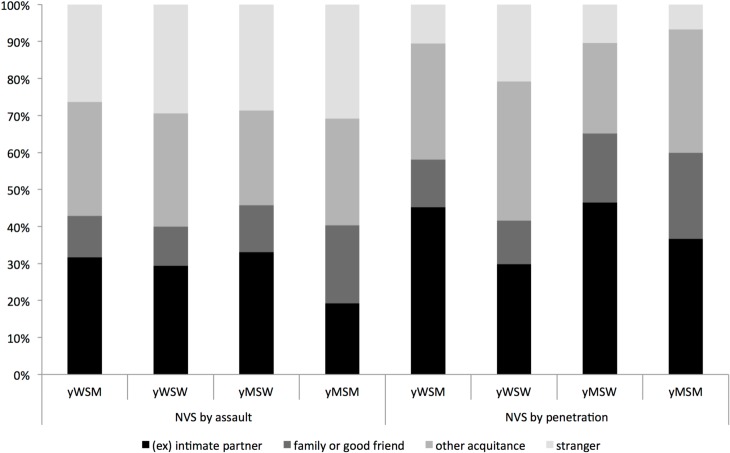
The prevalence of NVS ranged from 1% to 61%, depending on type. Prevalence was higher for young women (any: 40.6%) than men (any: 20.4%), and highest for yMSM and yWSW. Prevalence of NVS by assault or penetration was related to a range of socio-demographic, behavioral and social factors, which were largely similar regardless of sex or same-sex-experiences. The NVS perpetrators were in over 70% of cases known to the victim; 1 in 4 cases of NVS by penetration were accompanied by violence.
A substantial proportion of young people in the Netherlands have experienced NVS. Medical professionals, educators and caregivers should integrate services to continue to address NVS by targeting young people's multifaceted risk profiles and evidenced based interventions for doing so are needed.
年轻人中的非自愿性行为(NVS)仍然是一个主要的公共卫生问题,会产生长期的负面健康后果。首次对有同性性活动的年轻人和没有此类活动的年轻人之间不同类型的非自愿性行为及其相关因素的患病率进行了比较。
我们从参与荷兰一项性健康人群研究的10401名年轻女性和男性(年龄在12至25岁之间)中获取了数据。我们计算并比较了与男性发生性行为的女性(yWSM)或与女性发生性行为的女性(yWSW),以及与女性发生性行为的男性(yMSW)或与男性发生性行为的男性(yMSM)之间六种类型非自愿性行为的患病率。在有性经历的参与者(n = 5986)中,应用逻辑回归分析来评估与因攻击或插入导致的非自愿性行为的关联。分析进行了加权以代表荷兰人口。
非自愿性行为的患病率在1%至61%之间,具体取决于类型。年轻女性的患病率(任何类型:40.6%)高于男性(任何类型:20.4%),yMSM和yWSW的患病率最高。因攻击或插入导致的非自愿性行为的患病率与一系列社会人口学、行为和社会因素相关,无论性别或同性经历如何,这些因素在很大程度上都是相似的。在超过70%的案例中,非自愿性行为的实施者是受害者认识的人;四分之一的因插入导致的非自愿性行为案例伴有暴力行为。
荷兰相当一部分年轻人经历过非自愿性行为。医学专业人员、教育工作者和护理人员应整合服务,通过针对年轻人多方面的风险状况来持续解决非自愿性行为问题,为此需要有循证干预措施。