Centre for Sexual and Reproductive Health Research, Department of Social and Environmental Health Research, London School of Hygiene and Tropical Medicine, London, UK.
Lancet. 2013 Nov 30;382(9907):1845-55. doi: 10.1016/S0140-6736(13)62300-4. Epub 2013 Nov 26.
Sexual violence is increasingly recognised as a public health issue. Information about prevalence, associated factors, and consequences for health in the population of Britain (England, Scotland, and Wales) is scarce. The third National Survey of Sexual Health Attitudes and Lifestyles (Natsal-3) is the first of the Natsal surveys to include questions about sexual violence and the first population-based survey in Britain to explore the issue outside the context of crime.
Between Sept 6, 2010, and Aug 31, 2012, we did a probability sample survey of women and men aged 16-74 years living in Britain. We asked participants about their experience of sex against their will since age 13 years and the circumstances surrounding the most recent occurrence. We explored associations between ever experiencing non-volitional sex and a range of sociodemographic, health, and behavioural factors. We used logistic regression to estimate age-adjusted odds ratios to analyse factors associated with the occurrence of completed non-volitional sex in women and men.
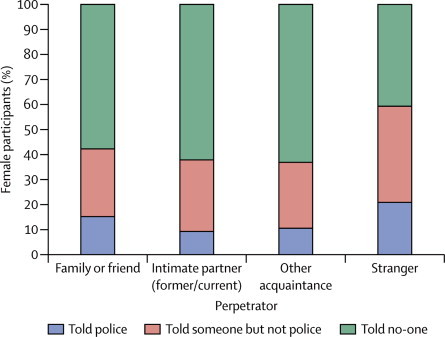
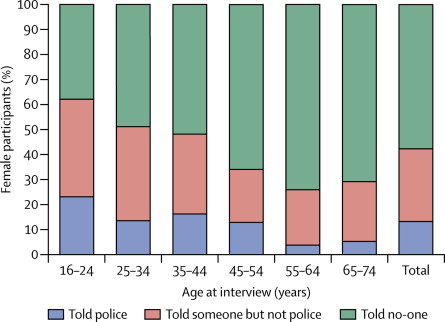
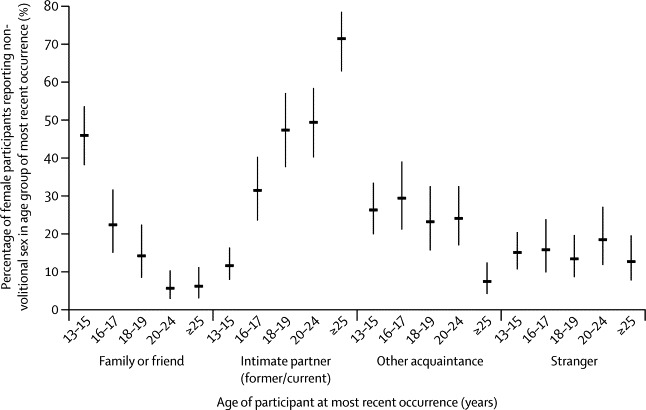
We interviewed 15,162 people. Completed non-volitional sex was reported by 9·8% (95% CI 9·0-10·5) of women and 1·4% (1·1-1·7) of men. Median age (interdecile range) at most recent occurrence was 18 years (14-32) for women and 16 years (13-30) for men. Completed non-volitional sex varied by family structure and, in women, by age, education, and area-level deprivation. It was associated with poor health, longstanding illness or disability, and treatment for mental health conditions, smoking, and use of non-prescription drugs in the past year in both sexes, and with binge drinking in women. Completed non-volitional sex was also associated with reporting of first heterosexual intercourse before 16 years of age, same-sex experience, more lifetime sexual partners, ever being diagnosed with a sexually transmitted infection, and low sexual function in both sexes, and, in women, with abortion and pregnancy outcome before 18 years of age. In most cases, the person responsible was known to the individual, although the nature of the relationship differed by age at most recent occurrence. Participants who were younger at interview were more likely to have told someone about the event and to have reported it to the police than were older participants.
These data provide the first population prevalence estimates of non-volitional sex in Britain. We showed it to be mainly an experience of young age and strongly associated with a range of adverse health outcomes in both women and men.
Grants from the UK Medical Research Council and the Wellcome Trust, with support from the Economic and Social Research Council and the Department of Health.
性暴力日益被视为公共卫生问题。有关英国(英格兰、苏格兰和威尔士)人口中性暴力的流行率、相关因素和对健康的影响的信息很少。第三次全国性健康态度和生活方式调查(Natsal-3)是 Natsal 调查中首次包含性暴力问题的调查,也是英国首次在犯罪背景之外探讨该问题的基于人群的调查。
在 2010 年 9 月 6 日至 2012 年 8 月 31 日期间,我们对年龄在 16-74 岁之间居住在英国的女性和男性进行了概率抽样调查。我们询问了参与者自 13 岁以来违背自己意愿发生性行为的经历,以及最近一次发生性行为的情况。我们探讨了曾经经历过非自愿性行为与一系列社会人口统计学、健康和行为因素之间的关联。我们使用逻辑回归来估计年龄调整后的优势比,以分析女性和男性中完成非自愿性行为发生的相关因素。
我们采访了 15162 人。9.8%(95%CI9.0-10.5)的女性和 1.4%(1.1-1.7)的男性报告发生过完成非自愿性行为。最近一次发生的性行为的中位年龄(四分位间距)为女性 18 岁(14-32 岁),男性 16 岁(13-30 岁)。完成非自愿性行为在女性中因家庭结构而异,在女性中还因年龄、教育程度和地区贫困程度而异。它与健康状况不佳、长期疾病或残疾、心理健康状况治疗、吸烟以及在过去一年中使用非处方药物有关,在女性中还与狂欢饮酒有关。完成非自愿性行为也与报告在 16 岁之前发生第一次异性性行为、同性经历、更多的终生性伴侣、曾被诊断患有性传播感染以及男女双方的性功能低下有关,在女性中还与 18 岁之前的堕胎和怀孕结局有关。在大多数情况下,责任人是参与者认识的人,尽管在最近一次发生性行为时的关系性质因年龄而异。接受采访时年龄较小的参与者更有可能告知他人事件并向警方报案,而年龄较大的参与者则不太可能这样做。
这些数据提供了英国非自愿性行为的首次人群流行率估计。我们表明,它主要是年轻时期的一种经历,并且与女性和男性的一系列不良健康后果密切相关。
英国医学研究理事会和惠康信托基金会的赠款,得到经济和社会研究理事会以及卫生部的支持。