Chistiakova Marina, Bannon Nicholas M, Chen Jen-Yung, Bazhenov Maxim, Volgushev Maxim
Department of Psychology, University of Connecticut Storrs, CT, USA.
Department of Cell Biology and Neuroscience, University of California, Riverside Riverside, CA, USA.
Front Comput Neurosci. 2015 Jul 13;9:89. doi: 10.3389/fncom.2015.00089. eCollection 2015.
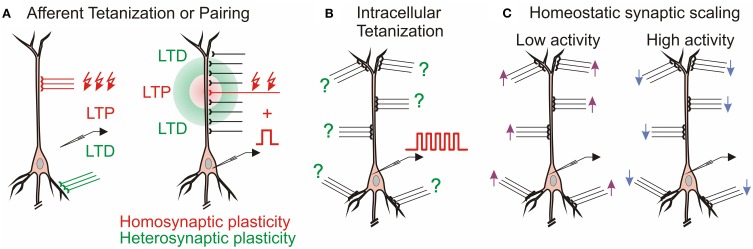
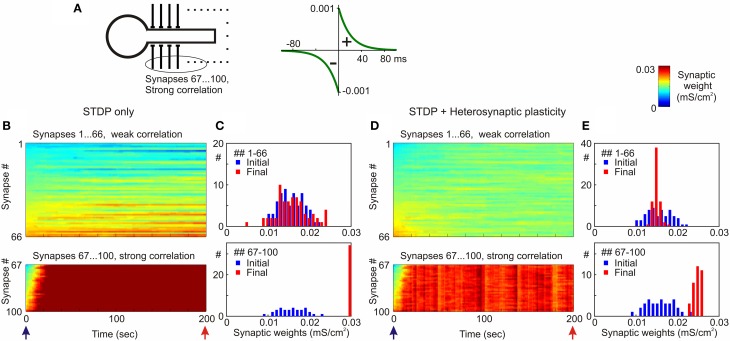
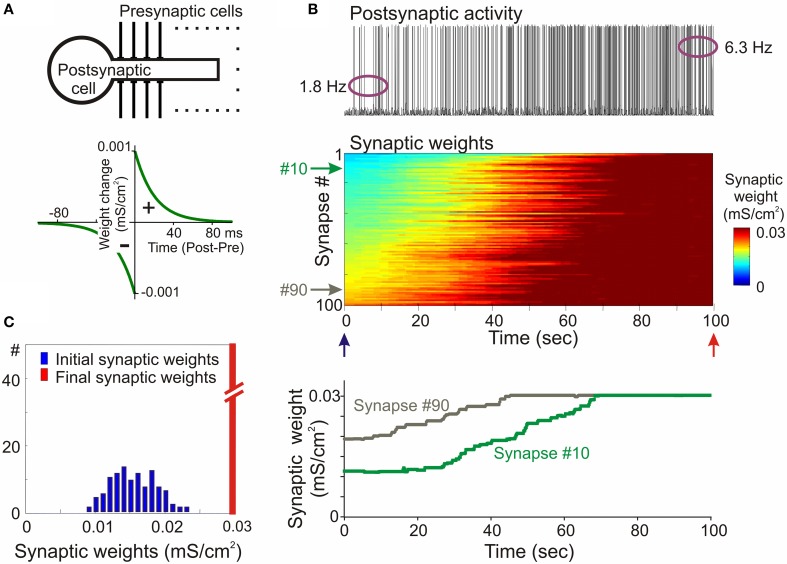
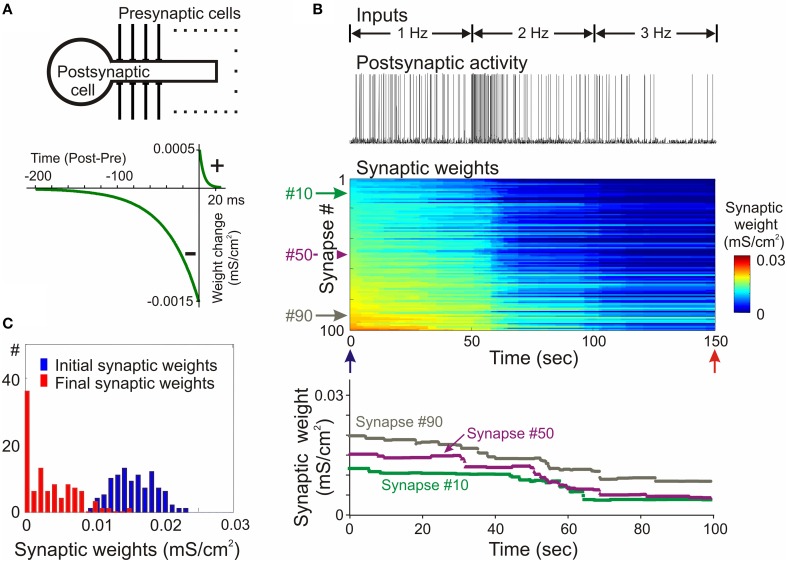
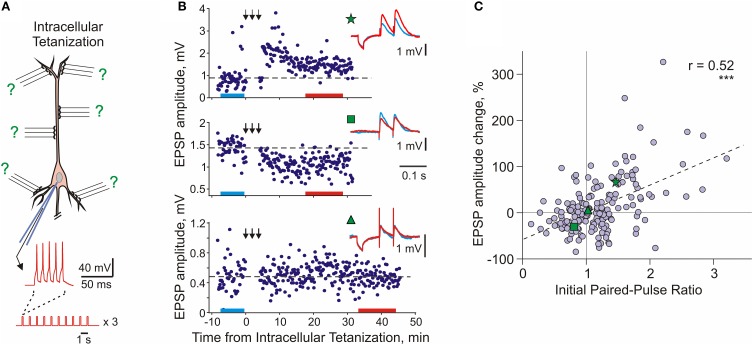
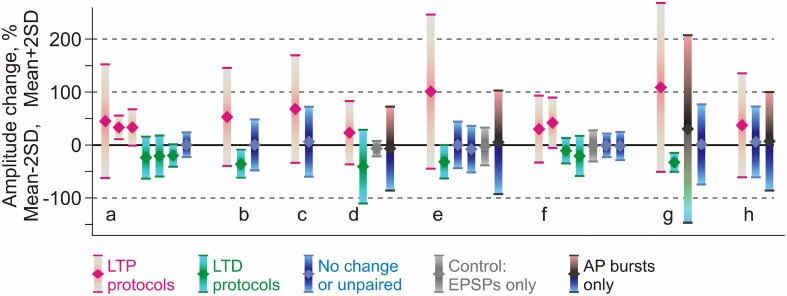
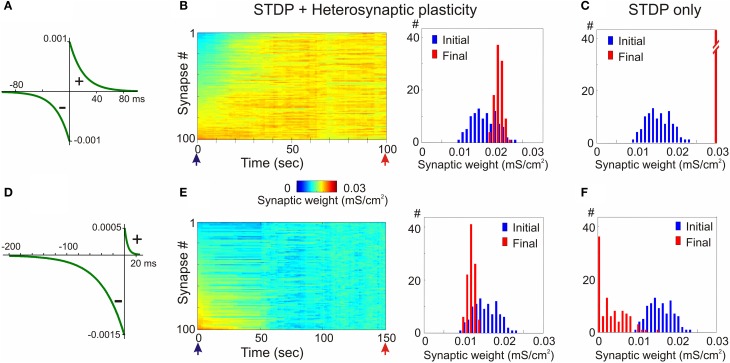
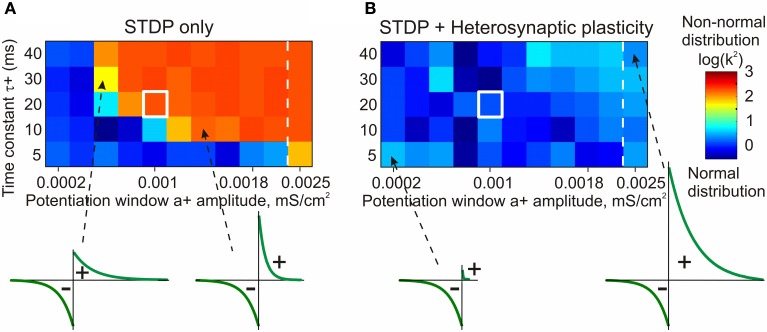
Homosynaptic Hebbian-type plasticity provides a cellular mechanism of learning and refinement of connectivity during development in a variety of biological systems. In this review we argue that a complimentary form of plasticity-heterosynaptic plasticity-represents a necessary cellular component for homeostatic regulation of synaptic weights and neuronal activity. The required properties of a homeostatic mechanism which acutely constrains the runaway dynamics imposed by Hebbian associative plasticity have been well-articulated by theoretical and modeling studies. Such mechanism(s) should robustly support the stability of operation of neuronal networks and synaptic competition, include changes at non-active synapses, and operate on a similar time scale to Hebbian-type plasticity. The experimentally observed properties of heterosynaptic plasticity have introduced it as a strong candidate to fulfill this homeostatic role. Subsequent modeling studies which incorporate heterosynaptic plasticity into model neurons with Hebbian synapses (utilizing an STDP learning rule) have confirmed its ability to robustly provide stability and competition. In contrast, properties of homeostatic synaptic scaling, which is triggered by extreme and long lasting (hours and days) changes of neuronal activity, do not fit two crucial requirements for a hypothetical homeostatic mechanism needed to provide stability of operation in the face of on-going synaptic changes driven by Hebbian-type learning rules. Both the trigger and the time scale of homeostatic synaptic scaling are fundamentally different from those of the Hebbian-type plasticity. We conclude that heterosynaptic plasticity, which is triggered by the same episodes of strong postsynaptic activity and operates on the same time scale as Hebbian-type associative plasticity, is ideally suited to serve a homeostatic role during on-going synaptic plasticity.
同突触赫布型可塑性为多种生物系统发育过程中的学习和连接细化提供了一种细胞机制。在本综述中,我们认为可塑性的一种补充形式——异突触可塑性——是突触权重和神经元活动稳态调节所必需的细胞成分。理论和建模研究已经很好地阐明了一种稳态机制的所需特性,这种机制可急性限制赫布联想可塑性所施加的失控动力学。这样的机制应该有力地支持神经网络运作的稳定性和突触竞争,包括在非活跃突触处的变化,并在与赫布型可塑性相似的时间尺度上起作用。实验观察到的异突触可塑性特性使其成为履行这种稳态作用的有力候选者。随后将异突触可塑性纳入具有赫布突触的模型神经元(利用STDP学习规则)的建模研究证实了其有力地提供稳定性和竞争的能力。相比之下,由神经元活动的极端和持久(数小时和数天)变化触发的稳态突触缩放特性,不符合在面对由赫布型学习规则驱动的持续突触变化时为提供运作稳定性所需的假设稳态机制的两个关键要求。稳态突触缩放的触发因素和时间尺度与赫布型可塑性的根本不同。我们得出结论,由相同的强突触后活动事件触发且与赫布型联想可塑性在相同时间尺度上起作用的异突触可塑性,非常适合在持续的突触可塑性过程中发挥稳态作用。