Thorp Alicia A, Schlaich Markus P
Neurovascular Hypertension and Kidney Disease Laboratory, Baker IDI Heart and Diabetes Institute Melbourne, VIC, Australia ; School of Public Health and Preventive Medicine, Monash University Melbourne, VIC, Australia.
Neurovascular Hypertension and Kidney Disease Laboratory, Baker IDI Heart and Diabetes Institute Melbourne, VIC, Australia ; Department of Cardiovascular Medicine, Alfred Hospital Melbourne, VIC, Australia ; Faculty of Medicine, Nursing and Health Sciences, Monash University Melbourne, VIC, Australia ; Royal Perth Hospital Unit, School of Medicine and Pharmacology, University of Western Australia Perth, WA, Australia.
Front Physiol. 2015 Jul 8;6:193. doi: 10.3389/fphys.2015.00193. eCollection 2015.
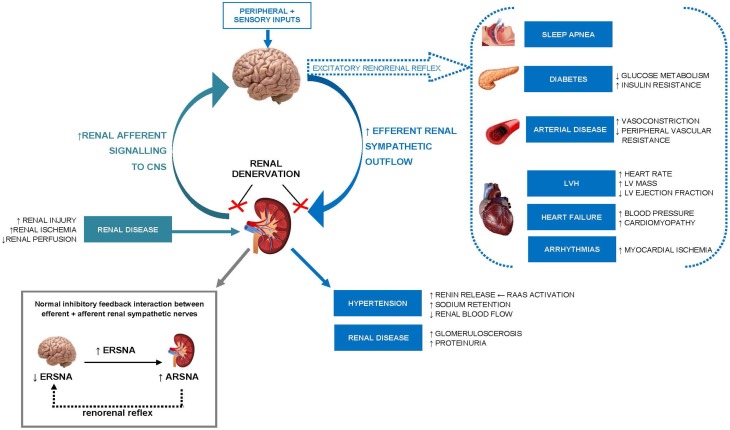
Animal and human studies have demonstrated that chronic activation of renal sympathetic nerves is critical in the pathogenesis and perpetuation of treatment-resistant hypertension. Bilateral renal denervation has emerged as a safe and effective, non-pharmacological treatment for resistant hypertension that involves the selective ablation of efferent and afferent renal nerves to lower blood pressure. However, the most recent and largest randomized controlled trial failed to confirm the primacy of renal denervation over a sham procedure, prompting widespread re-evaluation of the therapy's efficacy. Disrupting renal afferent sympathetic signaling to the hypothalamus with renal denervation lowers central sympathetic tone, which has the potential to confer additional clinical benefits beyond blood pressure control. Specifically, there has been substantial interest in the use of renal denervation as either a primary or adjunct therapy in pathological conditions characterized by central sympathetic overactivity such as renal disease, heart failure and metabolic-associated disorders. Recent findings from pre-clinical and proof-of-concept studies appear promising with renal denervation shown to confer cardiovascular and metabolic benefits, largely independent of changes in blood pressure. This review explores the pathological rationale for targeting sympathetic renal nerves for blood pressure control. Latest developments in renal nerve ablation modalities designed to improve procedural success are discussed along with prospective findings on the efficacy of renal denervation to lower blood pressure in treatment-resistant hypertensive patients. Preliminary evidence in support of renal denervation as a possible therapeutic option in disease states characterized by central sympathetic overactivity is also presented.
动物和人体研究表明,肾交感神经的慢性激活在难治性高血压的发病机制及病情持续发展中起关键作用。双侧肾去神经支配术已成为一种安全有效的难治性高血压非药物治疗方法,该方法通过选择性消融肾传出神经和传入神经来降低血压。然而,最近一项规模最大的随机对照试验未能证实肾去神经支配术优于假手术,这促使人们对该疗法的疗效进行广泛的重新评估。通过肾去神经支配术破坏肾传入神经向下丘脑的交感神经信号传递,可降低中枢交感神经张力,这有可能带来超出血压控制之外的额外临床益处。具体而言,人们对将肾去神经支配术作为原发性或辅助性治疗手段用于以中枢交感神经过度活跃为特征的病理状况(如肾病、心力衰竭和代谢相关疾病)有着浓厚兴趣。临床前研究和概念验证研究的最新发现显示出肾去神经支配术有望带来心血管和代谢方面的益处,且很大程度上与血压变化无关。本文综述探讨了针对交感肾神经进行血压控制的病理依据。讨论了旨在提高手术成功率的肾神经消融方式的最新进展,以及肾去神经支配术降低难治性高血压患者血压疗效的前瞻性研究结果。还介绍了支持肾去神经支配术作为以中枢交感神经过度活跃为特征的疾病状态下一种可能治疗选择的初步证据。