Kyung Hee-Soo, Lee Byoung-Joo, Kim Joon-Woo, Yoon Seong-Dae
Department of Orthopedic Surgery, Kyungpook National University School of Medicine, Daegu, Korea.
Clin Orthop Surg. 2015 Jun;7(2):185-90. doi: 10.4055/cios.2015.7.2.185. Epub 2015 May 18.
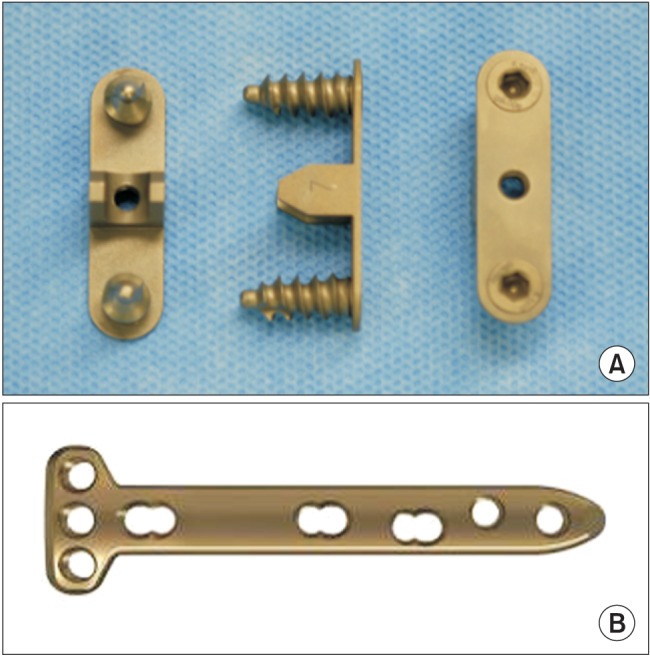
The purpose of this study was to compare the results of Aescula and TomoFix plates used for biplanar open wedge high tibial osteotomy in medial osteoarthritis of the knee joint with varus deformity.
A consecutive series of 50 cases of biplanar open wedge high tibial osteotomy were evaluated retrospectively. Group A contained 25 cases treated by using the Aescula plate, and group T contained 25 cases treated by using the TomoFix plate. Full weight-bearing was permitted at 6 weeks after surgery in group A and at 2 weeks in group T. Clinical evaluations were performed at the final follow-up by using postoperative knee scores and functional scores. Radiographic analysis included postoperative mechanical femur-tibia angle, change in posterior tibial slope angle, and complications related to implants. The mean follow-up periods were 30 months in group A and 26 months in group T.
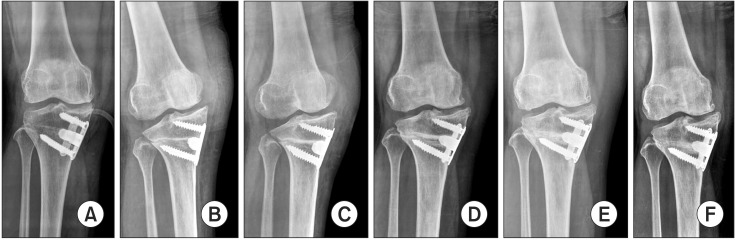
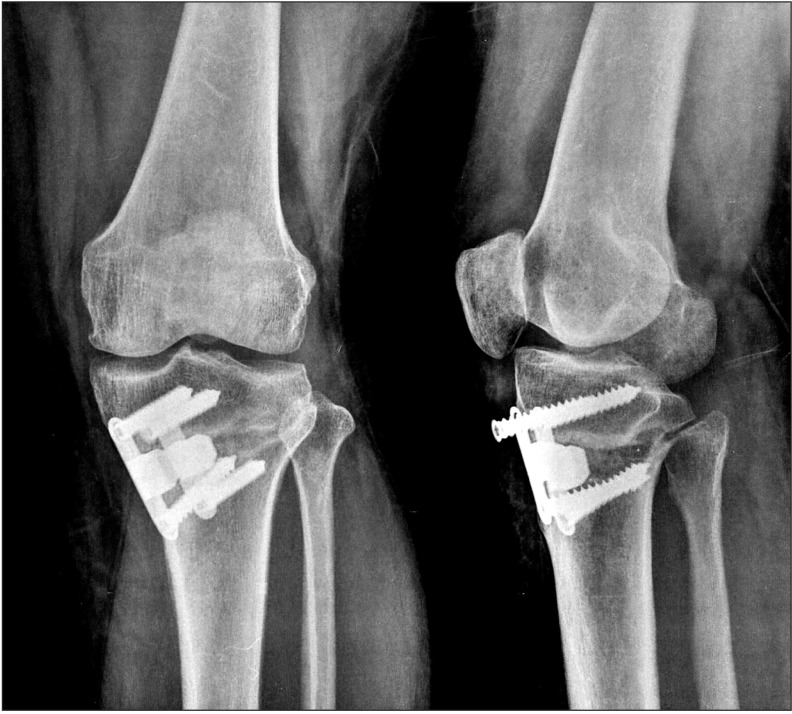
The knee and functional scores were improved at the final follow-up in both groups (p < 0.05), but no differences were observed between the two groups (p > 0.05). An acceptable correction angle was obtained in 52% of group A and in 84% of group T (p = 0.015). Change in posterior tibial slope angle was larger in group A than in group T (p < 0.001), showing better maintenance of posterior tibial slope in group T. In group A, there were 3 cases of screw loosening and 4 cases of delayed union. In addition, there were residual varus deformities in 7 cases (6 in group A and 1 in group T).
This study shows that firm fixation using a TomoFix plate for open wedge high tibial osteotomy produces better radiologic results and a low complication rate than those of the Aescula spacer plate.
本研究旨在比较Aescula钢板和TomoFix钢板用于治疗伴有内翻畸形的膝关节内侧骨关节炎的双平面开放性楔形高位胫骨截骨术的效果。
回顾性评估连续50例双平面开放性楔形高位胫骨截骨术病例。A组25例采用Aescula钢板治疗,T组25例采用TomoFix钢板治疗。A组术后6周允许完全负重,T组术后2周允许完全负重。在末次随访时通过术后膝关节评分和功能评分进行临床评估。影像学分析包括术后机械性股骨-胫骨角、胫骨后倾角度变化以及与植入物相关的并发症。A组平均随访时间为30个月,T组为26个月。
两组在末次随访时膝关节和功能评分均有所改善(p < 0.05),但两组之间未观察到差异(p > 0.05)。A组52%和T组84%获得了可接受的矫正角度(p = 0.015)。A组胫骨后倾角度变化大于T组(p < 0.001),表明T组胫骨后倾维持得更好。A组有3例螺钉松动和4例骨延迟愈合。此外,有7例存在残余内翻畸形(A组6例,T组1例)。
本研究表明,与Aescula间隔钢板相比,使用TomoFix钢板进行开放性楔形高位胫骨截骨术的牢固固定能产生更好的影像学结果和更低的并发症发生率。