Amin Faridah, Fatima Syeda Sadia, Islam Najmul, Gilani Anwar H
Natural Product Research Unit, Department of Biological and Biomedical Sciences, The Aga Khan University Medical College, Karachi, 74800 Pakistan.
Department of Biological and Biomedical Sciences, The Aga Khan University Medical College, Karachi, 74800 Pakistan.
BMC Obes. 2015 Mar 18;2:16. doi: 10.1186/s40608-015-0044-6. eCollection 2015.
Obesity is a global epidemic, which is a risk factor for cardiovascular diseases and metabolic abnormalities. It is measured by body mass index (BMI), waist circumference (WC), waist-hip ratio (WHR), body fat (BF) distribution and abdominal fat mass, each having its own merits and limitations. Variability in body composition between ethnic groups in South-Asians is significant and may not be truly reflected by BMI alone, which may result in misclassification. This study therefore, aims to determine the frequency of obesity, body fat composition and distribution, in a high risk population of an urban slum of Karachi, Pakistan. This survey included 451 participants selected by systematic sampling who were administered pre-tested questionnaires on socio-demographics, diet and physical activity. Chi-square was used to determine the association between categorical variables and multiple linear regression was used for quantitative variables. A P value of less than 0.05 was considered significant.
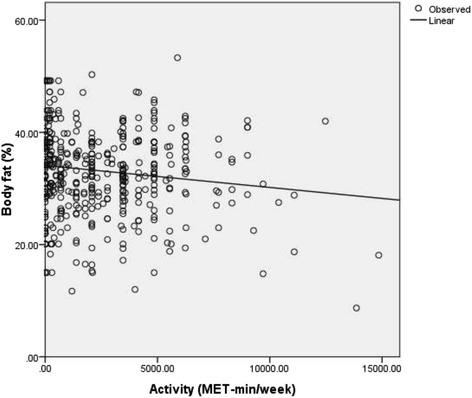
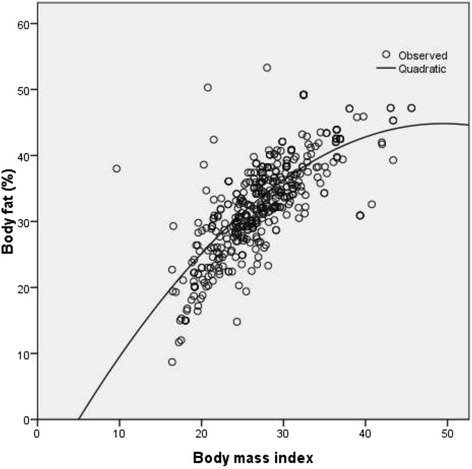
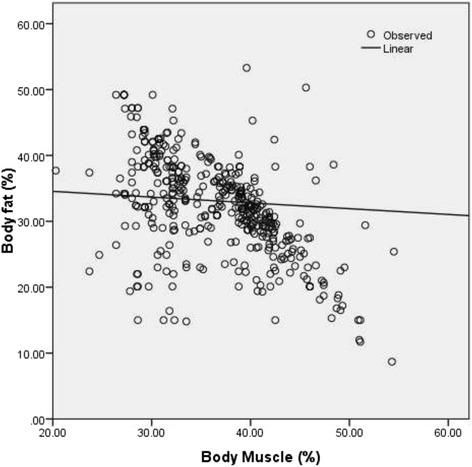
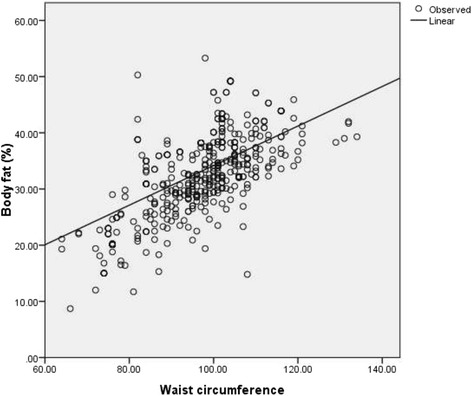
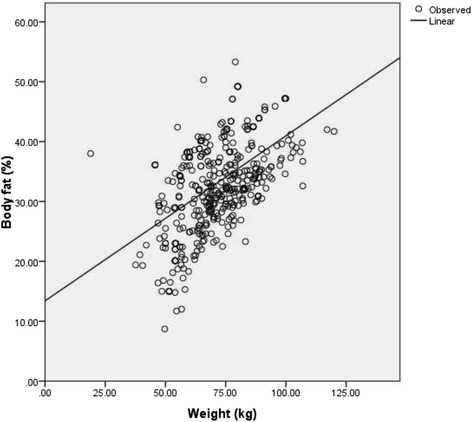
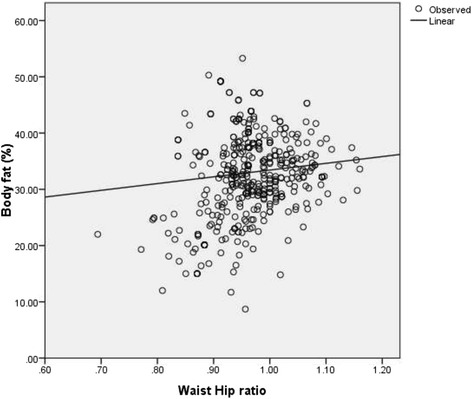
Classified by BMI, 29% study subjects were overweight and 21% obese (58.7% with central obesity). Body fat percent (BF%) classified 81% as overweight. Females were more obese (P 0.03) with higher prevalence of central obesity (P <0.001) and WHR (P 0.003) but with a lower muscle mass (P 0.001). Activity score and muscle mass showed inverse linear association with BF% whereas, WC, weight, BMI and WHR had a positive linear association with BF%. The relationship between BMI and BF% was quadratic with a weaker association at lower BMI. Adjusting for socio-demographic variables, BF%, weight, diastolic blood pressure (DBP), BMI and score on the diet questionnaire had a positive linear association with WC, while WC, WHR and BP had a positive linear association with BF%. BF%, muscle content and WC had a positive linear association with BMI.
Considering lower cut-offs for South-Asians BMI and WC, this study showed a high prevalence of obesity among a sub-urban population of Karachi, which was even higher when BF% was measured. Considering the rising prevalence of non-communicable diseases, BF%, WC, WHR and BMI measurements are convenient and feasible means of identifying population at risk and hence addressing it through public awareness and early detection.
肥胖是一种全球流行疾病,是心血管疾病和代谢异常的危险因素。肥胖通过体重指数(BMI)、腰围(WC)、腰臀比(WHR)、体脂(BF)分布和腹部脂肪量来衡量,每种指标都有其自身的优缺点。南亚不同种族之间身体成分的差异很大,仅靠BMI可能无法真实反映,这可能导致分类错误。因此,本研究旨在确定巴基斯坦卡拉奇一个城市贫民窟的高危人群中肥胖、体脂成分和分布的频率。本次调查包括通过系统抽样选取的451名参与者,他们接受了关于社会人口统计学、饮食和身体活动的预测试问卷。卡方检验用于确定分类变量之间的关联,多元线性回归用于定量变量。P值小于0.05被认为具有统计学意义。
按BMI分类,29%的研究对象超重,21%肥胖(58.7%为中心性肥胖)。按体脂百分比(BF%)分类,81%超重。女性肥胖程度更高(P = 0.03),中心性肥胖患病率更高(P <0.001),腰臀比更高(P = 0.003),但肌肉量更低(P = 0.001)。活动评分和肌肉量与BF%呈负线性相关,而腰围、体重、BMI和腰臀比与BF%呈正线性相关。BMI与BF%之间的关系呈二次曲线,在较低BMI时相关性较弱。在调整社会人口统计学变量后,BF%、体重、舒张压(DBP)、BMI和饮食问卷得分与腰围呈正线性相关,而腰围、腰臀比和血压与BF%呈正线性相关。BF%、肌肉含量和腰围与BMI呈正线性相关。
考虑到南亚人较低的BMI和腰围临界值,本研究表明卡拉奇郊区人群中肥胖患病率很高,若测量BF%,肥胖率更高。考虑到非传染性疾病患病率不断上升,测量BF%、腰围、腰臀比和BMI是识别高危人群的便捷可行方法,因此可通过提高公众意识和早期检测来应对这一问题。