Whitfield Michael G, Soeters Heidi M, Warren Robin M, York Talita, Sampson Samantha L, Streicher Elizabeth M, van Helden Paul D, van Rie Annelies
SA MRC Centre for TB Research, Stellenbosch University, South Africa; DST/NRF Centre of Excellence for Biomedical TB Research, Stellenbosch University, South Africa; Division of Molecular Biology and Human Genetics, Stellenbosch University, South Africa; Faculty of Medicine and Health Sciences, Stellenbosch University, South Africa.
Department of Epidemiology, University of North Carolina at Chapel Hill, Chapel Hill, North Carolina, United States of America.
PLoS One. 2015 Jul 28;10(7):e0133869. doi: 10.1371/journal.pone.0133869. eCollection 2015.
Pyrazinamide (PZA) is crucial for tuberculosis (TB) treatment, given its unique ability to eradicate persister bacilli. The worldwide burden of PZA resistance remains poorly described.
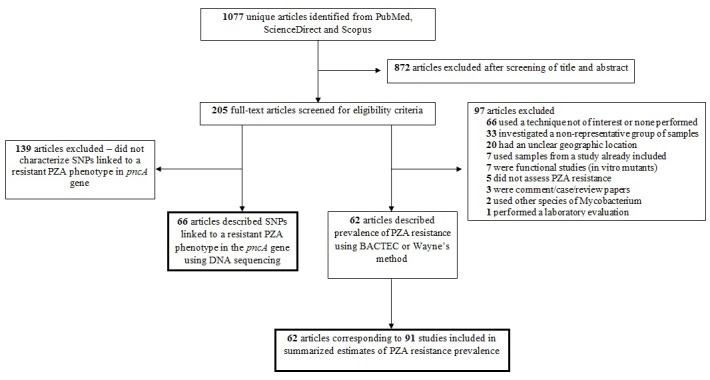
Systematic PubMed, Science Direct and Scopus searches for articles reporting phenotypic (liquid culture drug susceptibility testing or pyrazinamidase activity assays) and/or genotypic (polymerase chain reaction or DNA sequencing) PZA resistance. Global and regional summary estimates were obtained from random-effects meta-analysis, stratified by presence or risk of multidrug resistant TB (MDR-TB). Regional summary estimates were combined with regional WHO TB incidence estimates to determine the annual burden of PZA resistance. Information on single nucleotide polymorphisms (SNPs) in the pncA gene was aggregated to obtain a global summary.
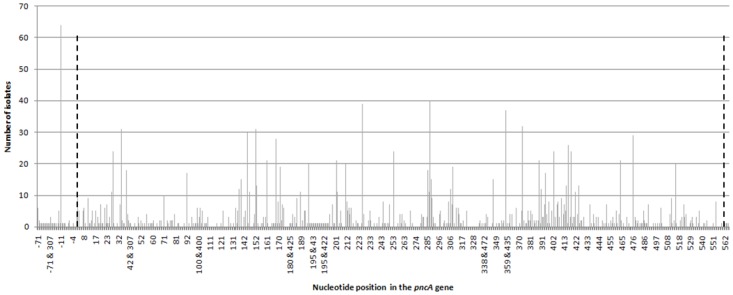
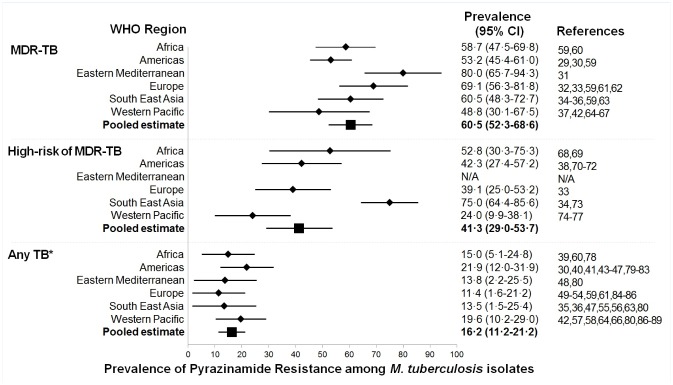
Pooled PZA resistance prevalence estimate was 16.2% (95% CI 11.2-21.2) among all TB cases, 41.3% (29.0-53.7) among patients at high MDR-TB risk, and 60.5% (52.3-68.6) among MDR-TB cases. The estimated global burden is 1.4 million new PZA resistant TB cases annually, about 270,000 in MDR-TB patients. Among 1,815 phenotypically resistant isolates, 608 unique SNPs occurred at 397 distinct positions throughout the pncA gene.
PZA resistance is ubiquitous, with an estimated one in six incident TB cases and more than half of all MDR-TB cases resistant to PZA globally. The diversity of SNPs across the pncA gene complicates the development of rapid molecular diagnostics. These findings caution against relying on PZA in current and future TB drug regimens, especially in MDR-TB patients.
吡嗪酰胺(PZA)对结核病(TB)治疗至关重要,因为它具有根除持留菌的独特能力。全球范围内吡嗪酰胺耐药负担仍描述不足。
通过系统检索PubMed、Science Direct和Scopus数据库,查找报告表型(液体培养药敏试验或吡嗪酰胺酶活性测定)和/或基因型(聚合酶链反应或DNA测序)吡嗪酰胺耐药情况的文章。通过随机效应荟萃分析获得全球和区域汇总估计值,并按耐多药结核病(MDR-TB)的存在情况或风险进行分层。将区域汇总估计值与世界卫生组织区域结核病发病率估计值相结合,以确定吡嗪酰胺耐药的年度负担。汇总pncA基因单核苷酸多态性(SNP)信息以获得全球汇总。
在所有结核病病例中,吡嗪酰胺耐药合并患病率估计为16.2%(95%CI 11.2 - 21.2),在MDR-TB高风险患者中为41.3%(29.0 - 53.7),在MDR-TB病例中为60.5%(52.3 - 68.6)。估计全球负担为每年140万例新的吡嗪酰胺耐药结核病病例,其中MDR-TB患者约27万例。在1815株表型耐药菌株中,pncA基因397个不同位置出现608个独特的SNP。
吡嗪酰胺耐药普遍存在,全球估计每六例新发结核病病例中就有一例耐药,所有MDR-TB病例中超过一半对吡嗪酰胺耐药。pncA基因SNP的多样性使快速分子诊断的开发复杂化。这些发现提醒人们在当前和未来的结核病治疗方案中慎用吡嗪酰胺,尤其是在MDR-TB患者中。