Eshetie Setegn, Gizachew Mucheye, Dagnew Mulat, Kumera Gemechu, Woldie Haile, Ambaw Fekadu, Tessema Belay, Moges Feleke
Department of Medical Microbiology, School of Biomedical and Laboratory Sciences, College of Medicine and Health Sciences, University of Gondar, Gondar Northwest, Ethiopia.
Department of Human Nutrition, College of Health Sciences, Debre Markos University, Debre Markos, Ethiopia.
BMC Infect Dis. 2017 Mar 20;17(1):219. doi: 10.1186/s12879-017-2323-y.
Efforts to control the global burden of tuberculosis (TB) have been jeopardized by the rapid evolution of multi-drug resistant Mycobacterium tuberculosis (MTB), which is resistant to at least isoniazid and rifampicin. Previous studies have documented variable prevalences of multidrug-resistant tuberculosis (MDR-TB) and its risk factors in Ethiopia. Therefore, this meta-analysis is aimed, firstly, to determine the pooled prevalence of MDR-TB among newly diagnosed and previously treated TB cases, and secondly, to measure the association between MDR-TB and a history of previous anti-TB drugs treatment.
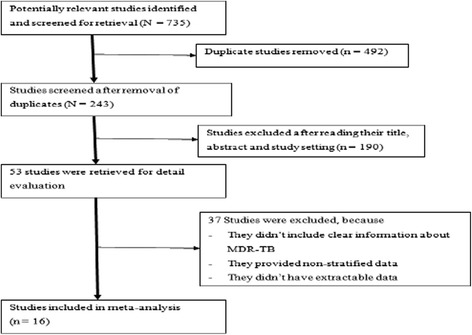
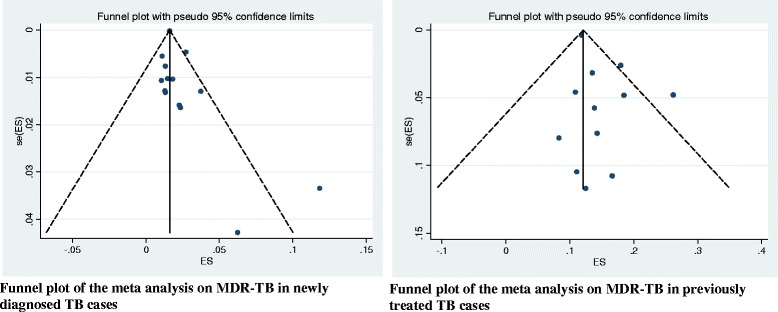
PubMed, Embase and Google Scholar databases were searched. Studies that reported a prevalence of MDR-TB among new and previously treated TB patients were selected. Studies or surveys conducted at national or sub-national level, with reported MDR-TB prevalence or sufficient data to calculate prevalence were considered for the analysis. Two authors searched and reviewed the studies for eligibility and extracted the data in pre-defined forms. Forest plots of all prevalence estimates were performed and summary estimates were also calculated using random effects models. Associations between previous TB treatment and MDR-MTB infection were examined through subgroup analyses stratified by new and previously treated patients.
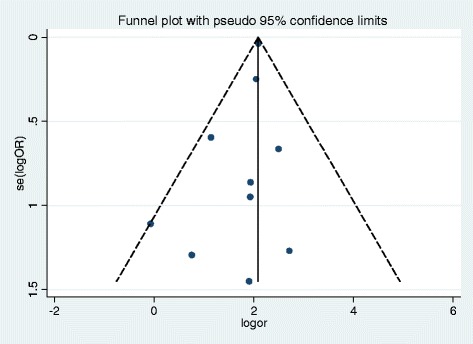
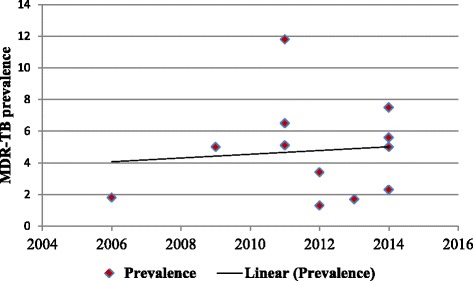
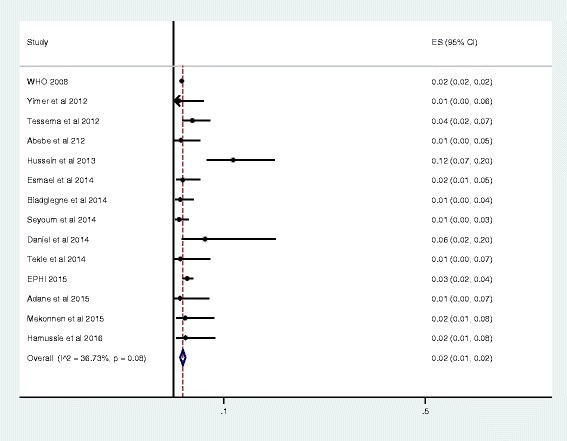
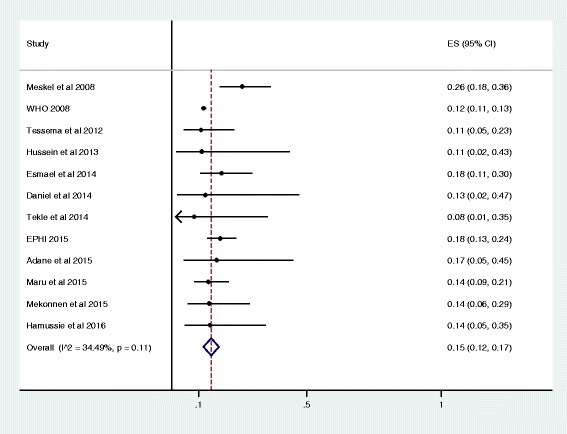
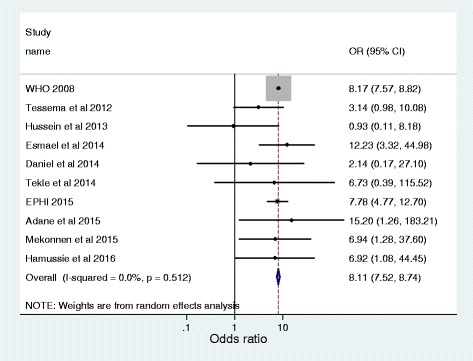
We identified 16 suitable studies and found an overall prevalence of MDR-TB among newly diagnosed and previously treated TB patients to be 2% (95% CI 1% - 2%) and 15% (95% CI 12% - 17%), respectively. The observed difference was statistically significant (P < 0.001) and there was an odds ratio of 8.1 (95% CI 7.5-8.7) for previously treated TB patients to develop a MDR-MTB infection compared to newly diagnosed cases. For the past 10 years (2006 to 2014) the overall MDR-TB prevalence showed a stable time trend.
The burden of MDR-TB remains high in Ethiopian settings, especially in previously treated TB cases. Previous TB treatment was the most powerful predictor for MDR-MTB infection. Strict compliance with anti-TB regimens and improving case detection rate are the necessary steps to tackle the problem in Ethiopia.
耐多药结核分枝杆菌(MTB)的快速演变危及了控制全球结核病负担的努力,耐多药结核分枝杆菌至少对异烟肼和利福平耐药。此前的研究记录了埃塞俄比亚耐多药结核病(MDR-TB)的不同患病率及其危险因素。因此,本荟萃分析旨在,首先,确定新诊断和既往治疗的结核病病例中耐多药结核病的合并患病率,其次,衡量耐多药结核病与既往抗结核药物治疗史之间的关联。
检索了PubMed、Embase和谷歌学术数据库。选择报告了新诊断和既往治疗的结核病患者中耐多药结核病患病率的研究。考虑纳入在国家或次国家层面进行的、报告了耐多药结核病患病率或有足够数据计算患病率的研究或调查进行分析。两名作者检索并审查研究的合格性,并以预定义的表格形式提取数据。对所有患病率估计值绘制森林图,并使用随机效应模型计算汇总估计值。通过按新诊断和既往治疗的患者分层的亚组分析,研究既往结核病治疗与耐多药结核分枝杆菌感染之间的关联。
我们确定了16项合适的研究,发现新诊断和既往治疗的结核病患者中耐多药结核病的总体患病率分别为2%(95%CI 1% - 2%)和15%(95%CI 12% - 17%)。观察到的差异具有统计学意义(P < 0.001),与新诊断病例相比,既往治疗的结核病患者发生耐多药结核分枝杆菌感染的优势比为8.1(95%CI 7.5 - 8.7)。在过去10年(2006年至2014年),耐多药结核病的总体患病率呈现稳定的时间趋势。
在埃塞俄比亚的环境中,耐多药结核病的负担仍然很高,尤其是在既往治疗的结核病病例中。既往结核病治疗是耐多药结核分枝杆菌感染最有力的预测因素。严格遵守抗结核治疗方案和提高病例发现率是埃塞俄比亚解决该问题的必要步骤。