Kwon Woosung, Do Sungan, Kim Ji-Hee, Seok Jeong Mun, Rhee Shi-Woo
Department of Chemical Engineering, Pohang University of Science and Technology (POSTECH), 77 Cheongam-ro, Nam-gu, Pohang 790-784, South Korea.
Center for Integrated Nanostructure Physics, Institute for Basic Science (IBS), 2066 Seobu-ro, Jangan-gu, Sungkyunkwan University, Suwon 440-746, South Korea.
Sci Rep. 2015 Jul 28;5:12604. doi: 10.1038/srep12604.
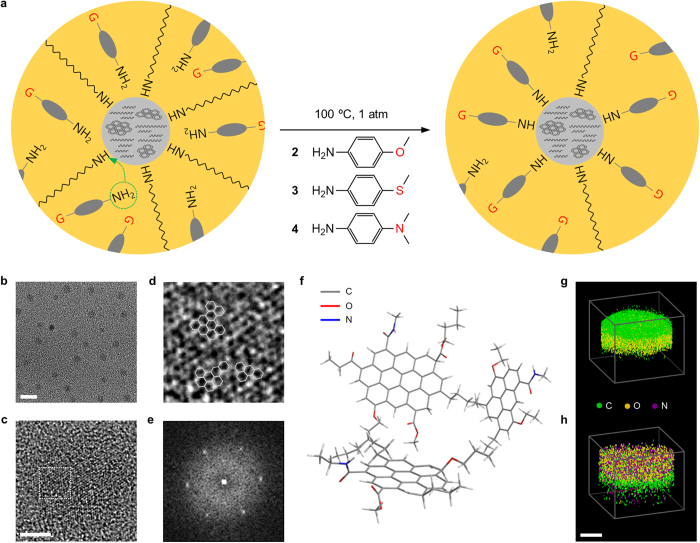
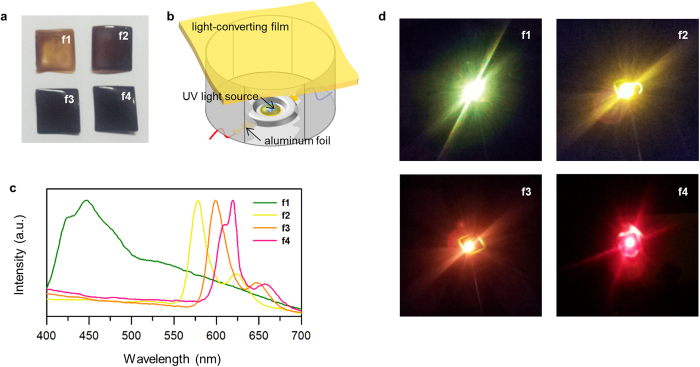
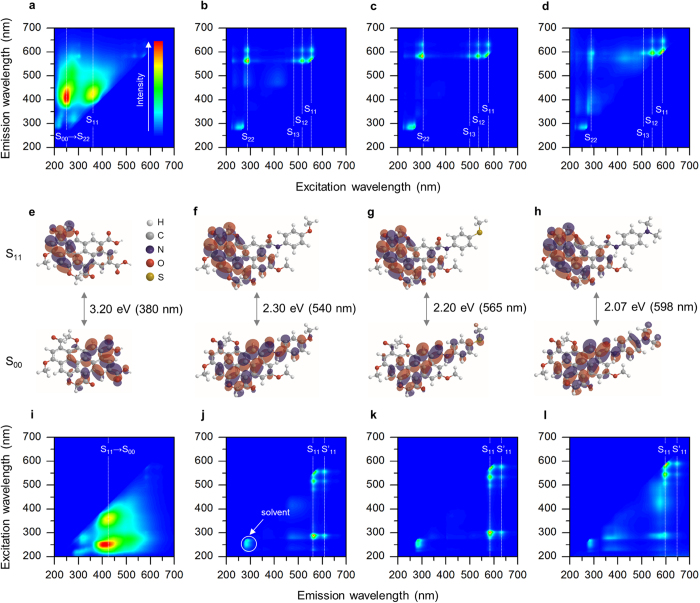
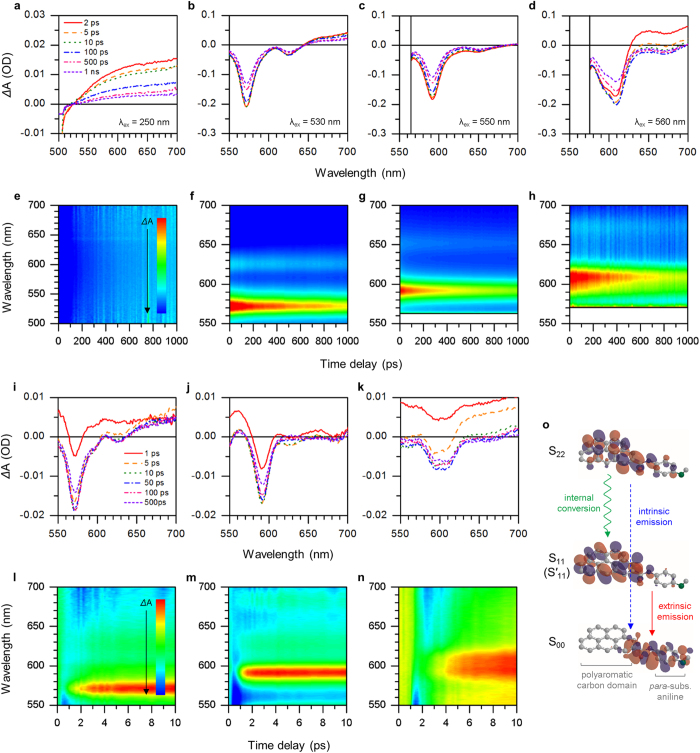
Carbon nanodots (C-dots) are a kind of fluorescent carbon nanomaterials, composed of polyaromatic carbon domains surrounded by amorphous carbon frames, and have attracted a great deal of attention because of their interesting properties. There are still, however, challenges ahead such as blue-biased photoluminescence, spectral broadness, undefined energy gaps and etc. In this report, we chemically modify the surface of C-dots with a series of para-substituted anilines to control their photoluminescence. Our surface functionalization endows our C-dots with new energy levels, exhibiting long-wavelength (up to 650 nm) photoluminescence of very narrow spectral widths. The roles of para-substituted anilines and their substituents in developing such energy levels are thoroughly studied by using transient absorption spectroscopy. We finally demonstrate light-emitting devices exploiting our C-dots as a phosphor, converting UV light to a variety of colors with internal quantum yields of ca. 20%.
碳纳米点(C点)是一种荧光碳纳米材料,由被无定形碳框架包围的多芳族碳域组成,因其有趣的特性而备受关注。然而,仍面临一些挑战,如蓝光偏置光致发光、光谱展宽、未定义的能隙等。在本报告中,我们用一系列对位取代苯胺对C点表面进行化学修饰,以控制其光致发光。我们的表面功能化赋予C点新的能级,呈现出光谱宽度非常窄的长波长(高达650nm)光致发光。通过瞬态吸收光谱法深入研究了对位取代苯胺及其取代基在形成此类能级中的作用。我们最终展示了利用我们的C点作为磷光体的发光器件,将紫外光转换为多种颜色,内部量子产率约为20%。