Takase Hiroyuki, Sugiura Tomonori, Kimura Genjiro, Ohte Nobuyuki, Dohi Yasuaki
Department of Internal Medicine, Enshu Hospital, Hamamatsu, Japan (H.T.).
Department of Cardio-Renal Medicine and Hypertension, Nagoya City University Graduate School of Medical Sciences, Nagoya, Japan (T.S., G.K., N.O., Y.D.).
J Am Heart Assoc. 2015 Jul 29;4(8):e001959. doi: 10.1161/JAHA.115.001959.
Although there is a close relationship between dietary sodium and hypertension, the concept that persons with relatively high dietary sodium are at increased risk of developing hypertension compared with those with relatively low dietary sodium has not been studied intensively in a cohort.
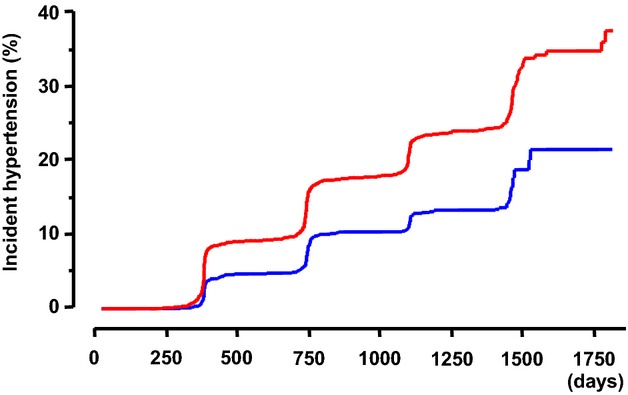
We conducted an observational study to investigate whether dietary sodium intake predicts future blood pressure and the onset of hypertension in the general population. Individual sodium intake was estimated by calculating 24-hour urinary sodium excretion from spot urine in 4523 normotensive participants who visited our hospital for a health checkup. After a baseline examination, they were followed for a median of 1143 days, with the end point being development of hypertension. During the follow-up period, hypertension developed in 1027 participants (22.7%). The risk of developing hypertension was higher in those with higher rather than lower sodium intake (hazard ratio 1.25, 95% CI 1.04 to 1.50). In multivariate Cox proportional hazards regression analysis, baseline sodium intake and the yearly change in sodium intake during the follow-up period (as continuous variables) correlated with the incidence of hypertension. Furthermore, both the yearly increase in sodium intake and baseline sodium intake showed significant correlations with the yearly increase in systolic blood pressure in multivariate regression analysis after adjustment for possible risk factors.
Both relatively high levels of dietary sodium intake and gradual increases in dietary sodium are associated with future increases in blood pressure and the incidence of hypertension in the Japanese general population.
尽管饮食中的钠与高血压之间存在密切关系,但与饮食中钠含量相对较低的人相比,饮食中钠含量相对较高的人患高血压风险增加这一概念在队列研究中尚未得到深入研究。
我们进行了一项观察性研究,以调查饮食中钠摄入量是否能预测普通人群未来的血压及高血压的发病情况。通过计算4523名因健康检查来我院就诊的血压正常参与者的随机尿样中24小时尿钠排泄量,估算个体钠摄入量。在基线检查后,对他们进行了中位数为1143天的随访,终点为高血压的发生。在随访期间,1027名参与者(22.7%)患上了高血压。钠摄入量较高者而非较低者患高血压的风险更高(风险比1.25,95%可信区间1.04至1.50)。在多变量Cox比例风险回归分析中,基线钠摄入量及随访期间钠摄入量的年度变化(作为连续变量)与高血压发病率相关。此外,在对可能的风险因素进行调整后的多变量回归分析中,钠摄入量的年度增加及基线钠摄入量均与收缩压的年度增加显著相关。
饮食中钠摄入量相对较高及饮食中钠的逐渐增加均与日本普通人群未来血压升高及高血压发病率相关。