Sara Jaskanwal D, Zhang Ming, Gharib Hossein, Lerman Lilach O, Lerman Amir
Division of Cardiovascular Diseases, Mayo Clinic, Rochester, MN (J.D.S., M.Z., A.L.).
Division of Endocrinology and Metabolic Disease, Mayo Clinic, Rochester, MN (H.G.).
J Am Heart Assoc. 2015 Jul 29;4(8):e002225. doi: 10.1161/JAHA.115.002225.
Hypothyroidism is associated with an increased risk of coronary artery disease, beyond that which can be explained by its association with conventional cardiovascular risk factors. Coronary endothelial dysfunction precedes atherosclerosis, has been linked to adverse cardiovascular events, and may account for some of the increased risk in patients with hypothyroidism. The aim of this study was to determine whether there is an association between epicardial and microvascular coronary endothelial dysfunction and hypothyroidism.
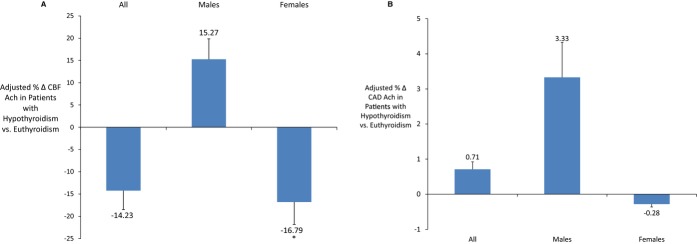
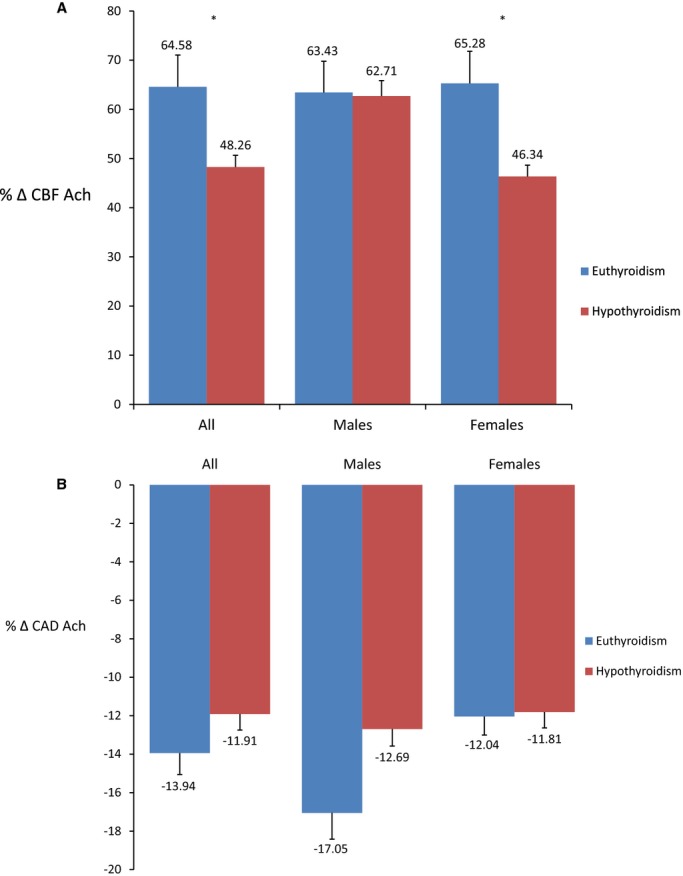
In 1388 patients (mean age 50.5 [12.3] years, 34% male) presenting with stable chest pain to Mayo Clinic, Rochester, MN for diagnostic coronary angiography, and who were found to have nonobstructive coronary artery disease (<40% stenosis), we invasively assessed coronary artery endothelial-dependent microvascular and epicardial function by evaluating changes in coronary blood flow (% Δ CBF Ach) and diameter (% Δ CAD Ach), respectively, in response to intracoronary infusions of acetylcholine. Patients were divided into 2 groups: hypothyroidism, defined as a documented history of hypothyroidism or a thyroid-stimulating hormone (TSH) >10.0 mU/mL, n=188, and euthyroidism, defined as an absence of a history of hypothyroidism in the clinical record and/or 0.3<TSH≤10.0 mU/mL, n=1200. Subjects with a history of hypothyroidism had a significantly lower % Δ CBF Ach (48.26 [80.66] versus 64.58 [128.30]) compared to patients with euthyroidism, while the % Δ CAD Ach did not vary significantly between groups. After adjusting for covariates, females with hypothyroidism still had a significantly lower % Δ CBF Ach (estimated difference in % Δ CBF Ach [SE]: -16.79 [8.18]).
Hypothyroidism in women is associated with microvascular endothelial dysfunction, even after adjusting for confounders, and may explain some of the increased risk of cardiovascular disease in these patients.
甲状腺功能减退与冠状动脉疾病风险增加相关,这种增加超出了其与传统心血管危险因素关联所能解释的范围。冠状动脉内皮功能障碍先于动脉粥样硬化出现,与不良心血管事件相关,可能是甲状腺功能减退患者风险增加的部分原因。本研究的目的是确定心外膜和微血管冠状动脉内皮功能障碍与甲状腺功能减退之间是否存在关联。
在梅奥诊所(明尼苏达州罗切斯特)因稳定型胸痛前来进行诊断性冠状动脉造影且被发现患有非阻塞性冠状动脉疾病(狭窄<40%)的1388例患者(平均年龄50.5[12.3]岁,男性占34%)中,我们通过分别评估冠状动脉内注射乙酰胆碱后冠状动脉血流变化(%ΔCBF Ach)和直径变化(%ΔCAD Ach),对冠状动脉内皮依赖性微血管和心外膜功能进行了有创评估。患者分为两组:甲状腺功能减退组,定义为有甲状腺功能减退病史记录或促甲状腺激素(TSH)>10.0 mU/mL,n = 188;甲状腺功能正常组,定义为临床记录中无甲状腺功能减退病史且/或0.3 < TSH≤10.0 mU/mL,n = 1200。与甲状腺功能正常的患者相比,有甲状腺功能减退病史的受试者的%ΔCBF Ach显著更低(48.26[80.66]对64.58[128.30]),而两组之间的%ΔCAD Ach无显著差异。在对协变量进行调整后,甲状腺功能减退的女性的%ΔCBF Ach仍然显著更低(%ΔCBF Ach的估计差异[SE]:-16.79[8.18])。
即使在对混杂因素进行调整后,女性甲状腺功能减退仍与微血管内皮功能障碍相关,这可能解释了这些患者心血管疾病风险增加的部分原因。