Theorell Töres, Hammarström Anne, Aronsson Gunnar, Träskman Bendz Lil, Grape Tom, Hogstedt Christer, Marteinsdottir Ina, Skoog Ingmar, Hall Charlotte
Stress Research Institute, Stockholm University, SE-106 91, Stockholm, Sweden.
Department of Neuroscience, Karolinska Institutet, SE- 171 77, Stockholm, Sweden.
BMC Public Health. 2015 Aug 1;15:738. doi: 10.1186/s12889-015-1954-4.
Depressive symptoms are potential outcomes of poorly functioning work environments. Such symptoms are frequent and cause considerable suffering for the employees as well as financial loss for the employers. Accordingly good prospective studies of psychosocial working conditions and depressive symptoms are valuable. Scientific reviews of such studies have pointed at methodological difficulties but still established a few job risk factors. Those reviews were published some years ago. There is need for an updated systematic review using the GRADE system. In addition, gender related questions have been insufficiently reviewed.
Inclusion criteria for the studies published 1990 to June 2013: 1. European and English speaking countries. 2. Quantified results describing the relationship between exposure (psychosocial or physical/chemical) and outcome (standardized questionnaire assessment of depressive symptoms or interview-based clinical depression). 3. Prospective or comparable case-control design with at least 100 participants. 4. Assessments of exposure (working conditions) and outcome at baseline and outcome (depressive symptoms) once again after follow-up 1-5 years later. 5. Adjustment for age and adjustment or stratification for gender. Studies filling inclusion criteria were subjected to assessment of 1.) relevance and 2.) quality using predefined criteria. Systematic review of the evidence was made using the GRADE system. When applicable, meta-analysis of the magnitude of associations was made. Consistency of findings was examined for a number of possible confounders and publication bias was discussed.
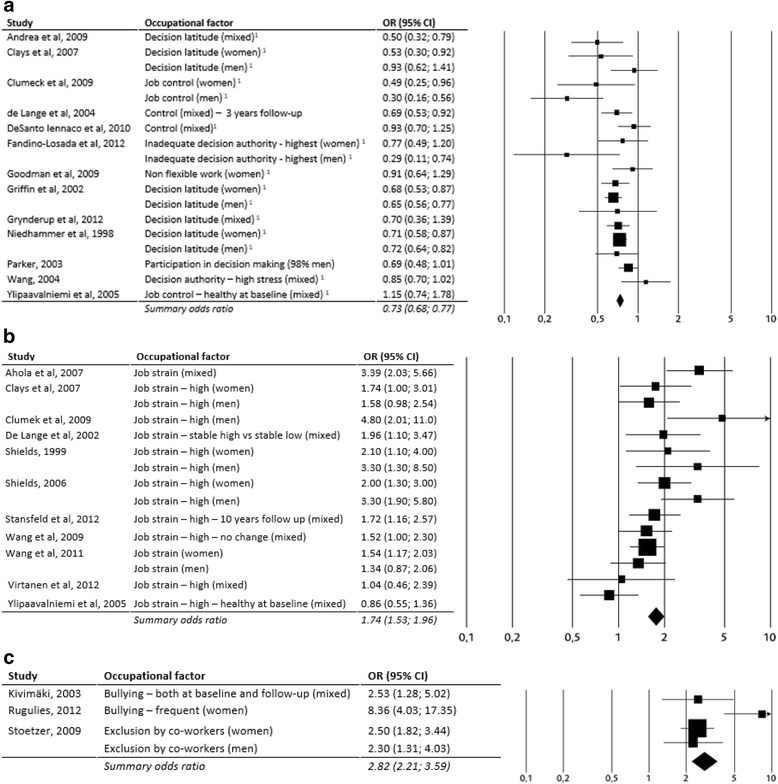
Fifty-nine articles of high or medium high scientific quality were included. Moderately strong evidence (grade three out of four) was found for job strain (high psychological demands and low decision latitude), low decision latitude and bullying having significant impact on development of depressive symptoms. Limited evidence (grade two) was shown for psychological demands, effort reward imbalance, low support, unfavorable social climate, lack of work justice, conflicts, limited skill discretion, job insecurity and long working hours. There was no differential gender effect of adverse job conditions on depressive symptoms
There is substantial empirical evidence that employees, both men and women, who report lack of decision latitude, job strain and bullying, will experience increasing depressive symptoms over time. These conditions are amenable to organizational interventions.
抑郁症状是工作环境不佳的潜在后果。此类症状很常见,会给员工带来巨大痛苦,也会给雇主造成经济损失。因此,针对社会心理工作条件和抑郁症状开展良好的前瞻性研究很有价值。对这类研究的科学综述指出了方法上的困难,但仍确定了一些工作风险因素。这些综述是几年前发表的。有必要使用GRADE系统进行更新的系统综述。此外,与性别相关的问题尚未得到充分审查。
纳入1990年至2013年6月发表的研究的纳入标准:1.欧洲和英语国家。2.量化结果描述暴露(社会心理或身体/化学)与结果(抑郁症状的标准化问卷调查评估或基于访谈的临床抑郁症)之间的关系。3.前瞻性或可比病例对照设计,至少100名参与者。4.在基线时评估暴露(工作条件)和结果,并在1 - 5年后随访再次评估结果(抑郁症状)。5.对年龄进行调整,并对性别进行调整或分层。符合纳入标准的研究需根据预定义标准进行1.)相关性和2.)质量评估。使用GRADE系统对证据进行系统综述。适当时,对关联程度进行荟萃分析。检查了一些可能的混杂因素的研究结果一致性,并讨论了发表偏倚。
纳入了59篇高质量或中高质量的文章。发现工作压力(高心理需求和低决策自由度)、低决策自由度和欺凌对抑郁症状的发展有显著影响,证据力度中等(四级中的三级)。心理需求、努力回报失衡、低支持、不良社会氛围、缺乏工作公正性、冲突、有限的技能自主权、工作不安全感和长时间工作的证据有限(二级)。不良工作条件对抑郁症状没有性别差异影响。
有大量实证证据表明,报告缺乏决策自由度、工作压力和遭受欺凌的员工,无论男女,随着时间的推移抑郁症状都会增加。这些情况适合进行组织干预。