Deibel Scott H, Zelinski Erin L, Keeley Robin J, Kovalchuk Olga, McDonald Robert J
Canadian Centre for Behavioural Neuroscience, Department of Neuroscience, University of Lethbridge, Lethbridge, AB, Canada.
Department of Biological Sciences, University of Lethbridge, Lethbridge, AB, Canada.
Oncotarget. 2015 Sep 15;6(27):23181-203. doi: 10.18632/oncotarget.4036.
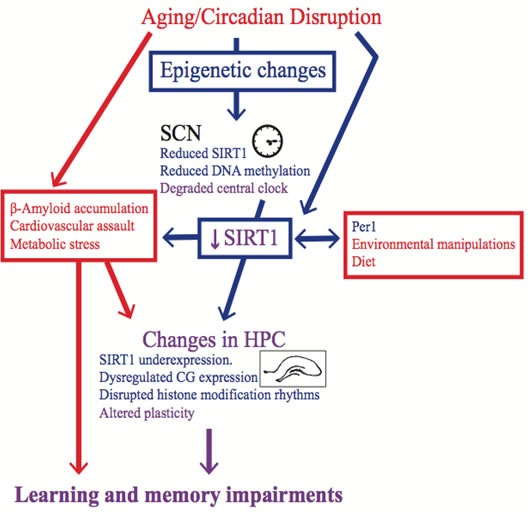
Circadian rhythm dysfunction and cognitive decline, specifically memory loss, frequently accompany natural aging. Circadian rhythms and memory are intertwined, as circadian rhythms influence memory formation and recall in young and old rodents. Although, the precise relationship between circadian rhythms and memory is still largely unknown, it is hypothesized that circadian rhythm disruption, which occurs during aging, contributes to age-associated cognitive decline, specifically memory loss. While there are a variety of mechanisms that could mediate this effect, changes in the epigenome that occur during aging has been proposed as a potential candidate. Interestingly, epigenetic mechanisms, such as DNA methylation and sirtuin1 (SIRT1) are necessary for both circadian rhythms and memory. During aging, similar alterations of epigenetic mechanisms occur in the suprachiasmatic nucleus (SCN) and hippocampus, which are necessary for circadian rhythm generation and memory, respectively. Recently, circadian rhythms have been linked to epigenetic function in the hippocampus, as some of these epigenetic mechanisms oscillate in the hippocampus and are disrupted by clock gene deletion. The current paper will review how circadian rhythms and memory change with age, and will suggest how epigenetic changes in these processes might contribute to age-related cognitive decline.
昼夜节律功能障碍和认知衰退,尤其是记忆力丧失,常伴随着自然衰老。昼夜节律与记忆相互交织,因为昼夜节律影响着年轻和年老啮齿动物的记忆形成和回忆。尽管昼夜节律与记忆之间的确切关系仍 largely 未知,但据推测,衰老过程中发生的昼夜节律紊乱会导致与年龄相关的认知衰退,尤其是记忆力丧失。虽然有多种机制可以介导这种效应,但衰老过程中发生的表观基因组变化被认为是一个潜在的候选因素。有趣的是,表观遗传机制,如 DNA 甲基化和沉默调节蛋白 1(SIRT1)对于昼夜节律和记忆都是必需的。在衰老过程中,表观遗传机制的类似改变分别发生在视交叉上核(SCN)和海马体中,而视交叉上核和海马体分别是产生昼夜节律和记忆所必需的。最近,昼夜节律与海马体中的表观遗传功能有关,因为其中一些表观遗传机制在海马体中振荡,并因时钟基因缺失而受到破坏。本文将综述昼夜节律和记忆如何随年龄变化,并将提出这些过程中的表观遗传变化可能如何导致与年龄相关的认知衰退。