Rha Jung Ho, Kwon Sung Min, Oh Jin Rok, Han Byung Keun, Lee Kang Hyung, Kim Jae Hyun
Department of Orthopedics, Yonsei University Wonju College of Medicine, Wonju, Korea.
Department of Internal Medicine, Yonsei University Wonju College of Medicine, Wonju, Korea.
Yonsei Med J. 2015 Sep;56(5):1443-8. doi: 10.3349/ymj.2015.56.5.1443.
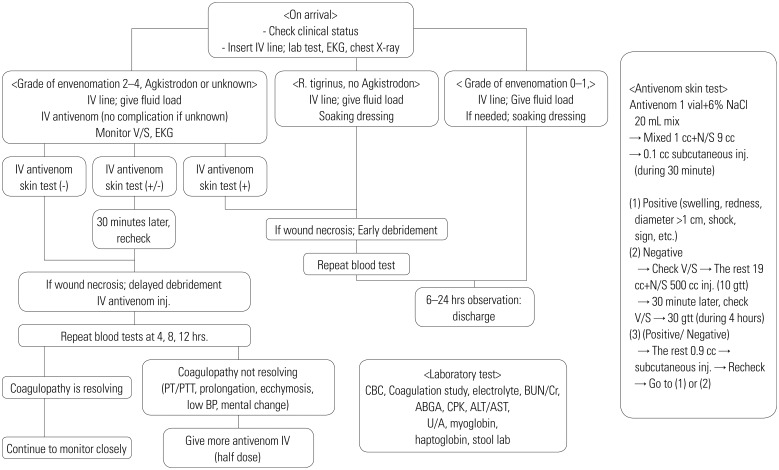
Snakebite is an emergency which causes local symptoms such as pain and edema around the bite. Systemic symptoms may also develop, such as dizziness or renal failure, and may even cause death. The purpose of this research was to assess the validity and safety of snakebite protocol for surgery when treating snakebite patients.
Retrospective research was performed on patients who were admitted after being treated at the emergency center from January 2008 to December 2012. When necessary, debridement was also performed, and 46 of 111 patients (41.4%) underwent debridement. Those who had received debridement without antivenom administration due to a positive skin reaction test were classified as group A, and group B received antivenom and delayed debridement. We reviewed the emergency and admission charts of the patients in each group and recorded and compared their age, sex, bite site, severity of local and general symptoms, time to receive antivenin, and complications.
Of the ten patients (21.7%) in group A, two (66.6%) developed cellulites, and one of them experienced skin necrosis, resulting in a skin graft. In group B, there were 36 patients (78.2%), 19 (52.7%) of whom developed cellulitis. Skin necrosis occurred in two patients, and one of these patients received a skin graft. Compartment syndrome was found in one patient, and fasciotomy and a skin graft were performed.
The treatment protocol implemented to treat snakebite patients admitted to the emergency center during this research was safely and properly followed during surgical treatment.
蛇咬伤是一种紧急情况,会导致咬伤部位周围出现疼痛和水肿等局部症状。也可能出现全身症状,如头晕或肾衰竭,甚至可能导致死亡。本研究的目的是评估蛇咬伤手术方案在治疗蛇咬伤患者时的有效性和安全性。
对2008年1月至2012年12月在急诊中心接受治疗后入院的患者进行回顾性研究。必要时也进行清创术,111例患者中有46例(41.4%)接受了清创术。因皮肤反应试验呈阳性而未接受抗蛇毒血清治疗的清创患者被归类为A组,B组接受抗蛇毒血清治疗并延迟清创。我们查阅了每组患者的急诊和入院病历,记录并比较了他们的年龄、性别、咬伤部位、局部和全身症状的严重程度、接受抗蛇毒血清的时间以及并发症。
A组的10例患者(21.7%)中,2例(66.6%)发生蜂窝织炎,其中1例出现皮肤坏死,进行了皮肤移植。B组有36例患者(78.2%),其中19例(52.7%)发生蜂窝织炎。2例患者出现皮肤坏死,其中1例接受了皮肤移植。1例患者出现骨筋膜室综合征,进行了筋膜切开术和皮肤移植。
本研究期间对入住急诊中心的蛇咬伤患者实施的治疗方案在手术治疗过程中得到了安全、正确的遵循。