
大鼠模型中纳米羟基磷灰石-壳聚糖的异位骨生成及支架生物降解
Ectopic osteogenesis and scaffold biodegradation of nano-hydroxyapatite-chitosan in a rat model.
作者信息
He Yiqun, Dong Youhai, Cui Fuzhai, Chen Xujun, Lin Rongqiang
机构信息
The Orthopaedic Department of The Fifth People's Hospital of Shanghai, Fudan University, Shanghai, China.
State Key Laboratory of New Ceramic and Fine Processing, Department of Materials Science and Engineering, Tsinghua University, Beijing, China.
出版信息
PLoS One. 2015 Aug 10;10(8):e0135366. doi: 10.1371/journal.pone.0135366. eCollection 2015.
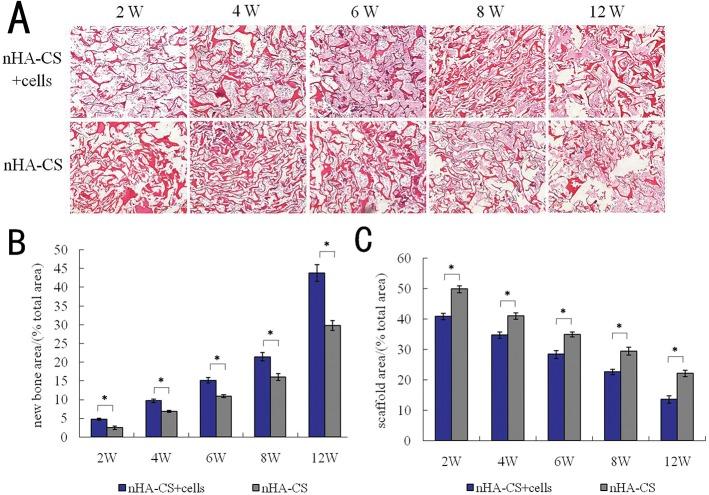
The bone-formation and scaffold-biodegradation processes have not been fully characterized. This study aimed to determine the osteogenic ability of nHA-CS osteo-induced bone marrow mesenchymal stem cell (BMSC) composites and to explore the relationship between bone formation and scaffold biodegradation. The nHA-CS osteo-induced BMSC composites (nHA-CS+cells group) and the nHA-CS scaffolds (nHA-CS group) were implanted into the femoral spatium intermusculare of SD rats. At 2, 4, 6, 8, and 12 weeks post-implantation, the rat femurs were scanned using computerized tomography (CT), and the CT values of the implants were measured and comparatively analyzed. The implants were then harvested and subjected to hematoxylin and eosin (HE) and Masson's trichrome staining, and the percentages of bone area, scaffold area and collagen area were compared between the two groups. The CT values of the implants were higher in the nHA-CS+cells group than the nHA-CS group at the same time points (P < 0.05). Histological analysis revealed that de novo bone and collagen formation in the pores of the scaffolds gradually increased from 2 weeks post-implantation in both groups and that the scaffold gradually degraded as bone formation proceeded. However, more de novo bone and collagen formation and scaffold degradation occurred in the nHA-CS+cells group than in the nHA-CS group at the same time points (P < 0.05). In conclusion, nHA-CS osteo-induced BMSC composites are promising bone tissue engineering substitutes, and osteo-induced BMSCs can significantly enhance the osteogenic ability and play an active role in the degradation of nHA-CS scaffolds on par with bone formation.
骨形成和支架生物降解过程尚未得到充分表征。本研究旨在确定nHA-CS骨诱导骨髓间充质干细胞(BMSC)复合材料的成骨能力,并探讨骨形成与支架生物降解之间的关系。将nHA-CS骨诱导BMSC复合材料(nHA-CS+细胞组)和nHA-CS支架(nHA-CS组)植入SD大鼠的股肌间隙。植入后2、4、6、8和12周,使用计算机断层扫描(CT)对大鼠股骨进行扫描,测量并比较分析植入物的CT值。然后取出植入物,进行苏木精-伊红(HE)和Masson三色染色,比较两组之间骨面积、支架面积和胶原面积的百分比。在相同时间点,nHA-CS+细胞组植入物的CT值高于nHA-CS组(P<0.05)。组织学分析显示,两组支架孔隙中新生骨和胶原形成从植入后2周开始逐渐增加,并且随着骨形成的进行,支架逐渐降解。然而,在相同时间点,nHA-CS+细胞组比nHA-CS组出现更多的新生骨和胶原形成以及支架降解(P<0.05)。总之,nHA-CS骨诱导BMSC复合材料是有前景的骨组织工程替代物,并且骨诱导BMSCs可以显著增强成骨能力,并在nHA-CS支架降解过程中与骨形成发挥同等的积极作用。




 Zotero 插件