Shimada Koji, Takiguchi Shinichiro, Mizushima Sakae, Fujisawa Takashi X, Saito Daisuke N, Kosaka Hirotaka, Okazawa Hidehiko, Tomoda Akemi
Research Center for Child Mental Development, University of Fukui, 23-3 Matsuoka-Shimoaizuki, Eiheiji-cho, Fukui 910-1193, Japan ; Biomedical Imaging Research Center, University of Fukui, 23-3 Matsuoka-Shimoaizuki, Eiheiji-cho, Fukui 910-1193, Japan ; Division of Developmental Higher Brain Functions, United Graduate School of Child Development, University of Fukui, 23-3 Matsuoka-Shimoaizuki, Eiheiji-cho, Fukui 910-1193, Japan.
Graduate School of Medical Sciences, University of Fukui, 23-3 Matsuoka-Shimoaizuki, Eiheiji-cho, Fukui 910-1193, Japan.
Neuroimage Clin. 2015 Jul 31;9:13-9. doi: 10.1016/j.nicl.2015.07.001. eCollection 2015.
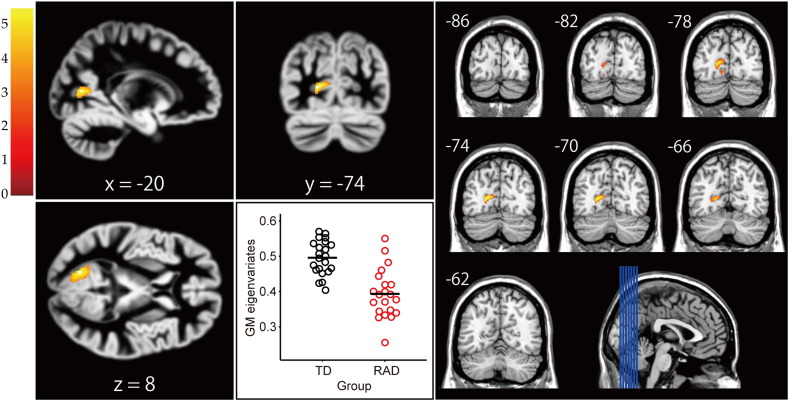
Child maltreatment increases the risk for psychiatric disorders throughout childhood and into adulthood. One negative outcome of child maltreatment can be a disorder of emotional functioning, reactive attachment disorder (RAD), where the child displays wary, watchful, and emotionally withdrawn behaviours. Despite its clinical importance, little is known about the potential neurobiological consequences of RAD. The aim of this study was to elucidate whether RAD was associated with alterations in grey matter volume (GMV). High-resolution magnetic resonance imaging datasets were obtained for children and adolescents with RAD (n = 21; mean age = 12.76 years) and typically developing (TD) control subjects (n = 22; mean age = 12.95 years). Using a whole-brain voxel-based morphometry approach, structural images were analysed controlling for age, gender, full scale intelligence quotient, and total brain volume. The GMV was significantly reduced by 20.6% in the left primary visual cortex (Brodmann area 17) of the RAD group compared to the TD group (p = .038, family-wise error-corrected cluster level). This GMV reduction was related to an internalising problem measure of the Strength and Difficulties Questionnaire. The visual cortex has been viewed as part of the neurocircuit regulating the stress response to emotional visual images. Combined with previous studies of adults with childhood maltreatment, early adverse experience (e.g. sensory deprivation) may affect the development of the primary visual system, reflecting in the size of the visual cortex in children and adolescents with RAD. These visual cortex GMV abnormalities may also be associated with the visual emotion regulation impairments of RAD, leading to an increased risk for later psychopathology.
儿童虐待会增加儿童期直至成年期患精神疾病的风险。儿童虐待的一个负面后果可能是情绪功能障碍,即反应性依恋障碍(RAD),患病儿童会表现出警惕、戒备和情绪退缩行为。尽管其在临床上具有重要意义,但对于RAD潜在的神经生物学后果却知之甚少。本研究的目的是阐明RAD是否与灰质体积(GMV)改变有关。我们获取了患有RAD的儿童和青少年(n = 21;平均年龄 = 12.76岁)以及发育正常(TD)的对照受试者(n = 22;平均年龄 = 12.95岁)的高分辨率磁共振成像数据集。使用基于体素的全脑形态测量方法,对结构图像进行分析,并控制年龄、性别、全量表智商和全脑体积。与TD组相比,RAD组左侧初级视觉皮层(布罗德曼区17)的GMV显著减少了20.6%(p = .038,家族性错误校正聚类水平)。这种GMV减少与《长处与困难问卷》中的内化问题测量指标有关。视觉皮层被视为调节对情绪化视觉图像应激反应的神经回路的一部分。结合先前对有童年虐待经历成年人的研究,早期不良经历(如感觉剥夺)可能会影响初级视觉系统的发育,这在患有RAD的儿童和青少年的视觉皮层大小上有所体现。这些视觉皮层GMV异常也可能与RAD的视觉情绪调节受损有关,从而导致日后患精神病理学疾病的风险增加。