Wang Juan, Peng Yuanqiu, Liu Yuan, Yang Jun, Ding Ning, Tan Wenfu
Department of Pharmacology, School of Pharmacy, Fudan University, 826 Zhangheng Road, Shanghai, 201203, P.R. China.
Department of Medicinal Chemistry, School of Pharmacy, Fudan University, 826 Zhangheng Rd, Shanghai, 201203, P.R. China.
BMC Cancer. 2015 Aug 22;15:595. doi: 10.1186/s12885-015-1596-z.
Berberine (BBR), a natural alkaloid compound, is used as a non-prescription drug in China for treating diarrhea and gastroenteritis. Many studies have revealed that BBR possesses anticancer effect. However, the molecular mechanisms underlying its anticancer action is far from being fully elucidated. This study is aimed to determine the effect of BBR on the hedgehog (Hh) activity and the growth of cancers addiction to Hh activity.
The Hh activity was determined by dual luciferase assays and quantitative RT-PCR analyses. The growth inhibition of BBR on medulloblastoma which was obtained from ptch+/-;p53-/- mice was analyzed by 5-bromo-2-deoxyuridine (Brdu) assays and by allografting the medulloblastoma into nude mice. The data were statistically analyzed by one-way analysis of variance (ANOVA), and multiple comparison between the groups was performed using Dunnett's method.
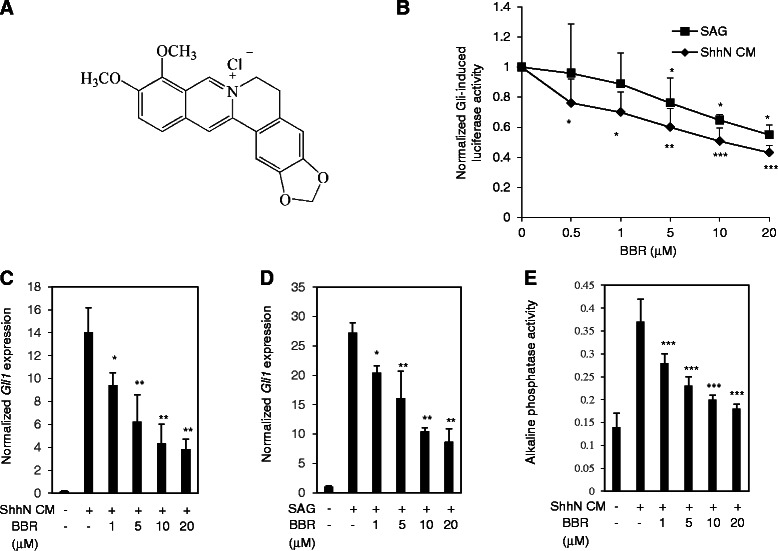
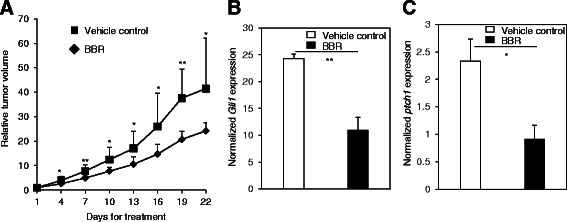
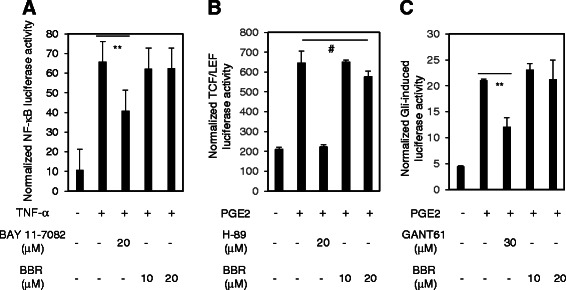
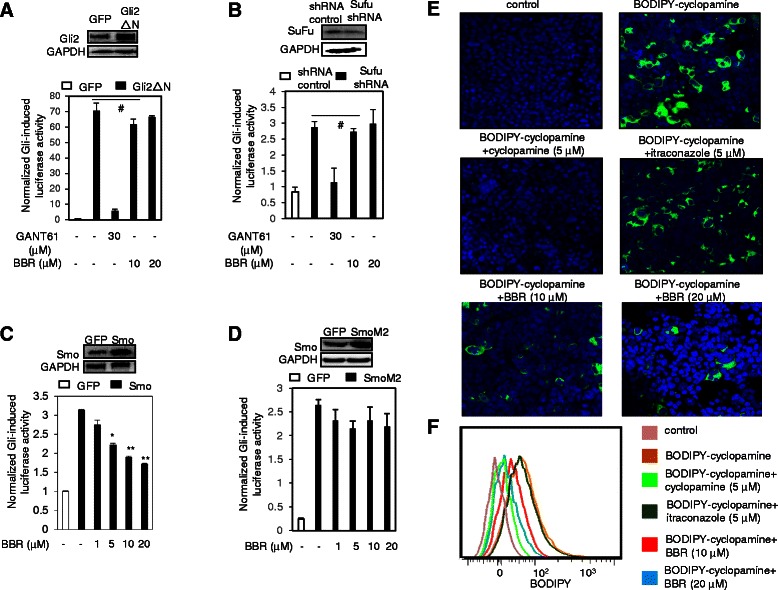
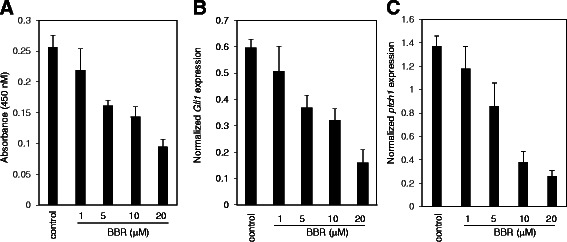
In this study, we found that BBR significantly inhibited the Hh pathway activity. Meanwhile, we observed that BBR failed to affect the transcriptional factors activities provoked by tumor necrosis factor-α (TNF-α) and Prostaglandin E2 (PGE2), thus suggesting its unique property against Hh pathway activity. Further studies revealed that BBR inhibited the Hh pathway activity by potentially targeting the critical component Smoothened (Smo) and most likely shared the same binding site on Smo with cyclopamine, a classical Smo inhibitor. Finally, we demonstrated that BBR obviously suppressed the Hh-dependent medulloblastoma growth in vitro and in vivo.
Collectively, our study uncovered a novel molecular mechanism responsible for the anticancer action of BBR, thus opening the way for the usage of BBR for therapeutics of cancers addiction to aberrant Hh pathway activity.
黄连素(BBR)是一种天然生物碱化合物,在中国作为非处方药用于治疗腹泻和肠胃炎。许多研究表明BBR具有抗癌作用。然而,其抗癌作用的分子机制尚未完全阐明。本研究旨在确定BBR对刺猬信号通路(Hh)活性以及依赖Hh活性的肿瘤生长的影响。
通过双荧光素酶测定和定量RT-PCR分析来确定Hh活性。通过5-溴-2-脱氧尿苷(Brdu)测定以及将髓母细胞瘤移植到裸鼠体内,分析BBR对从ptch+/-;p53-/-小鼠获得的髓母细胞瘤的生长抑制作用。数据采用单因素方差分析(ANOVA)进行统计学分析,组间多重比较采用Dunnett法。
在本研究中,我们发现BBR显著抑制Hh信号通路活性。同时,我们观察到BBR不影响由肿瘤坏死因子-α(TNF-α)和前列腺素E2(PGE2)引发的转录因子活性,这表明其对Hh信号通路活性具有独特作用。进一步研究表明,BBR可能通过靶向关键成分 smoothened(Smo)来抑制Hh信号通路活性,并且很可能与经典的Smo抑制剂环杷明在Smo上具有相同的结合位点。最后,我们证明BBR在体外和体内均明显抑制依赖Hh的髓母细胞瘤生长。
总体而言,我们的研究揭示了BBR抗癌作用的一种新的分子机制,从而为将BBR用于治疗依赖异常Hh信号通路活性的癌症开辟了道路。