Hanbang Cardio‑Renal Syndrome Research Center, Wonkwang University, Iksan, Jeonbuk 54538, Republic of Korea.
Division of Beauty Sciences, School of Natural Sciences, Wonkwang University, Iksan, Jeonbuk 54538, Republic of Korea.
Mol Med Rep. 2020 Jan;21(1):258-266. doi: 10.3892/mmr.2019.10823. Epub 2019 Nov 19.
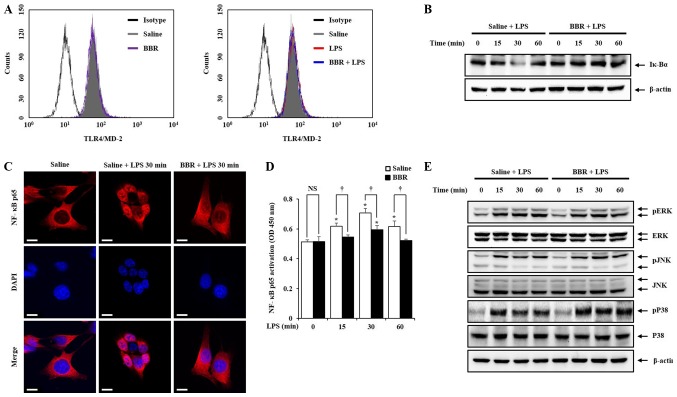
The major role of inner medullary collecting duct (IMCD) cells is to maintain water and sodium homeostasis. In addition to the major role, it also participates in the protection of renal and systemic inflammation. Although IMCD cells could take part in renal and systemic inflammation, investigations on renal inflammation in IMCD cells have rarely been reported. Although berberine (BBR) has been reported to show diverse pharmacological effects, its anti‑inflammatory and protective effects on IMCD cells have not been studied. Therefore, in the present study, we examined the anti‑inflammatory and protective effects of BBR in mouse IMCD‑3 (mIMCD‑3) cells against lipopolysaccharide (LPS). An MTT assay was carried out to investigate the toxicity of BBR on mIMCD‑3 cells. Reverse transcription quantitative‑PCR and western blotting were performed to analysis pro‑inflammatory molecules and cytokines. Mechanisms of BBR were examined by western blotting and immunocytochemistry. According to previous studies, pro‑inflammatory molecules, such as inducible nitric oxide synthase and cyclooxygenase‑2, and pro‑inflammatory cytokines, such as interleukin (IL)‑1β, IL‑6 and tumor necrosis factor‑α are increased in LPS‑exposed mIMCD‑3 cells. However, the production of these pro‑inflammatory molecules is significantly inhibited by treatment with BBR. In addition, BBR inhibited translocation of nuclear factor (NF)‑κB p65 from the cytosol to the nucleus, and degradation of inhibitory κ‑Bα in LPS‑exposed mIMCD‑3 cells. In conclusion, BBR could inhibit renal inflammatory responses via inhibition of NF‑κB signaling and ultimately contribute to amelioration of renal injury during systemic inflammation.
内髓集合管(IMCD)细胞的主要作用是维持水和钠的体内平衡。除了主要作用外,它还参与肾脏和全身炎症的保护。尽管 IMCD 细胞可以参与肾脏和全身炎症,但对 IMCD 细胞中肾脏炎症的研究很少。尽管小檗碱(BBR)已被报道具有多种药理作用,但尚未研究其对 IMCD 细胞的抗炎和保护作用。因此,在本研究中,我们研究了 BBR 对脂多糖(LPS)诱导的小鼠 IMCD-3(mIMCD-3)细胞的抗炎和保护作用。通过 MTT 分析检测 BBR 对 mIMCD-3 细胞的毒性。通过逆转录定量 PCR 和 Western blot 分析促炎分子和细胞因子。通过 Western blot 和免疫细胞化学分析 BBR 的作用机制。根据先前的研究,在 LPS 暴露的 mIMCD-3 细胞中,促炎分子,如诱导型一氧化氮合酶和环氧化酶-2,以及促炎细胞因子,如白细胞介素(IL)-1β、IL-6 和肿瘤坏死因子-α,均增加。然而,用 BBR 处理可显著抑制这些促炎分子的产生。此外,BBR 抑制了 LPS 暴露的 mIMCD-3 细胞中核因子(NF)-κB p65 从细胞质向细胞核的易位,以及抑制κBα的降解。综上所述,BBR 通过抑制 NF-κB 信号通路抑制肾脏炎症反应,从而有助于改善全身炎症期间的肾脏损伤。