Johnson Tammie M, Richards Jennifer, Churilla James R
University of North Florida, Department of Public Health, Brooks College of Health, Jacksonville, FL.
University of North Florida, Department of Clinical and Applied Movement Science, Brooks College of Health, Jacksonville, FL.
Diabetes Spectr. 2015 Aug;28(3):193-200. doi: 10.2337/diaspect.28.3.193.
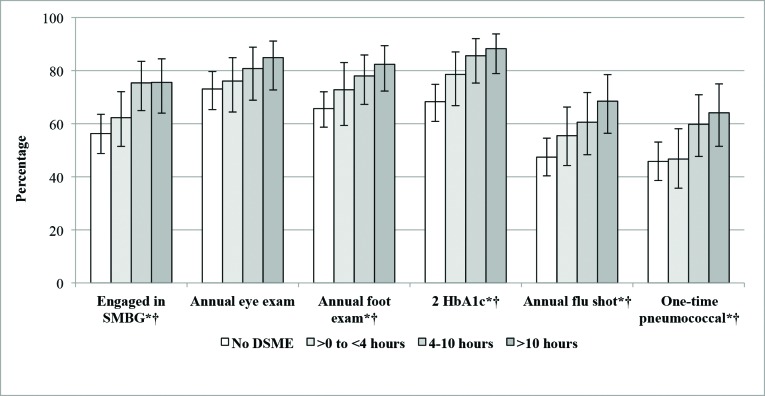
Objective. Previous studies have shown that receiving diabetes self-management education (DSME) is associated with increased care utilization. However, the relationship between DSME duration and care utilization patterns remains largely unexamined. Our purpose is to characterize DSME duration and examine the relationship between DSME duration and clinical- and self-care utilization patterns. Methods. The study sample included 1,446 adults who were ≥18 years of age, had diabetes, and had participated in the 2008 Florida Behavioral Risk Factor Surveillance System survey. Clinical- and self-care outcomes were derived using responses to the survey's diabetes module and were based on minimum standards of care established by the American Diabetes Association. The outcomes examined included self-monitoring of blood glucose at least once per day; receiving at least one eye exam, one foot exam, A1C tests, and an influenza vaccination in the past year; and ever receiving a pneumococcal vaccination. DSME duration was categorized as no DSME, >0 to <4 hours, 4-10 hours, and >10 hours. Results. After adjusting for sociodemographic variables, compared to those who did not receive DSME, those who had 4-10 or 10+ hours of DSME were more likely to receive two A1C tests (odds ratio [95% CI] 2.69 [1.30-5.58] and 2.63 [1.10-6.31], respectively) and have a pneumococcal vaccination (1.98 [1.03-3.80] and 1.92 [1.01-3.64], respectively). Those receiving 10+ hours of DSME were 2.2 times (95% CI 1.18-4.09) as likely to have an influenza vaccination. Conclusion. These data reveal a positive relationship between DSME duration and utilization of some diabetes clinical care services.
目的。以往研究表明,接受糖尿病自我管理教育(DSME)与医疗服务利用率提高有关。然而,DSME时长与医疗服务利用模式之间的关系在很大程度上仍未得到研究。我们的目的是描述DSME时长特征,并研究DSME时长与临床及自我护理利用模式之间的关系。方法。研究样本包括1446名年龄≥18岁、患有糖尿病且参与了2008年佛罗里达行为危险因素监测系统调查的成年人。临床和自我护理结果通过对调查中糖尿病模块的回答得出,并基于美国糖尿病协会制定的最低护理标准。所检查的结果包括每天至少进行一次血糖自我监测;在过去一年中接受至少一次眼科检查、一次足部检查、糖化血红蛋白(A1C)检测和流感疫苗接种;以及是否曾接受肺炎球菌疫苗接种。DSME时长分为未接受DSME、>0至<4小时、4 - 10小时和>10小时。结果。在对社会人口统计学变量进行调整后,与未接受DSME的人相比,接受4 - 10小时或10小时以上DSME的人更有可能接受两次A1C检测(优势比[95%置信区间]分别为2.69[1.30 - 5.58]和2.63[1.10 - 6.31])以及接种肺炎球菌疫苗(分别为1.98[1.03 - 3.80]和1.92[1.01 - 3.64])。接受10小时以上DSME的人接种流感疫苗的可能性是未接受者的2.2倍(95%置信区间1.18 - 4.09)。结论。这些数据揭示了DSME时长与某些糖尿病临床护理服务利用之间的正相关关系。