
咖啡摄入量与子宫内膜癌风险:前瞻性队列研究的剂量反应荟萃分析
Coffee consumption and risk of endometrial cancer: a dose-response meta-analysis of prospective cohort studies.
作者信息
Zhou Quan, Luo Mei-Ling, Li Hui, Li Min, Zhou Jian-Guo
机构信息
Department of Science and Education, First People's Hospital of Changde City, Changde 415003, Hunan, People's Republic of China.
Changsha Center for Disease Control and Prevention, Changsha 410001, Hunan, People's Republic of China.
出版信息
Sci Rep. 2015 Aug 25;5:13410. doi: 10.1038/srep13410.
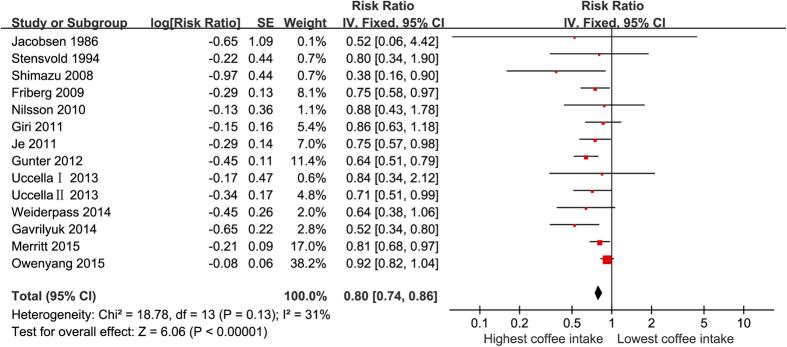
This is a dose-response (DR) meta-analysis to evaluate the association of coffee consumption on endometrial cancer (EC) risk. A total 1,534,039 participants from 13 published articles were added in this meta-analysis. The RR of total coffee consumption and EC were 0.80 (95% CI: 0.74-0.86). A stronger association between coffee intake and EC incidence was found in patients who were never treated with hormones, 0.60 (95% CI: 0.50-0.72), and subjects with a BMI ≥25 kg/m(2), 0.57 (95% CI: 0.46-0.71). The overall RRs for caffeinated and decaffeinated coffee were 0.66 (95% CI: 0.52-0.84) and 0.77 (95% CI: 0.63-0.94), respectively. A linear DR relationship was seen in coffee, caffeinated coffee, decaffeinated coffee and caffeine intake. The EC risk decreased by 5% for every 1 cup per day of coffee intake, 7% for every 1 cup per day of caffeinated coffee intake, 4% for every 1 cup per day of decaffeinated intake of coffee, and 4% for every 100 mg of caffeine intake per day. In conclusion, coffee and intake of caffeine might significantly reduce the incidence of EC, and these effects may be modified by BMI and history of hormone therapy.
这是一项剂量反应(DR)荟萃分析,旨在评估咖啡消费与子宫内膜癌(EC)风险之间的关联。本荟萃分析纳入了13篇已发表文章中的总共1,534,039名参与者。总咖啡消费量与EC的风险比(RR)为0.80(95%置信区间:0.74 - 0.86)。在从未接受过激素治疗的患者中,发现咖啡摄入量与EC发病率之间存在更强的关联,RR为0.60(95%置信区间:0.50 - 0.72),在体重指数(BMI)≥25 kg/m²的受试者中,RR为0.57(95%置信区间:0.46 - 0.71)。含咖啡因咖啡和脱咖啡因咖啡的总体RR分别为0.66(95%置信区间:0.52 - 0.84)和0.77(95%置信区间:0.63 - 0.94)。在咖啡、含咖啡因咖啡、脱咖啡因咖啡和咖啡因摄入量方面均观察到线性剂量反应关系。每天每多摄入1杯咖啡,EC风险降低5%;每天每多摄入1杯含咖啡因咖啡,EC风险降低7%;每天每多摄入1杯脱咖啡因咖啡,EC风险降低4%;每天每多摄入100毫克咖啡因,EC风险降低4%。总之,咖啡和咖啡因摄入可能会显著降低EC的发病率,并且这些影响可能会因BMI和激素治疗史而有所改变。




 Zotero 插件