Yao Haipeng, Li Lamei, Wang Xiabo, Wang Zhongqun
Department of Cardiology, Affiliated Hospital of Jiangsu University, Zhenjiang, China.
Institute of Cardiovascular Diseases, Jiangsu University, Zhenjiang, China.
Diabetol Metab Syndr. 2024 Jul 26;16(1):177. doi: 10.1186/s13098-024-01417-6.
The association between caffeine intake and mortality in prediabetes and diabetes is not well defined. This study was designed to investigate the association between caffeine intake and all-cause mortality and cardiovascular disease (CVD) mortality in adults with prediabetes and diabetes in the United States.
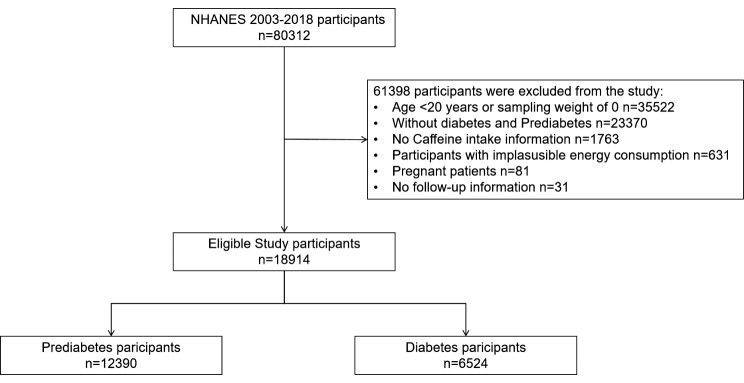
This analysis included 18,914 adult patients with diabetes and prediabetes from the National Health and Nutrition Examination Survey (NHANES) 2003-2018. Follow-up extended to December 31, 2019. Weighted Cox proportional hazards regression models were used to estimate the hazard ratios (HR) and 95% confidence intervals (CI) for all-cause mortality and CVD mortality.
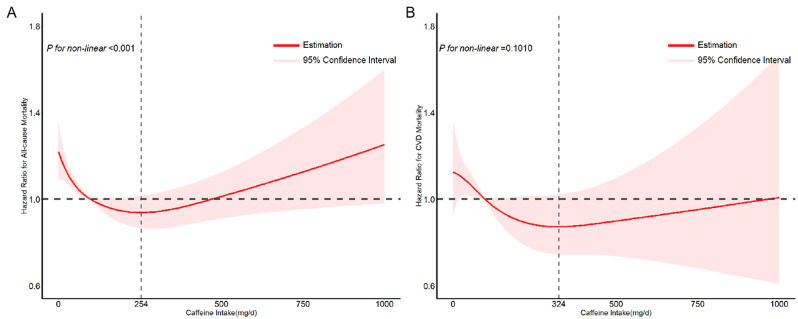
During 142,460 person-years of follow-up, there were 3,166 cases of all-cause mortality and 1,031 cases of CVD mortality recorded. In the fully adjusted models, caffeine intake showed a significant dose-response association with the risk of all-cause mortality and CVD mortality in individuals with diabetes and prediabetes. When comparing extreme quartiles of caffeine intake, the multivariable-adjusted hazard ratio for all-cause mortality was 0.78 (0.67-0.91) (P for trend = 0.007); however, there was no significant association with the risk of CVD mortality. Results remained consistent in stratified analyses by sex, age, race/ethnicity, education level, family income-poverty ratio, BMI, hypertension, smoking status, alcohol intake, and HEI-2015.
This study suggests that caffeine intake is significantly inversely associated with the risk of all-cause mortality in individuals with diabetes and prediabetes. In individuals with prediabetes, there is also a significant inverse association between caffeine intake and CVD events, but this association is not present in those with diabetes.
在糖尿病前期和糖尿病患者中,咖啡因摄入量与死亡率之间的关联尚不明确。本研究旨在调查美国糖尿病前期和糖尿病成年患者中咖啡因摄入量与全因死亡率及心血管疾病(CVD)死亡率之间的关联。
本分析纳入了2003 - 2018年美国国家健康与营养检查调查(NHANES)中的18914例糖尿病和糖尿病前期成年患者。随访至2019年12月31日。采用加权Cox比例风险回归模型估计全因死亡率和CVD死亡率的风险比(HR)及95%置信区间(CI)。
在142460人年的随访期间,记录到3166例全因死亡病例和1031例CVD死亡病例。在完全调整模型中,咖啡因摄入量与糖尿病和糖尿病前期个体的全因死亡率及CVD死亡率风险呈显著的剂量反应关系。比较咖啡因摄入量的极端四分位数时,全因死亡率的多变量调整风险比为0.78(0.67 - 0.91)(趋势P值 = 0.007);然而,与CVD死亡率风险无显著关联。在按性别、年龄、种族/民族、教育水平、家庭收入 - 贫困率、BMI、高血压、吸烟状况、酒精摄入量和HEI - 2015进行的分层分析中,结果保持一致。
本研究表明,咖啡因摄入量与糖尿病和糖尿病前期个体的全因死亡率风险显著负相关。在糖尿病前期个体中,咖啡因摄入量与CVD事件之间也存在显著的负相关,但在糖尿病患者中不存在这种关联。