Rana Zaker, Hong Robert L, Abugideiri Mustafa, McRae Donald, Cernica George, Mordkin Robert, Joel Andrew B, Bernstein Gregory, Nasr Nadim M
Department of Radiation Oncology Medicine, Virginia Hospital Center, 1701 N George Mason Dr, Arlington, VA 22205, USA.
Radiat Oncol. 2015 Aug 28;10:182. doi: 10.1186/s13014-015-0488-3.
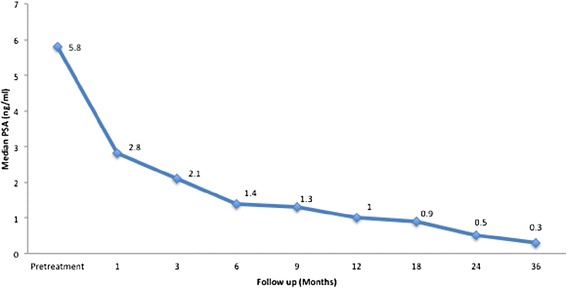
Urinary symptoms and sexual dysfunction are the two most common complaints following prostate radiotherapy. The impact of hypofractionated treatment on sexual function, irritative symptoms, and voiding symptoms has not been determined within the same patient population. Here we present our institutional data on sexual function, voiding function, irritative symptoms, and treatment response following SBRT.
This retrospective analysis includes 102 non-metastatic patients treated with SBRT at a single institution between May 2008 and September 2014. The course of radiotherapy consisted of 36.25 Gy (range 35-40) over five daily fractions. International Prostate Symptom Score (IPSS), Sexual Health Inventory for Men (SHIM), and PSA were recorded at baseline, 1, 3, 6, 9, 12, 18, 24, and 36 months after treatment.
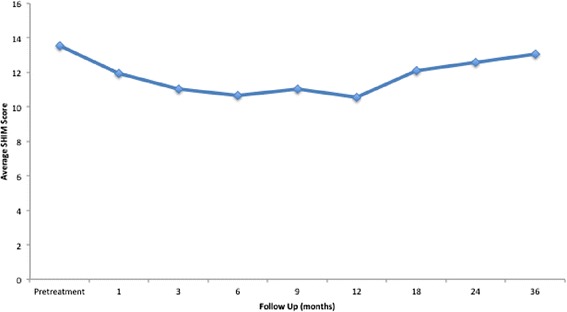
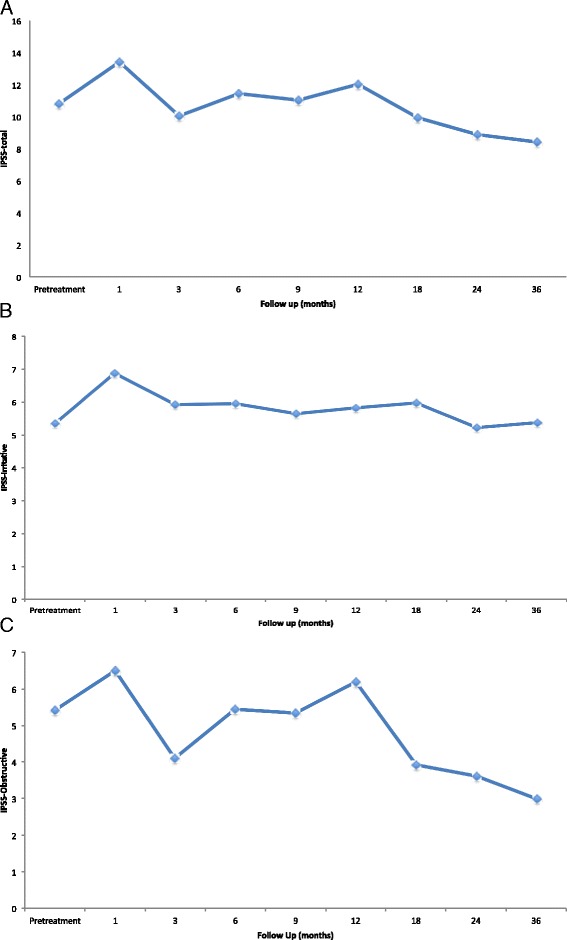
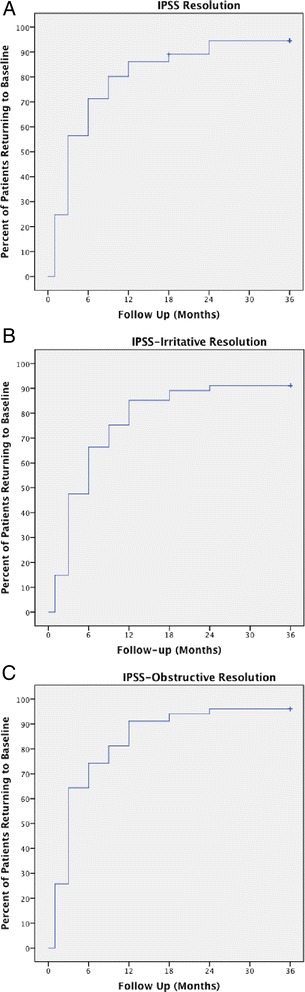
Median patient age was 72 years old with a median follow-up of 4.3 years. Pretreatment IPSS-I score was 5.21, increasing to 6.97 (p < .001) after 1 month. The mean IPSS-I score returned close to baseline after 3 months to 5.86 and decreased to below baseline after 2 years to 5.09. At 3 months, 9 months, and 2 years, 47.5, 76.2, and 91.1% of patients had reached IPSS-I resolution. The mean IPSS-O score prior to treatment was 5.31 and there was an increase in the score to 6.45 (p = 0.344) at 1 month. The score remained close to baseline and decreased to 4.00 at 2 years and significantly decreased to 3.74 (p = 0.035) at 3 years. 64.4, 82.1, and 96.0% of patients had IPSS-O resolution by 3 months, 9 months, and 2 years. The mean SHIM score prior to treatment was 13.52 and continually decreased to below baseline a year after treatment to 10.56 (p < .001). SHIM score began to improve at 18 months, but was still significantly less than baseline at 12.12 (p = .01).
While an increase in AUA/IPSS score initially occurred, all patients resume normal activities immediately following treatment and the AUA/IPSS symptoms improved from baseline. Irittative symptoms take longer to resolve when compared to obstructive voiding symptoms in patients treated with SBRT. Three year PSA response, reported toxicity, erectile function preservation, and urinary function improvement, shows favorable results.
尿路症状和性功能障碍是前列腺放疗后最常见的两种主诉。在同一患者群体中,尚未确定大分割治疗对性功能、刺激性症状和排尿症状的影响。在此,我们展示了我们机构关于立体定向体部放疗(SBRT)后性功能、排尿功能、刺激性症状及治疗反应的数据。
这项回顾性分析纳入了2008年5月至2014年9月期间在单一机构接受SBRT治疗的102例非转移性患者。放疗疗程为5个每日分次,总剂量36.25Gy(范围35 - 40Gy)。在治疗前、治疗后1、3、6、9、12、18、24和36个月记录国际前列腺症状评分(IPSS)、男性性健康量表(SHIM)和前列腺特异性抗原(PSA)。
患者中位年龄为72岁,中位随访时间为4.3年。治疗前IPSS - I评分是5.21,1个月后升至6.97(p < 0.001)。3个月后平均IPSS - I评分接近基线至5.86,2年后降至基线以下至5.09。在3个月、9个月和2年时,分别有47.5%、76.2%和91.1%的患者达到IPSS - I症状缓解。治疗前IPSS - O评分平均为5.31,1个月时升至6.45(p = 0.344)。该评分在2年时仍接近基线并降至4.00,3年时显著降至3.74(p = 0.035)。在3个月、9个月和2年时,分别有64.4%、82.1%和96.0%的患者达到IPSS - O症状缓解。治疗前SHIM评分平均为13.52,治疗1年后持续降至基线以下至10.56(p < 0.001)。SHIM评分在18个月时开始改善,但在12.12时仍显著低于基线(p = 0.01)。
虽然最初AUA/IPSS评分有所升高,但所有患者在治疗后立即恢复正常活动,且AUA/IPSS症状较基线有所改善。与接受SBRT治疗的患者的梗阻性排尿症状相比,刺激性症状缓解所需时间更长。三年的PSA反应、报告的毒性、勃起功能保留及排尿功能改善均显示出良好结果。