Fwu Peter T, Chen Jeon-Hor, Li Yifan, Chan Siwa, Su Min-Ying
Center for Functional Onco-Imaging, Department of Radiological Sciences, University of California, Irvine, CA, USA.
Center for Functional Onco-Imaging, Department of Radiological Sciences, University of California, Irvine, CA, USA; Department of Radiology, E-Da Hospital and I-Shou University, Kaohsiung, Taiwan.
Transl Oncol. 2015 Aug;8(4):250-7. doi: 10.1016/j.tranon.2015.04.005.
This study presented a three-dimensional magnetic resonance (MR)-based method to separate a breast into four quadrants for quantitative measurements of the quadrant breast volume (BV) and density.
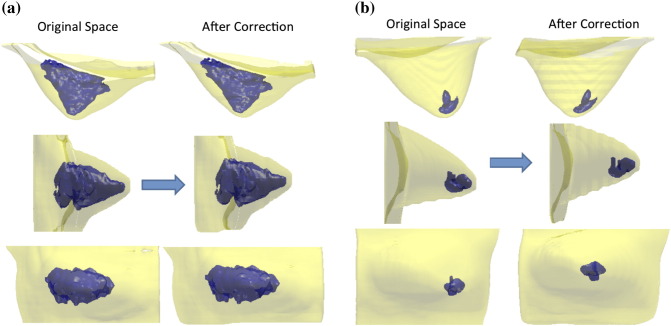
Breast MR images from 58 healthy women were studied. The breast and the fibroglandular tissue were segmented by using a computer-based algorithm. A breast was divided into four quadrants using two perpendicular planes intersecting at the nipple or the nipple-centroid line. After the separation, the BV, the fibroglandular tissue volume, and the percent density (PD) were calculated. The symmetry of the quadrant BV in the left and right breasts separated by using the nipple alone, or the nipple-centroid line, was compared.
The quadrant separation made on the basis of the nipple-centroid line showed closer BVs in four quadrants than using the nipple alone. The correlation and agreement for the BV in corresponding quadrants of the left and the right breasts were improved after the nipple-centroid reorientation. Among the four quadrants, PD was the highest in the lower outer and the lowest in the upper outer (significant than the other three) quadrants (P < .05).
We presented a quantitative method to divide a breast into four quadrants. The reorientation based on the nipple-centroid line improved the left to right quadrant symmetry, and this may provide a better standardized method to measure quantitative quadrant density. The cancer occurrence rates are known to vary in different sites of a breast, and our method may provide a tool for investigating its association with the quantitative breast density.
本研究提出了一种基于三维磁共振(MR)的方法,将乳房分为四个象限,以定量测量象限乳房体积(BV)和密度。
对58名健康女性的乳房MR图像进行研究。使用基于计算机的算法对乳房和纤维腺体组织进行分割。通过两个在乳头或乳头-质心线处相交的垂直平面将乳房分为四个象限。分割后,计算BV、纤维腺体组织体积和百分比密度(PD)。比较仅使用乳头或乳头-质心线分割的左右乳房象限BV的对称性。
基于乳头-质心线进行的象限分割显示,四个象限中的BV比仅使用乳头时更接近。乳头-质心重新定位后,左右乳房相应象限中BV的相关性和一致性得到改善。在四个象限中,PD在乳房外下象限最高,在上外象限最低(显著低于其他三个象限)(P <.05)。
我们提出了一种将乳房分为四个象限的定量方法。基于乳头-质心线的重新定位改善了左右象限的对称性,这可能为测量定量象限密度提供更好的标准化方法。已知乳腺癌发生率在乳房的不同部位有所不同,我们的方法可能为研究其与定量乳房密度的关联提供一种工具。