Cooper Sally-Ann, McLean Gary, Guthrie Bruce, McConnachie Alex, Mercer Stewart, Sullivan Frank, Morrison Jill
Mental Health and Wellbeing group, Institute of Health and Wellbeing, University of Glasgow, Administrative Building, Gartnavel Royal Hospital, 1055 Great Western Road, Glasgow, G12 0XH, UK.
General Practice and Primary Care group, Institute of Health and Wellbeing, University of Glasgow, 1, Horselethill Road, Glasgow, G12 9LX,, UK.
BMC Fam Pract. 2015 Aug 27;16:110. doi: 10.1186/s12875-015-0329-3.
Adults with intellectual disabilities have increased early mortality compared with the general population. However, their extent of multimorbidity (two or more additional conditions) compared with the general population is unknown, particularly with regards to physical ill-health, as are associations between comorbidities, neighbourhood deprivation, and age.
We analysed primary health-care data on 1,424,378 adults registered with 314 representative Scottish practices. Data on intellectual disabilities, 32 physical, and six mental health conditions were extracted. We generated standardised prevalence rates by age-groups, gender, and neighbourhood deprivation, then calculated odds ratio (OR) and 95 % confidence intervals (95 % CI) for adults with intellectual disabilities compared to those without, for the prevalence, and number of condition.
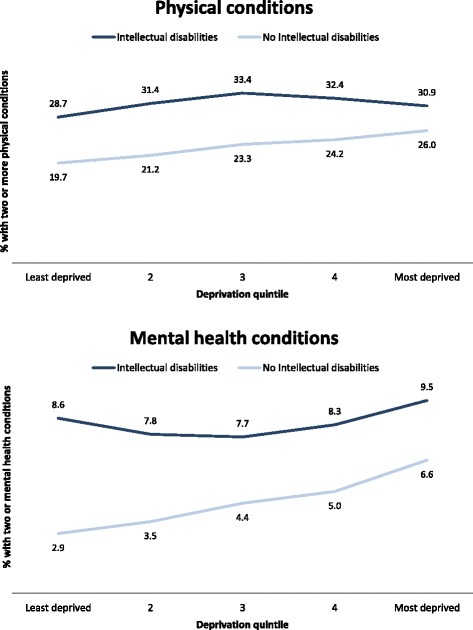
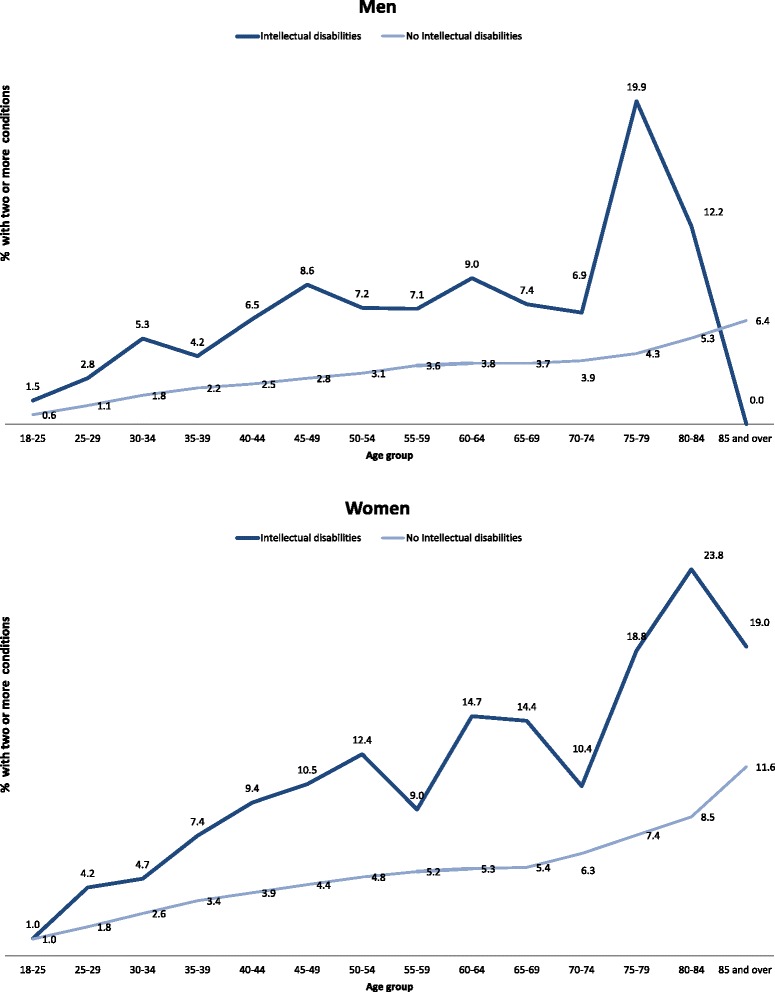
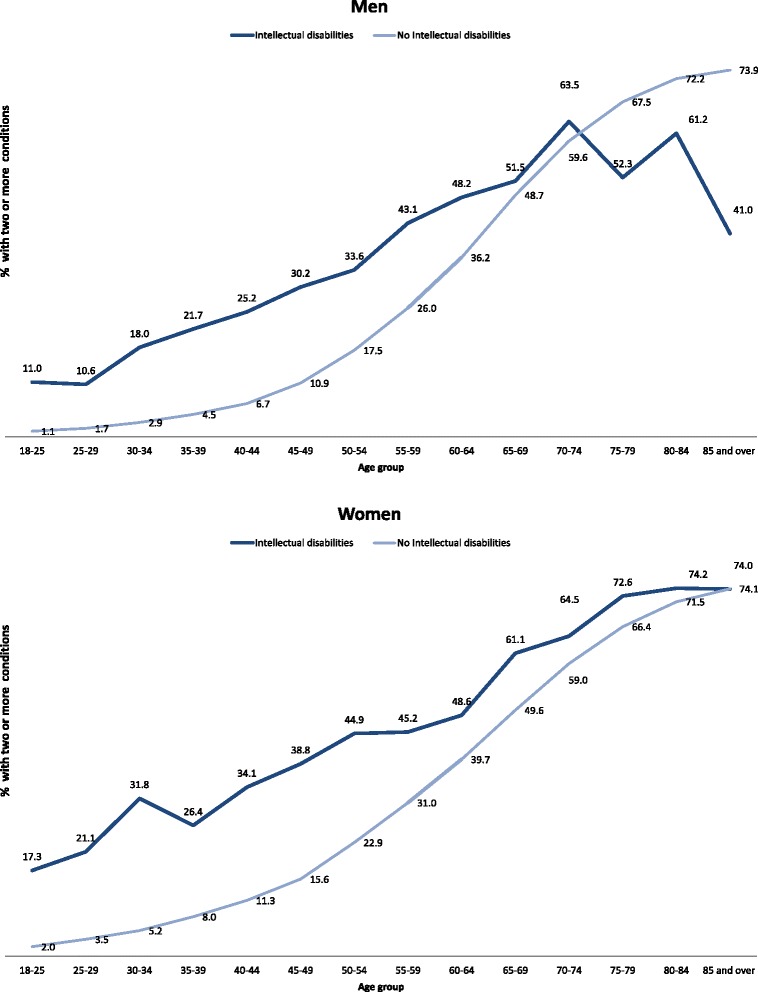
Eight thousand fourteen (0.56 %) had intellectual disabilities, of whom only 31.8 % had no other conditions compared to 51.6 % without intellectual disabilities (OR 0.26, 95 % 0.25-0.27). The intellectual disabilities group were significantly more likely to have more conditions, with the biggest difference found for three conditions (10.9 % versus 6.8 %; OR 2.28, 95 % CI 2.10-2.46). Fourteen physical conditions were significantly more prevalent, and four cardiovascular conditions occurred less frequently, as did any cancers, and chronic obstructive pulmonary diseases. Five of the six mental health conditions were significantly more prevalent. For the adults with intellectual disabilities, no gradient was seen in extent of multimorbidity with increasing neighbourhood deprivation; indeed findings were similar in the most affluent and most deprived areas. Co-morbidity increased with age but is highly prevalent at all ages, being similar at age 20-25 to 50-54 year olds in the general population.
Multi-morbidity burden is greater, occurs at much earlier age, and the profile of health conditions differs, for adults with intellectual disabilities compared with the general population. There is no association with neighbourhood deprivation; people with intellectual disabilities need focussed services irrespective of where they live, and at a much earlier age than the general population. They require specific initiatives to reduce inequalities.
与普通人群相比,成年智障者的早期死亡率更高。然而,与普通人群相比,他们的多种疾病并存(两种或更多其他病症)程度尚不清楚,尤其是在身体健康方面,共病、邻里贫困和年龄之间的关联也不清楚。
我们分析了在苏格兰314家具有代表性的医疗机构注册的1,424,378名成年人的初级医疗保健数据。提取了有关智障、32种身体疾病和6种心理健康状况的数据。我们按年龄组、性别和邻里贫困程度生成了标准化患病率,然后计算了有智障成年人与无智障成年人在患病率和病症数量方面的比值比(OR)和95%置信区间(95%CI)。
8014人(0.56%)患有智障,其中只有31.8%没有其他病症,而无智障者这一比例为51.6%(OR 0.26,95% 0.25 - 0.27)。智障组更有可能患有更多病症,三种病症的差异最为明显(10.9%对6.8%;OR 2.28,95%CI 2.10 - 2.46)。14种身体疾病的患病率显著更高,4种心血管疾病以及所有癌症和慢性阻塞性肺疾病的患病率较低。6种心理健康状况中有5种的患病率显著更高。对于患有智障的成年人,多种疾病并存的程度并未随邻里贫困程度的增加而呈现出梯度变化;事实上,在最富裕和最贫困地区的结果相似。共病率随年龄增长而增加,但在所有年龄段都非常普遍,在20 - 25岁年龄段与普通人群中50 - 54岁年龄段相似。
与普通人群相比,成年智障者的多种疾病并存负担更重,发病年龄更早,健康状况的特征也不同。与邻里贫困无关;智障者无论居住何处,都需要针对性的服务,且比普通人群的年龄要早得多。他们需要采取具体举措来减少不平等现象。