Yu Dan-Dan, Jing Ying-Ying, Guo Shi-Wei, Ye Fei, Lu Wen, Li Quan, Dong Yu-Long, Gao Lu, Yang Yu-Ting, Yang Yang, Wu Meng-Chao, Wei Li-Xin
Tumor Immunology and Gene Therapy Center, Eastern Hepatobiliary Surgery Hospital, The Second Military Medical University, Shanghai, China.
Department of Comprehensive Treatment, Eastern Hepatobiliary Surgery Hospital, The Second Military Medical University, Shanghai, China.
Sci Rep. 2015 Aug 27;5:13319. doi: 10.1038/srep13319.
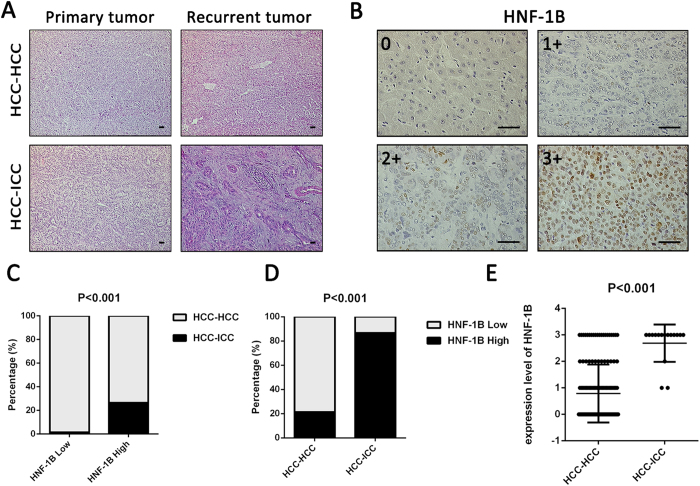
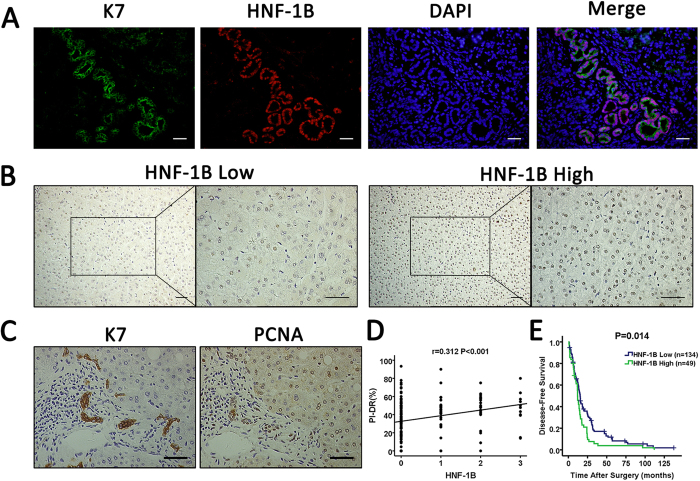
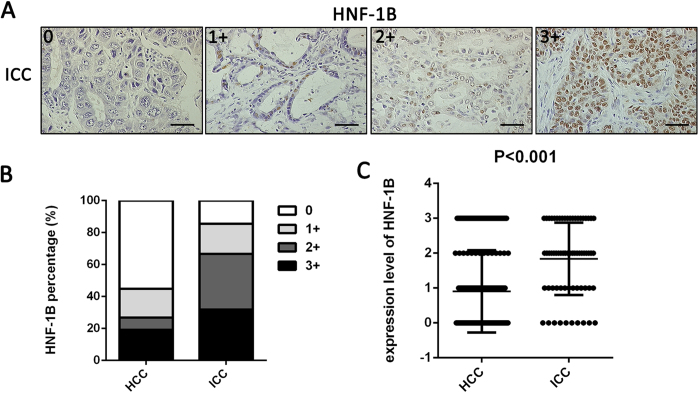
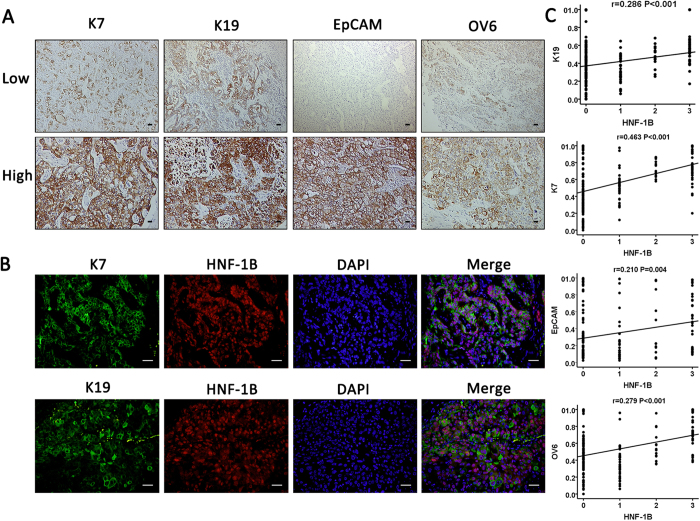
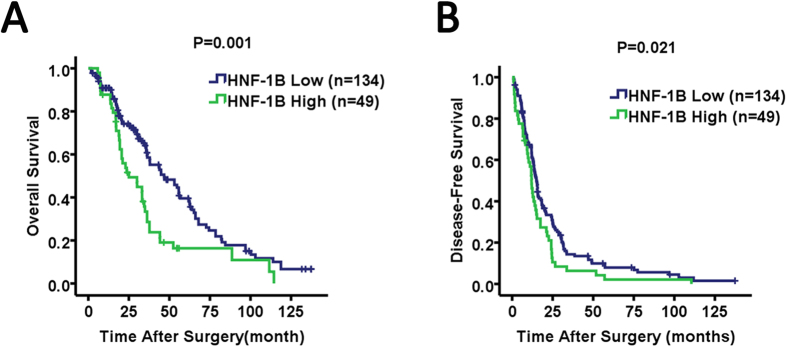
Hepatocyte nuclear factor-1beta (HNF-1B) is involved in the hepatobiliary specification of hepatoblasts to cholangiocytes during liver development, and is strongly expressed throughout adult biliary epithelium. The aim of this study was to examine the expression of HNF-1B in different pathologic subtypes of primary liver cancer, including hepatocellular carcinoma (HCC) and cholangiocarcinoma (ICC), and the relationship between HNF-1B expression, clinicopathological features and prognosis. We retrospectively investigated 2 cohorts of patients, including 183 HCCs and 69 ICCs. The expression of HNF-1B was examined by immunohistochemistry. We found that HNF-1B expression was associated with pathological subtype of primary tumor, and HNF-1B expression in HCC tissue may be associated with the change of phenotype on recurrence. The HNF-1B expression was positively correlated with biliary/HPC (hepatic progenitor cell) markers expression. Further, multivariable analysis showed that HNF-1B expression was an independent prognostic factor for both overall survival and disease-free survival of HCC patients. However, no correlation between HNF-1B expression and survival was found in ICC patients. In summary, HCC with high HNF-1B expression displayed biliary phenotype and tended to show poorer prognosis. HNF-1B-positive malignant cells could be bipotential cells and give rise to both hepatocytic and cholangiocytic lineages during tumorigenesis.
肝细胞核因子-1β(HNF-1B)在肝脏发育过程中参与肝母细胞向胆管细胞的肝胆定向分化,且在整个成人胆管上皮中强烈表达。本研究旨在检测HNF-1B在原发性肝癌不同病理亚型(包括肝细胞癌(HCC)和胆管癌(ICC))中的表达情况,以及HNF-1B表达与临床病理特征和预后之间的关系。我们回顾性研究了2组患者,包括183例HCC患者和69例ICC患者。通过免疫组织化学检测HNF-1B的表达。我们发现HNF-1B表达与原发性肿瘤的病理亚型相关,HCC组织中HNF-1B表达可能与复发时的表型改变有关。HNF-1B表达与胆管/肝祖细胞(HPC)标志物表达呈正相关。此外,多变量分析显示,HNF-1B表达是HCC患者总生存和无病生存的独立预后因素。然而,在ICC患者中未发现HNF-1B表达与生存之间的相关性。总之,HNF-1B高表达的HCC表现出胆管表型,且预后往往较差。HNF-1B阳性恶性细胞可能是双潜能细胞,在肿瘤发生过程中可产生肝细胞和胆管细胞系。