Thompson Jeremy M, Ji Guangchen, Neugebauer Volker
Department of Pharmacology and Neuroscience, School of Medicine, Texas Tech University Health Sciences Center, 3601 4th St, Lubbock, TX, 79430-6592, USA.
Center of Excellence for Translational Neuroscience and Therapeutics, Texas Tech University Health Sciences Center, Lubbock, TX, USA.
Mol Pain. 2015 Aug 28;11:51. doi: 10.1186/s12990-015-0055-9.
Arthritis pain is an important healthcare issue with significant emotional and affective consequences. Here we focus on potentially beneficial effects of activating small-conductance calcium-activated potassium (SK) channels in the amygdala, a brain center of emotions that plays an important role in central pain modulation and processing. SK channels have been reported to regulate neuronal activity in the central amygdala (CeA, output nucleus). We tested the effects of riluzole, a clinically available drug for the treatment of amyotrophic lateral sclerosis, for the following reasons. Actions of riluzole include activation of SK channels. Evidence in the literature suggests that riluzole may have antinociceptive effects through an action in the brain but not the spinal cord. Mechanism and site of action of riluzole remain to be determined. Here we tested the hypothesis that riluzole inhibits pain behaviors by acting on SK channels in the CeA in an arthritis pain model.
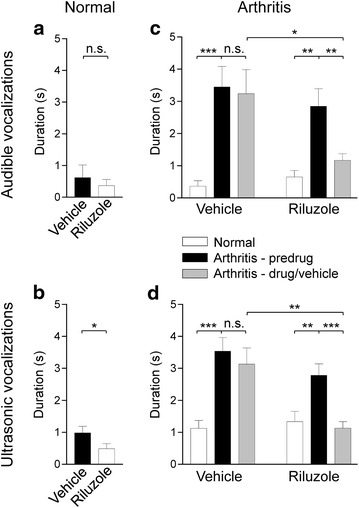
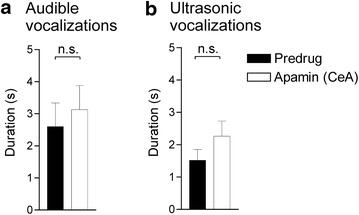
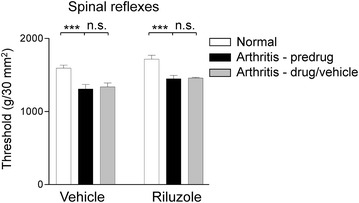
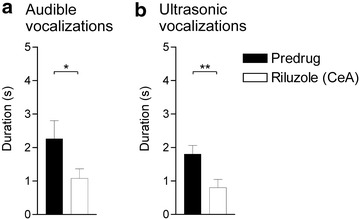
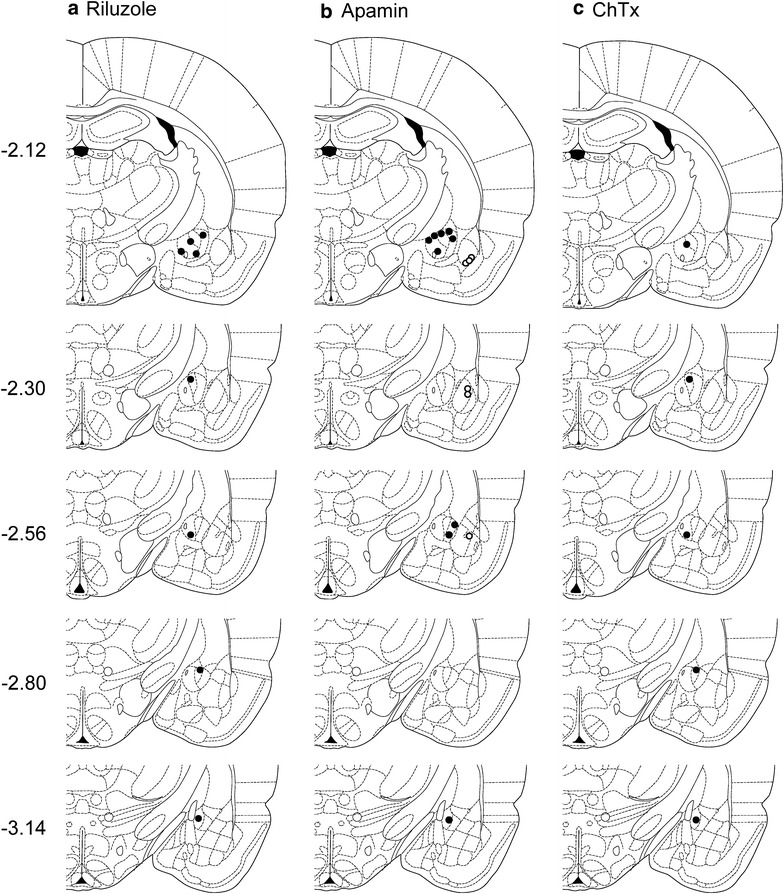
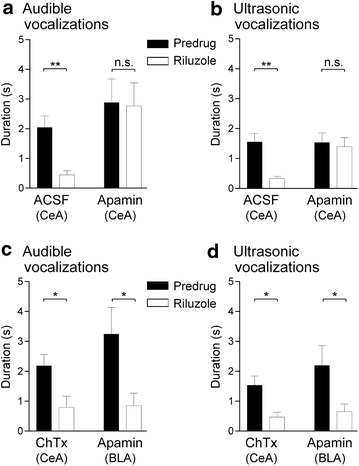
Systemic (intraperitoneal) application of riluzole (8 mg/kg) inhibited audible (nocifensive response) and ultrasonic (averse affective response) vocalizations of adult rats with arthritis (5 h postinduction of a kaolin-carrageenan monoarthritis in the knee) but did not affect spinal withdrawal thresholds, which is consistent with a supraspinal action. Stereotaxic administration of riluzole into the CeA by microdialysis (1 mM, concentration in the microdialysis fiber, 15 min) also inhibited vocalizations, confirming the CeA as a site of action of riluzole. Stereotaxic administration of a selective SK channel blocker (apamin, 1 µM, concentration in the microdialysis fiber, 15 min) into the CeA had no effect by itself but inhibited the effect of systemic riluzole on vocalizations. Off-site administration of apamin into the basolateral amygdala (BLA) as a placement control or stereotaxic application of a selective blocker of large-conductance calcium-activated potassium (BK) channels (charybdotoxin, 1 µM, concentration in the microdialysis fiber, 15 min) into the CeA did not affect the inhibitory effects of systemically applied riluzole.
The results suggest that riluzole can inhibit supraspinally organized pain behaviors in an arthritis model by activating SK, but not BK, channels in the amygdala (CeA but not BLA).
关节炎疼痛是一个重要的医疗保健问题,会产生重大的情绪和情感后果。在此,我们聚焦于激活杏仁核中小电导钙激活钾(SK)通道的潜在有益作用,杏仁核是大脑的情绪中枢,在中枢性疼痛调制和处理中起重要作用。据报道,SK通道可调节中央杏仁核(CeA,输出核)中的神经元活动。我们测试了利鲁唑(一种临床上用于治疗肌萎缩侧索硬化症的药物)的效果,原因如下。利鲁唑的作用包括激活SK通道。文献中的证据表明,利鲁唑可能通过在大脑而非脊髓中的作用产生抗伤害感受作用。利鲁唑的作用机制和作用部位仍有待确定。在此,我们在关节炎疼痛模型中测试了利鲁唑通过作用于CeA中的SK通道来抑制疼痛行为的假说。
全身性(腹腔内)应用利鲁唑(8毫克/千克)可抑制成年关节炎大鼠(膝关节高岭土-角叉菜胶单关节炎诱导后5小时)的可听性(伤害性反应)和超声(厌恶情感反应)发声,但不影响脊髓退缩阈值,这与脊髓上的作用一致。通过微透析将利鲁唑立体定向给药至CeA(微透析纤维中的浓度为1毫摩尔,15分钟)也可抑制发声,证实CeA是利鲁唑的作用部位。将选择性SK通道阻滞剂(蜂毒明肽,微透析纤维中的浓度为1微摩尔,15分钟)立体定向给药至CeA本身无作用,但可抑制全身性利鲁唑对发声的作用。将蜂毒明肽作为定位对照异位给药至基底外侧杏仁核(BLA),或将选择性大电导钙激活钾(BK)通道阻滞剂(蝎毒素,微透析纤维中的浓度为1微摩尔,15分钟)立体定向给药至CeA,均不影响全身性应用利鲁唑的抑制作用。
结果表明,利鲁唑可通过激活杏仁核(CeA而非BLA)中的SK通道而非BK通道,抑制关节炎模型中脊髓上组织的疼痛行为。