Doyle Tomas, Dunn David T, Ceccherini-Silberstein Francesca, De Mendoza Carmen, Garcia Frederico, Smit Erasmus, Fearnhill Esther, Marcelin Anne-Genevieve, Martinez-Picado Javier, Kaiser Rolf, Geretti Anna Maria
Department of Infectious Diseases, King's College London, London, UK.
MRC Clinical Trial Unit at UCL, London, UK.
J Antimicrob Chemother. 2015 Nov;70(11):3080-6. doi: 10.1093/jac/dkv243. Epub 2015 Aug 26.
The aim of this study was to characterize the prevalence and patterns of genotypic integrase inhibitor (INI) resistance in relation to HIV-1 clade.
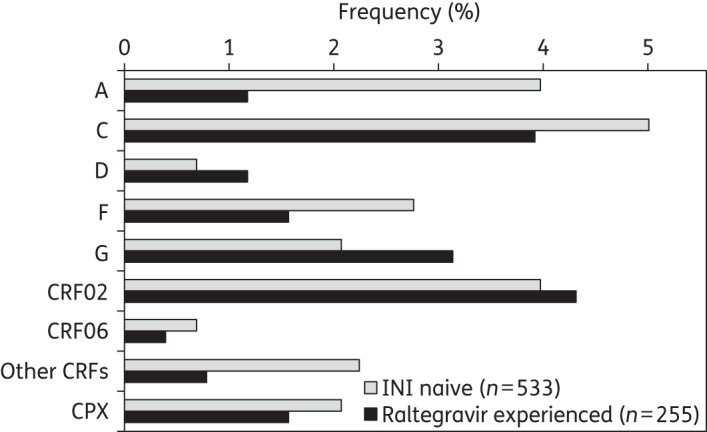
The cohort comprised 533 INI-naive subjects and 255 raltegravir recipients with viraemia who underwent integrase sequencing in routine care across Europe, including 134/533 (25.1%) and 46/255 (18.0%), respectively, with non-B clades (A, C, D, F, G, CRF01, CRF02, other CRFs, complex).
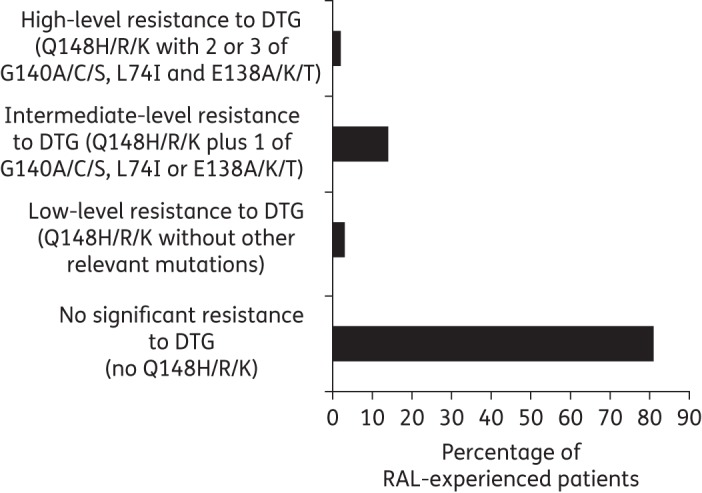
No major INI resistance-associated mutations (RAMs) occurred in INI-naive subjects. Among raltegravir recipients with viraemia (median 3523 HIV-1 RNA copies/mL), 113/255 (44.3%) had one or more major INI RAMs, most commonly N155H (45/255, 17.6%), Q148H/R/K + G140S/A (35/255, 13.7%) and Y143R/C/H (12/255, 4.7%). In addition, four (1.6%) raltegravir recipients showed novel mutations at recognized resistance sites (E92A, S147I, N155D, N155Q) and novel mutations at other integrase positions that were statistically associated with raltegravir exposure (K159Q/R, I161L/M/T/V, E170A/G). Comparing subtype B with non-B clades, Q148H/R/K occurred in 42/209 (20.1%) versus 2/46 (4.3%) subjects (P = 0.009) and G140S/A occurred in 36/209 (17.2%) versus 1/46 (2.2%) subjects (P = 0.005). Intermediate- to high-level cross-resistance to twice-daily dolutegravir was predicted in 40/255 (15.7%) subjects, more commonly in subtype B versus non-B clades (39/209, 18.7% versus 1/46, 2.2%; P = 0.003). A glycine (G) to serine (S) substitution at integrase position 140 required one nucleotide change in subtype B and two nucleotide changes in all non-B clades.
No major INI resistance mutations occurred in INI-naive subjects. Reduced occurrence of Q148H/R/K + G140S/A was seen in non-B clades versus subtype B, and was explained by the higher genetic barrier to the G140S mutation observed in all non-B clades analysed.
本研究旨在描述与HIV-1进化枝相关的基因型整合酶抑制剂(INI)耐药性的流行情况和模式。
该队列包括533名未接受过INI治疗的受试者和255名接受raltegravir治疗且有病毒血症的患者,他们在欧洲各地的常规治疗中接受了整合酶测序,其中分别有134/533(25.1%)和46/255(18.0%)为非B进化枝(A、C、D、F、G、CRF01、CRF02、其他CRF、复合型)。
未接受过INI治疗的受试者未出现主要的INI耐药相关突变(RAMs)。在接受raltegravir治疗且有病毒血症的患者中(中位HIV-1 RNA拷贝数为3523/mL),113/255(44.3%)有一个或多个主要的INI RAMs,最常见的是N155H(45/255,17.6%)、Q148H/R/K+G140S/A(35/255,13.7%)和Y143R/C/H(12/255,4.7%)。此外,4名(1.6%)接受raltegravir治疗的患者在公认的耐药位点出现新突变(E92A、S147I、N155D、N155Q),在整合酶其他位置出现与raltegravir暴露有统计学关联的新突变(K159Q/R、I161L/M/T/V、E170A/G)。将B亚型与非B进化枝进行比较,Q148H/R/K在42/209(20.1%)的受试者中出现,而在2/46(4.3%)的受试者中出现(P=0.009),G140S/A在36/209(17.2%)的受试者中出现,而在1/46(2.2%)的受试者中出现(P=0.005)。在40/255(15.7%)的受试者中预测对每日两次的dolutegravir有中到高水平的交叉耐药,在B亚型中比非B进化枝更常见(39/209,18.7%对1/46,2.2%;P=0.003)。整合酶第140位的甘氨酸(G)到丝氨酸(S)的替换在B亚型中需要一个核苷酸改变,在所有非B进化枝中需要两个核苷酸改变。
未接受过INI治疗的受试者未出现主要的INI耐药突变。与B亚型相比,非B进化枝中Q148H/R/K+G140S/A的发生率降低,这是由于在所有分析的非B进化枝中观察到G140S突变的遗传屏障更高。