Oong Xiang Yong, Ng Kim Tien, Lam Tommy Tsan-Yuk, Pang Yong Kek, Chan Kok Gan, Hanafi Nik Sherina, Kamarulzaman Adeeba, Tee Kok Keng
Department of Medicine, Faculty of Medicine, University of Malaya, Kuala Lumpur, Malaysia.
School of Public Health, The University of Hong Kong, Hong Kong Special Administrative Region, Hong Kong, China.
PLoS One. 2015 Aug 27;10(8):e0136254. doi: 10.1371/journal.pone.0136254. eCollection 2015.
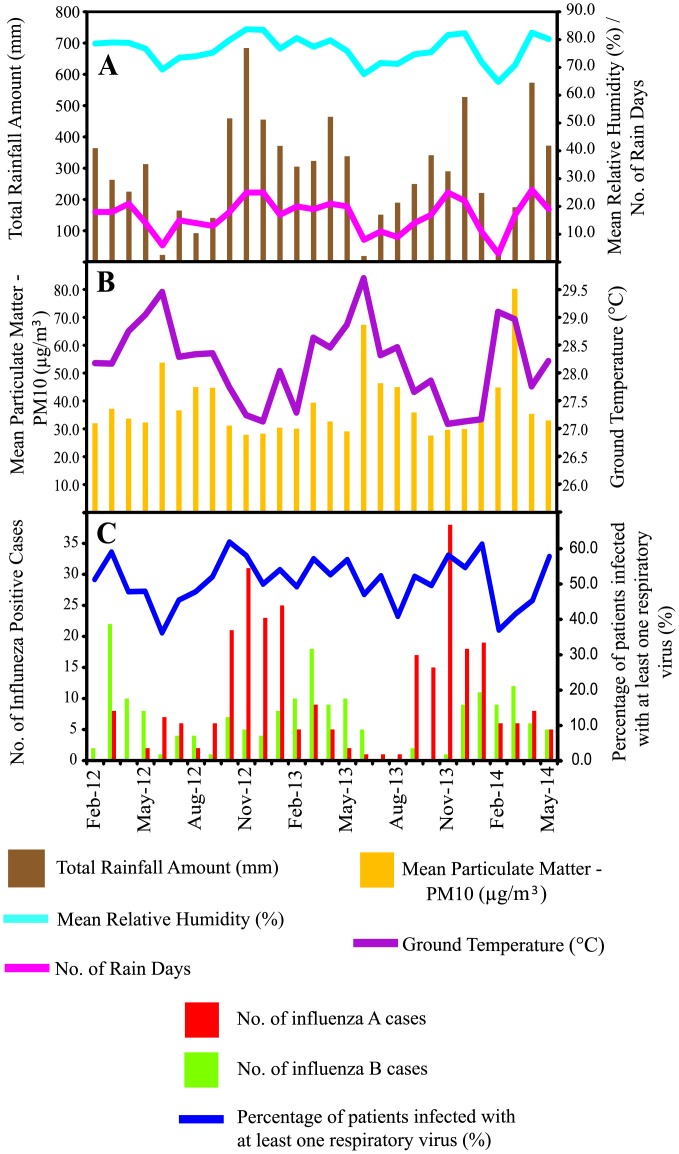
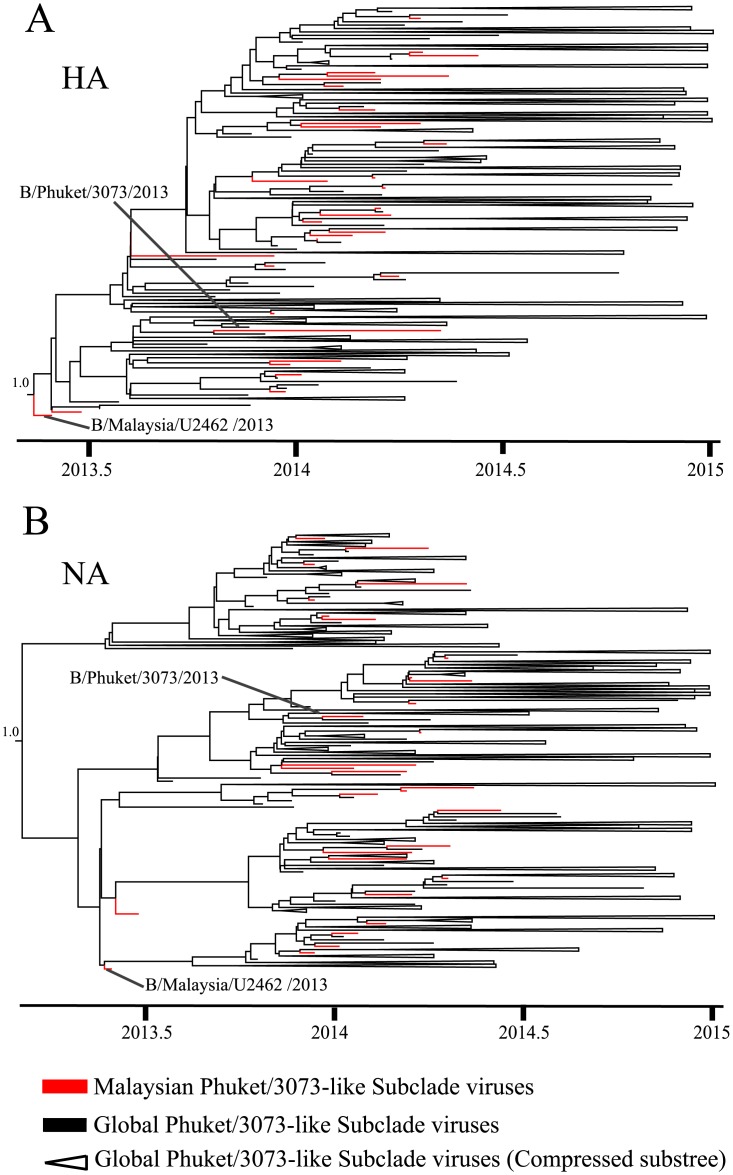
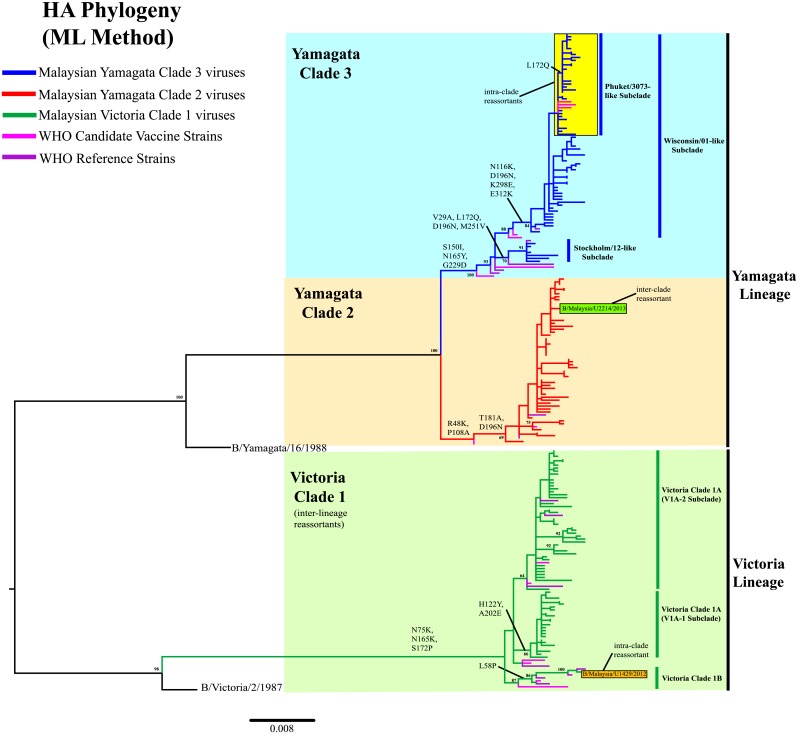
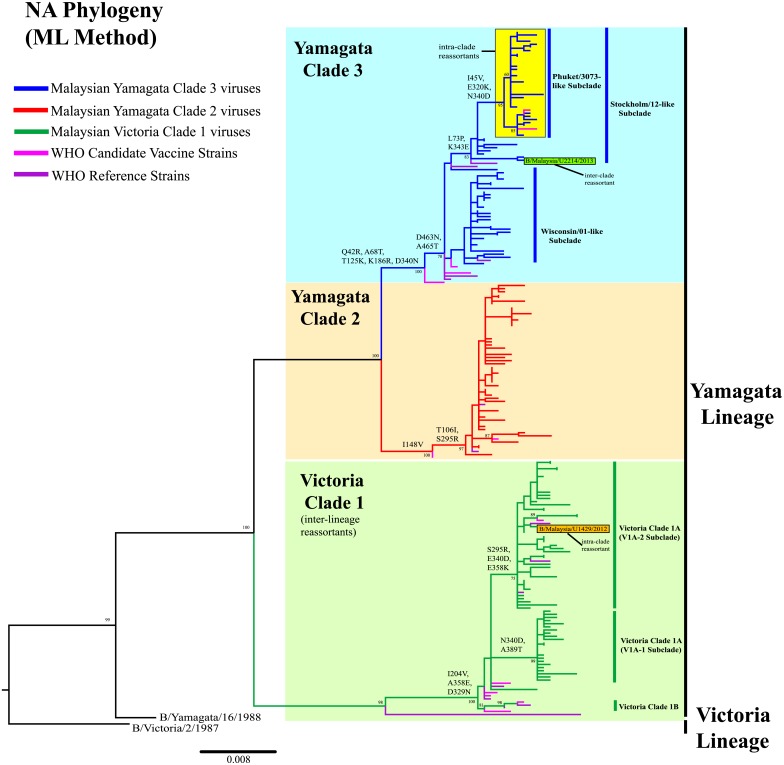
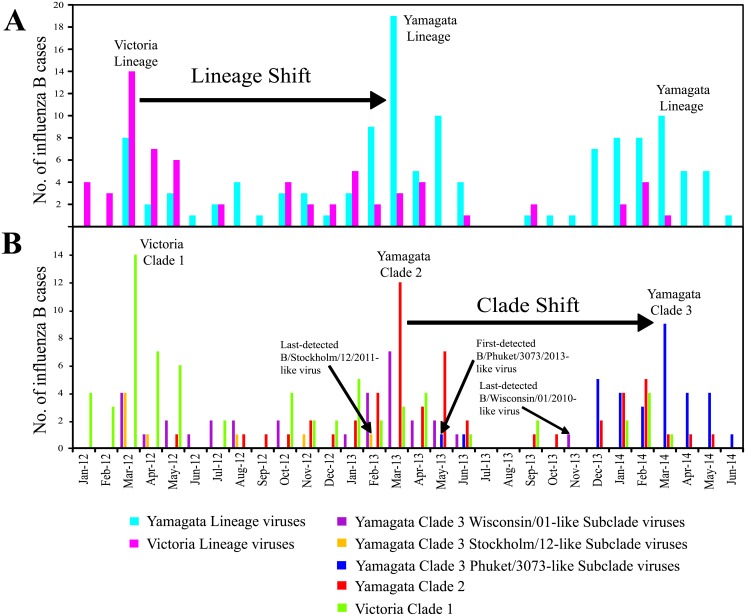
Epidemiological and evolutionary dynamics of influenza B Victoria and Yamagata lineages remained poorly understood in the tropical Southeast Asia region, despite causing seasonal outbreaks worldwide. From 2012-2014, nasopharyngeal swab samples collected from outpatients experiencing acute upper respiratory tract infection symptoms in Kuala Lumpur, Malaysia, were screened for influenza viruses using a multiplex RT-PCR assay. Among 2,010/3,935 (51.1%) patients infected with at least one respiratory virus, 287 (14.3%) and 183 (9.1%) samples were tested positive for influenza A and B viruses, respectively. Influenza-positive cases correlate significantly with meteorological factors-total amount of rainfall, relative humidity, number of rain days, ground temperature and particulate matter (PM10). Phylogenetic reconstruction of haemagglutinin (HA) gene from 168 influenza B viruses grouped them into Yamagata Clade 3 (65, 38.7%), Yamagata Clade 2 (48, 28.6%) and Victoria Clade 1 (55, 32.7%). With neuraminidase (NA) phylogeny, 30 intra-clade (29 within Yamagata Clade 3, 1 within Victoria Clade 1) and 1 inter-clade (Yamagata Clade 2-HA/Yamagata Clade 3-NA) reassortants were identified. Study of virus temporal dynamics revealed a lineage shift from Victoria to Yamagata (2012-2013), and a clade shift from Yamagata Clade 2 to Clade 3 (2013-2014). Yamagata Clade 3 predominating in 2014 consisted of intra-clade reassortants that were closely related to a recent WHO vaccine candidate strain (B/Phuket/3073/2013), with the reassortment event occurred approximately 2 years ago based on Bayesian molecular clock estimation. Malaysian Victoria Clade 1 viruses carried H274Y substitution in the active site of neuraminidase, which confers resistance to oseltamivir. Statistical analyses on clinical and demographic data showed Yamagata-infected patients were older and more likely to experience headache while Victoria-infected patients were more likely to experience nasal congestion and sore throat. This study describes the evolution of influenza B viruses in Malaysia and highlights the importance of continuous surveillance for better vaccination policy in this region.
尽管乙型流感病毒的维多利亚和山形谱系在全球引发季节性疫情,但在热带东南亚地区,其流行病学和进化动态仍知之甚少。2012年至2014年期间,在马来西亚吉隆坡,对有急性上呼吸道感染症状的门诊患者采集的鼻咽拭子样本,使用多重逆转录聚合酶链反应(RT-PCR)检测法筛查流感病毒。在至少感染一种呼吸道病毒的2010/3935(51.1%)名患者中,分别有287(14.3%)和183(9.1%)份样本的甲型和乙型流感病毒检测呈阳性。流感阳性病例与气象因素——总降雨量、相对湿度、降雨天数、地面温度和颗粒物(PM10)显著相关。对168株乙型流感病毒的血凝素(HA)基因进行系统发育重建,将它们分为山形谱系3(65株,38.7%)、山形谱系2(48株,28.6%)和维多利亚谱系1(55株,32.7%)。根据神经氨酸酶(NA)系统发育分析,鉴定出30个谱系内重组体(山形谱系3内29个,维多利亚谱系1内1个)和1个谱系间重组体(山形谱系2-HA/山形谱系3-NA)。病毒时间动态研究显示,出现了从维多利亚谱系到山形谱系的转变(2012 - 2013年),以及从山形谱系2到谱系3的分支转变(2013 - 2014年)。2014年占主导的山形谱系3由谱系内重组体组成,这些重组体与世界卫生组织近期的一种候选疫苗株(B/普吉/3073/2013)密切相关,根据贝叶斯分子钟估计,重组事件大约发生在两年前。马来西亚的维多利亚谱系1病毒在神经氨酸酶活性位点携带H274Y替换,这使其对奥司他韦产生耐药性。对临床和人口统计学数据的统计分析表明,感染山形谱系的患者年龄较大,更易出现头痛症状,而感染维多利亚谱系的患者更易出现鼻塞和喉咙痛症状。本研究描述了马来西亚乙型流感病毒的进化情况,并强调了持续监测对于该地区制定更好的疫苗接种政策的重要性。