Oong Xiang Yong, Ng Kim Tien, Tan Joon Ling, Chan Kok Gan, Kamarulzaman Adeeba, Chan Yoke Fun, Sam I-Ching, Tee Kok Keng
Department of Medicine, Faculty of Medicine, University of Malaya, Kuala Lumpur, Malaysia.
Department of Medical Microbiology, Faculty of Medicine, University of Malaya, Kuala Lumpur, Malaysia.
PLoS One. 2017 Jan 27;12(1):e0170610. doi: 10.1371/journal.pone.0170610. eCollection 2017.
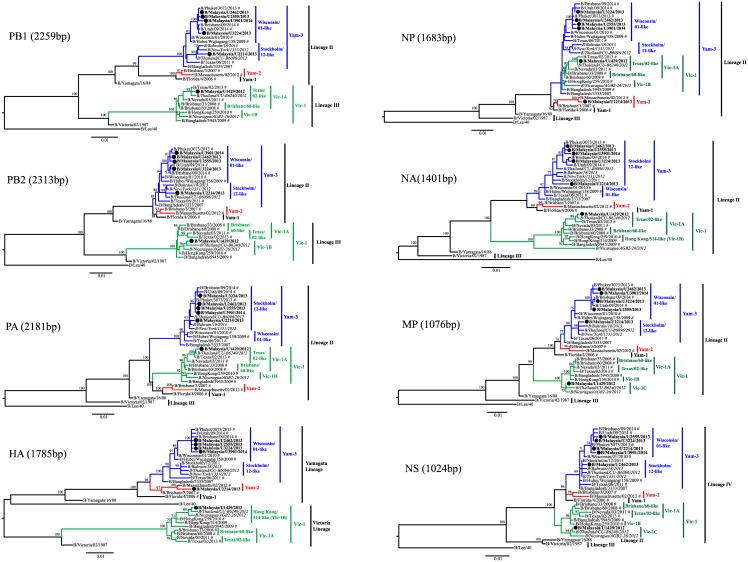
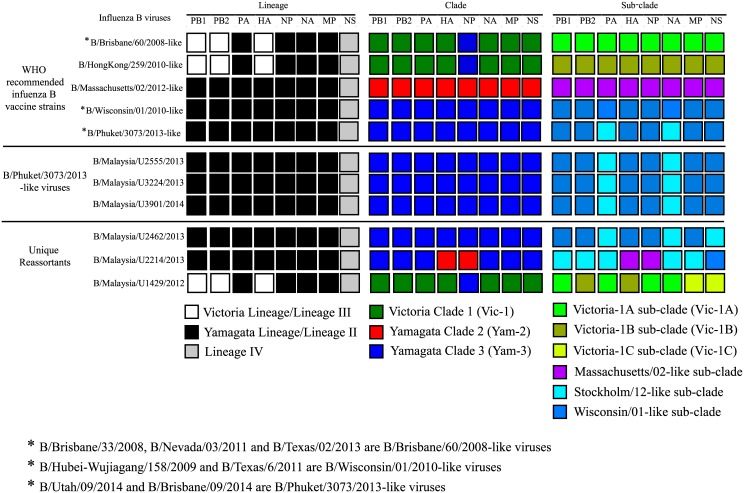
Reassortment of genetic segments between and within influenza B lineages (Victoria and Yamagata) has been shown to generate novel reassortants with unique genetic characteristics. Based on hemagglutinin (HA) and neuraminidase (NA) genes, recent surveillance study has identified reassortment properties in B/Phuket/3073/2013-like virus, which is currently used in the WHO-recommended influenza vaccine. To understand the potential reassortment patterns for all gene segments, four B/Phuket/3073/2013-like viruses and two unique reassortants (one each from Yamagata and Victoria) detected in Malaysia from 2012-2014 were subjected to whole-genome sequencing. Each gene was phylogenetically classified into lineages, clades and sub-clades. Three B/Phuket/3073/2013-like viruses from Yamagata lineage were found to be intra-clade reassortants, possessing PA and NA genes derived from Stockholm/12-like sub-clade, while the remaining genes from Wisconsin/01-like sub-clade (both sub-clades were within Yamagata Clade 3/Yam-3). However, the other B/Phuket/3073/2013-like virus had NS gene that derived from Stockholm/12-like sub-clade instead of Wisconsin/01-like sub-clade. One inter-clade reassortant had Yamagata Clade 2/Yam-2-derived HA and NP, and its remaining genes were Yam-3-derived. Within Victoria Clade 1/Vic-1 in Victoria lineage, one virus had intra-clade reassortment properties: HA and PB2 from Vic-1B sub-clade, MP and NS from a unique sub-clade "Vic-1C", and the remaining genes from Vic-1A sub-clade. Although random reassortment event may generate unique reassortants, detailed phylogenetic classification of gene segments showed possible genetic linkage between PA and NA genes in B/Phuket/3073/2013-like viruses, which requires further investigation. Understanding on reassortment patterns in influenza B evolution may contribute to future vaccine design.
乙型流感病毒谱系(维多利亚系和山形系)之间及内部的基因片段重配已被证明可产生具有独特遗传特征的新型重配病毒。基于血凝素(HA)和神经氨酸酶(NA)基因,近期的监测研究已确定了B/普吉/3073/2013样病毒的重配特性,该病毒目前被用于世界卫生组织推荐的流感疫苗中。为了解所有基因片段的潜在重配模式,对2012 - 2014年在马来西亚检测到的4株B/普吉/3073/2013样病毒和2株独特的重配病毒(分别来自山形系和维多利亚系各1株)进行了全基因组测序。每个基因在系统发育上被分类为谱系、分支和亚分支。发现来自山形谱系的3株B/普吉/3073/2013样病毒是分支内重配病毒,其PA和NA基因源自斯德哥尔摩/12样亚分支,而其余基因源自威斯康星/01样亚分支(这两个亚分支均在山形分支3/Yam - 3内)。然而,另一株B/普吉/3073/2013样病毒的NS基因源自斯德哥尔摩/12样亚分支而非威斯康星/01样亚分支。一株分支间重配病毒具有源自山形分支2/Yam - 2的HA和NP,其其余基因源自Yam - 3。在维多利亚谱系的维多利亚分支1/Vic - 1内,一株病毒具有分支内重配特性:HA和PB2来自Vic - 1B亚分支,MP和NS来自一个独特的亚分支“Vic - 1C”,其余基因来自Vic - 1A亚分支。尽管随机重配事件可能产生独特的重配病毒,但基因片段的详细系统发育分类显示,B/普吉/3073/2013样病毒中PA和NA基因之间可能存在遗传联系,这需要进一步研究。了解乙型流感病毒进化中的重配模式可能有助于未来的疫苗设计。