Denner Joachim, Mueller Nicolas J
Robert Koch Institute, Berlin, Germany.
Division of Infectious Diseases and Hospital Epidemiology, University Hospital Zurich, Switzerland.
Int J Surg. 2015 Nov;23(Pt B):306-311. doi: 10.1016/j.ijsu.2015.08.032. Epub 2015 Aug 24.
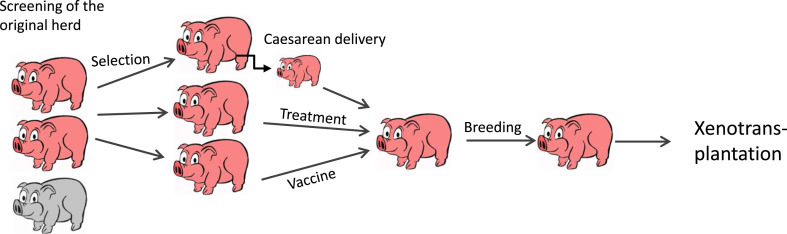
Xenotransplantation using pig cells, tissues and organs may be associated with the transfer of porcine infectious agents, which may infect the human recipient and in the worst case induce a disease (zoonosis). To prevent this, a broad screening program of the donor animals for putative zoonotic microorganisms, including bacteria, viruses, fungi and others, using sensitive and specific detection methods has to be performed. As long as it is still unknown, which microorganism represents a real risk for the recipient, experience from allotransplantation should be brought in. Due to the fact that pigs can be screened long before the date of transplantation, xenotransplantation will become eventually safer compared with allotransplantation. Screening and selection of animals free of potential zoonotic microorganisms, Caesarean section, vaccination and/or treatment with chemotherapeutics are the strategies of choice to obtain donor animals not transmitting microorganisms. In the case of porcine endogenous retroviruses (PERVs) which are integrated in the genome of all pigs and which cannot be eliminated this way, selection of animals with low virus expression and generation of genetically modified pigs suppressing PERV expressions may be performed.
使用猪的细胞、组织和器官进行异种移植可能与猪传染性病原体的传播有关,这些病原体可能感染人类受体,在最坏的情况下会引发疾病(人畜共患病)。为防止这种情况发生,必须使用灵敏且特异的检测方法,对供体动物进行广泛筛查,以检测包括细菌、病毒、真菌等在内的潜在人畜共患病微生物。只要仍不清楚哪种微生物对受体构成真正风险,就应借鉴同种异体移植的经验。由于猪在移植日期前很久就可以进行筛查,与同种异体移植相比,异种移植最终将变得更安全。筛选和选择无潜在人畜共患病微生物的动物、剖腹产、接种疫苗和/或使用化学治疗剂进行治疗,是获得不传播微生物的供体动物的首选策略。对于整合在所有猪基因组中且无法通过这种方式消除的猪内源性逆转录病毒(PERV),可以选择病毒表达低的动物,并培育出抑制PERV表达的转基因猪。