Chin Eric K, Almeida David Rp, Roybal C Nathaniel, Niles Philip I, Gehrs Karen M, Sohn Elliott H, Boldt H Culver, Russell Stephen R, Folk James C
Department of Ophthalmology and Visual Sciences, University of Iowa, Iowa City, IA, USA.
Clin Ophthalmol. 2015 Aug 11;9:1449-56. doi: 10.2147/OPTH.S86778. eCollection 2015.
To evaluate the effect and tolerance of oral mineralocorticoid antagonists, eplerenone and/or spironolactone, in recalcitrant central serous chorioretinopathy.
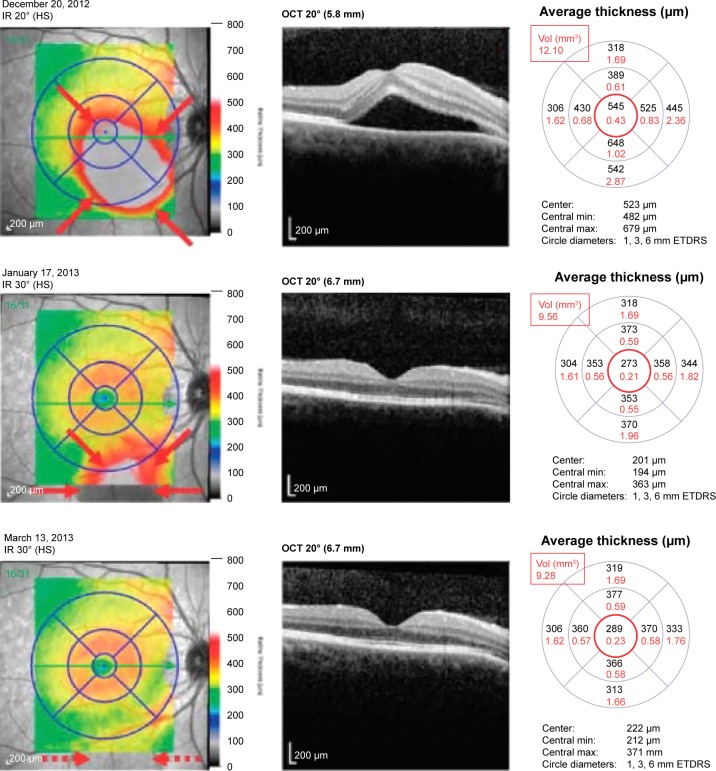
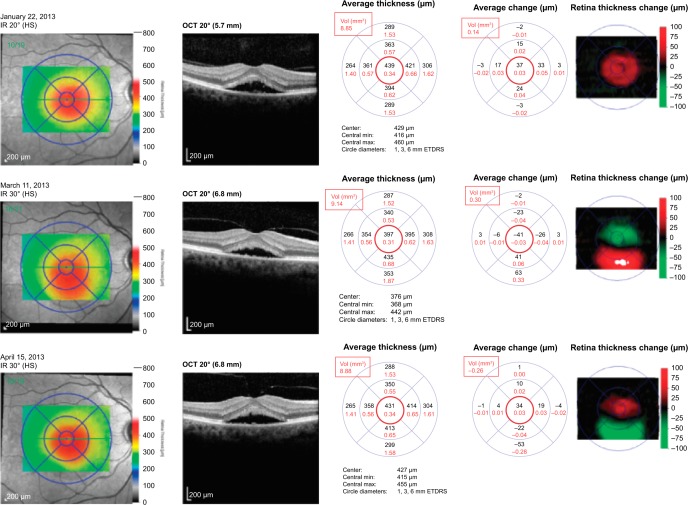
Retrospective consecutive observational case series. Primary outcome measures included central macular thickness (CMT, μm), macular volume (MV, mm(3)), Snellen visual acuity, and prior treatment failures. Secondary outcomes included duration of treatment, treatment dosage, and systemic side effects.
A total of 120 patients with central serous chorioretinopathy were reviewed, of which 29 patients were treated with one or more mineralocorticoid antagonists. The average age of patients was 58.4 years. Sixteen patients (69.6%) were recalcitrant to other interventions prior to treatment with oral mineralocorticoid antagonists, with an average washout period of 15.3 months. The average duration of mineralocorticoid antagonist treatment was 3.9±2.3 months. Twelve patients (52.2%) showed decreased CMT and MV, six patients (26.1%) had increase in both, and five patients (21.7%) had negligible changes. The mean decrease in CMT of all patients was 42.4 μm (range, -136 to 255 μm): 100.7 μm among treatment-naïve patients, and 16.9 μm among recalcitrant patients. The mean decrease in MV of all patients was 0.20 mm(3) (range, -2.33 to 2.90 mm(3)): 0.6 mm(3) among treatment-naïve patients, and 0.0 mm(3) among recalcitrant patients. Median visual acuity at the start of therapy was 20/30 (range, 20/20-20/250), and at final follow-up it was 20/40 (range, 20/20-20/125). Nine patients (39.1%) experienced systemic side effects, of which three patients (13.0%) were unable to continue therapy.
Mineralocorticoid antagonist treatment had a positive treatment effect in half of our patients. The decrease in CMT and MV was much less in the recalcitrant group compared to the treatment-naïve group. An improvement in vision was seen only in the treatment-naïve group. Systemic side effects, even at low doses, may limit its usage in some patients.
评估口服盐皮质激素拮抗剂依普利酮和/或螺内酯治疗顽固性中心性浆液性脉络膜视网膜病变的疗效及耐受性。
回顾性连续观察病例系列。主要观察指标包括中心黄斑厚度(CMT,μm)、黄斑体积(MV,mm³)、Snellen视力及既往治疗失败情况。次要观察指标包括治疗持续时间、治疗剂量及全身副作用。
共纳入120例中心性浆液性脉络膜视网膜病变患者,其中29例接受了一种或多种盐皮质激素拮抗剂治疗。患者平均年龄58.4岁。16例患者(69.6%)在接受口服盐皮质激素拮抗剂治疗前对其他干预措施无效,平均洗脱期为15.3个月。盐皮质激素拮抗剂治疗的平均持续时间为3.9±2.3个月。12例患者(52.2%)CMT和MV降低,6例患者(26.1%)两者均升高,5例患者(21.7%)变化可忽略不计。所有患者CMT的平均降低值为42.4μm(范围:-136至255μm):初治患者为100.7μm,顽固性患者为16.9μm。所有患者MV的平均降低值为0.20mm³(范围:-2.33至2.90mm³):初治患者为0.6mm³,顽固性患者为0.0mm³。治疗开始时的中位视力为20/30(范围:20/20 - 20/250),末次随访时为20/40(范围:20/20 - 20/125)。9例患者(39.1%)出现全身副作用,其中3例患者(13.0%)无法继续治疗。
盐皮质激素拮抗剂治疗对半数患者有积极治疗效果。与初治组相比,顽固性组CMT和MV的降低幅度小得多。仅在初治组中观察到视力改善。全身副作用即使在低剂量时也可能限制其在部分患者中的应用。