Singh Devinder K A, Pillai Sharmila G K, Tan Sin Thien, Tai Chu Chiau, Shahar Suzana
Physiotherapy Programme, School of Rehabilitation Sciences, Universiti Kebangsaan Malaysia, Jalan Raja Muda Abdul Aziz, Kuala Lumpur, Malaysia.
Nutrition and Dietetics Programme, School of Healthcare Sciences, Faculty of Health Sciences, Universiti Kebangsaan Malaysia, Jalan Raja Muda Abdul Aziz, Kuala Lumpur, Malaysia.
Clin Interv Aging. 2015 Aug 13;10:1319-26. doi: 10.2147/CIA.S79398. eCollection 2015.
Physical performance and balance declines with aging and may lead to increased risk of falls. Physical performance tests may be useful for initial fall-risk screening test among community-dwelling older adults. Physiological profile assessment (PPA), a composite falls risk assessment tool is reported to have 75% accuracy to screen for physiological falls risk. PPA correlates with Timed Up and Go (TUG) test. However, the association between many other commonly used physical performance tests and PPA is not known. The aim of the present study was to examine the association between physiological falls risk measured using PPA and a battery of physical performance tests.
One hundred and forty older adults from a senior citizens club in Kuala Lumpur, Malaysia (94 females, 46 males), aged 60 years and above (65.77±4.61), participated in this cross-sectional study. Participants were screened for falls risk using PPA. A battery of physical performance tests that include ten-step test (TST), short physical performance battery (SPPB), functional reach test (FRT), static balance test (SBT), TUG, dominant hand-grip strength (DHGS), and gait speed test (GST) were also performed. Spearman's rank correlation and binomial logistic regression were performed to examine the significantly associated independent variables (physical performance tests) with falls risk (dependent variable).
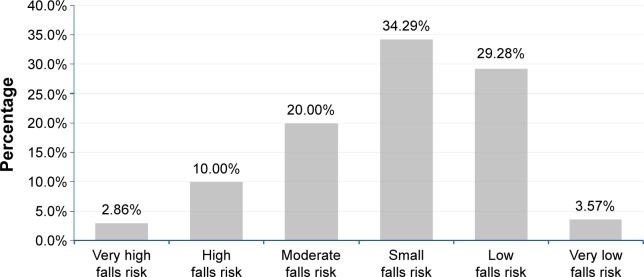
Approximately 13% older adults were at high risk of falls categorized using PPA. Significant differences (P<0.05) were demonstrated for age, TST, SPPB, FRT, SBT, TUG between high and low falls risk group. A significant (P<0.01) weak correlation was found between PPA and TST (r=0.25), TUG (r=0.27), SBT (r=0.23), SPPB (r=-0.33), and FRT (r=-0.23). Binary logistic regression results demonstrated that SBT measuring postural sways objectively using a balance board was the only significant predictor of physiological falls risk (P<0.05, odds ratio of 2.12).
The reference values of physical performance tests in our study may be used as a guide for initial falls screening to categorize high and low physiological falls risk among community-dwelling older adults. A more comprehensive assessment of falls risk can be performed thereafter for more specific intervention of underlying impairments.
身体机能和平衡能力会随着年龄增长而下降,这可能会导致跌倒风险增加。身体机能测试对于社区居住的老年人进行初步跌倒风险筛查可能是有用的。据报道,生理特征评估(PPA)作为一种综合跌倒风险评估工具,在筛查生理跌倒风险方面具有75%的准确率。PPA与计时起立行走测试(TUG)相关。然而,许多其他常用的身体机能测试与PPA之间的关联尚不清楚。本研究的目的是探讨使用PPA测量的生理跌倒风险与一系列身体机能测试之间的关联。
来自马来西亚吉隆坡一个老年人俱乐部的140名老年人(94名女性,46名男性),年龄在60岁及以上(65.77±4.61),参与了这项横断面研究。使用PPA对参与者进行跌倒风险筛查。还进行了一系列身体机能测试,包括十步测试(TST)、简短身体机能测试组合(SPPB)、功能性伸展测试(FRT)、静态平衡测试(SBT)、TUG、优势手握力(DHGS)和步态速度测试(GST)。进行Spearman等级相关性分析和二项逻辑回归分析,以检验与跌倒风险(因变量)显著相关的自变量(身体机能测试)。
使用PPA分类,约13%的老年人处于高跌倒风险。高跌倒风险组和低跌倒风险组在年龄、TST、SPPB、FRT、SBT、TUG方面存在显著差异(P<0.05)。PPA与TST(r=0.25)、TUG(r=0.27)、SBT(r=0.23)、SPPB(r=-0.33)和FRT(r=-0.23)之间存在显著的(P<0.01)弱相关性。二元逻辑回归结果表明,使用平衡板客观测量姿势摆动的SBT是生理跌倒风险的唯一显著预测因素(P<0.05,优势比为2.12)。
我们研究中身体机能测试的参考值可作为初步跌倒筛查的指导,以对社区居住的老年人中高低生理跌倒风险进行分类。此后可进行更全面的跌倒风险评估,以便对潜在损伤进行更具体的干预。