Vance Carol Gt, Rakel Barbara A, Dailey Dana L, Sluka Kathleen A
Department of Physical Therapy and Rehabilitation Science, University of Iowa Carver College of Medicine, IA, USA.
Department of Physical Therapy and Rehabilitation Science, University of Iowa Carver College of Medicine, IA, USA ; University of Iowa, College Nursing Iowa City, IA, USA.
J Pain Res. 2015 Aug 19;8:571-80. doi: 10.2147/JPR.S86577. eCollection 2015.
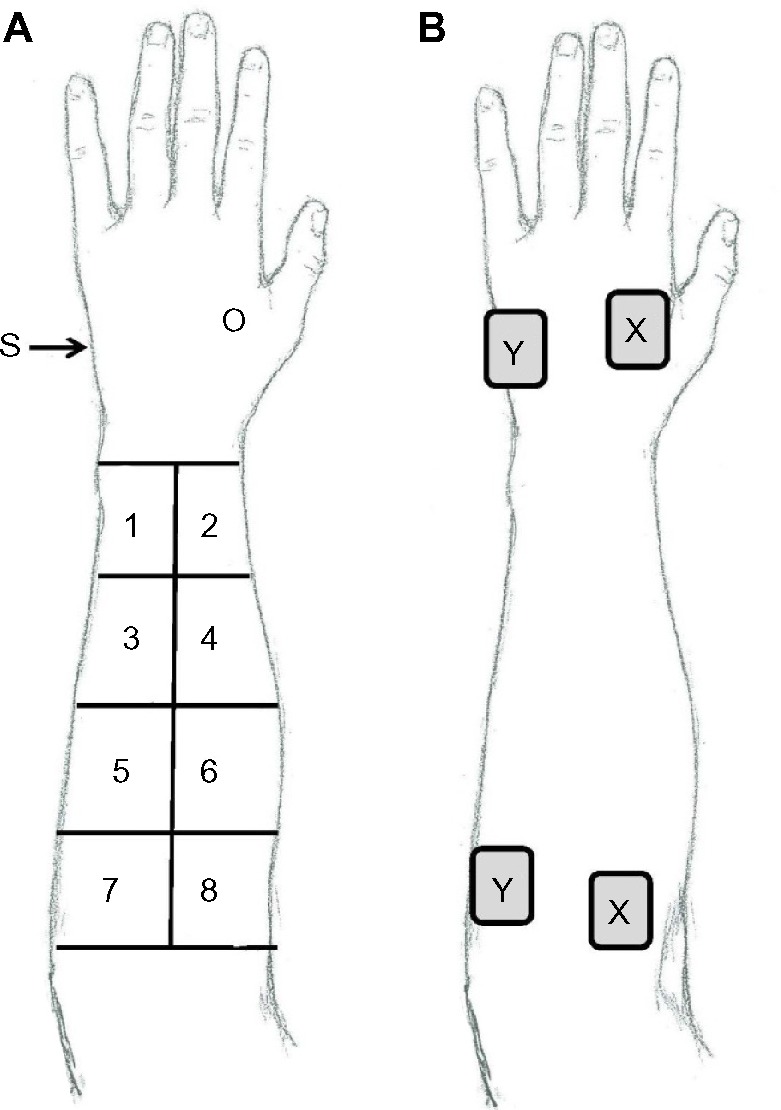
Transcutaneous electrical nerve stimulation (TENS) is a nonpharmacological intervention used to manage pain using skin surface electrodes. Optimal electrode placement is unclear. We hypothesized that better analgesia would occur if electrodes were placed over sites with lower skin impedance. Optimal site selection (OSS) and sham site selection (SSS) electrode sites on the forearm were identified using a standard clinical technique.
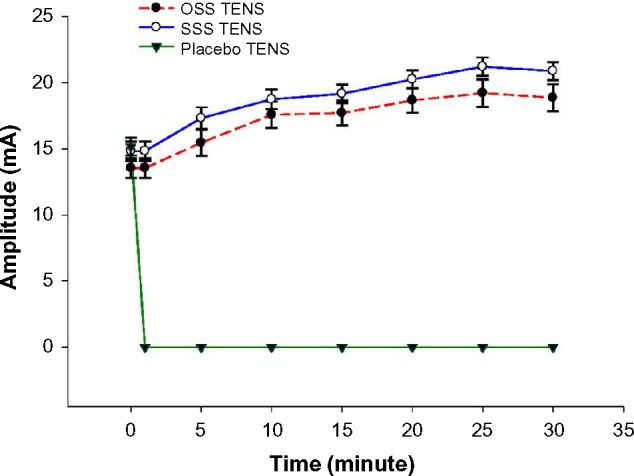
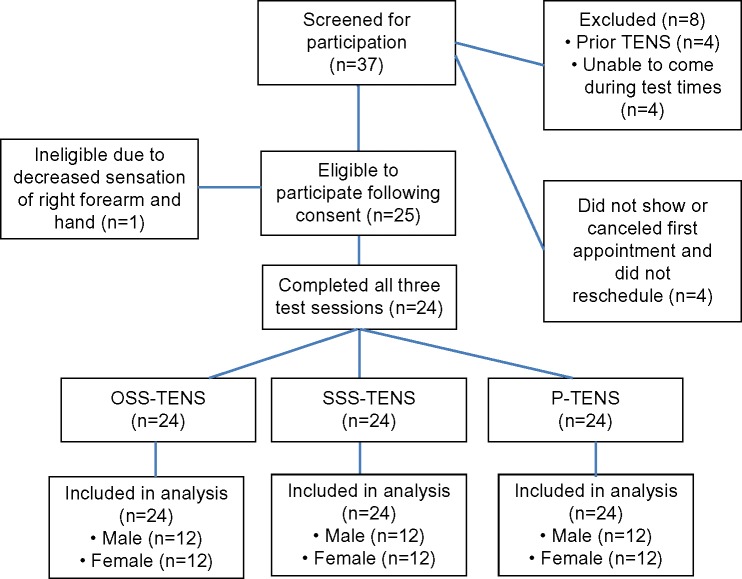
Experiment 1 measured skin impedance in the forearm at OSS and SSS. Experiment 2 was a crossover design double-blind randomized controlled trial comparing OSS-TENS, SSS-TENS, and placebo TENS (P-TENS) to confirm differences in skin impedance between OSS and SSS, and measure change in pressure pain threshold (PPT) following a 30-minute TENS treatment. Healthy volunteers were recruited (ten for Experiment 1 [five male, five female] and 24 for Experiment 2 [12 male, 12 female]). TENS was applied for 30 minutes at 100 Hz frequency, 100 µs pulse duration, and "strong but nonpainful" amplitude.
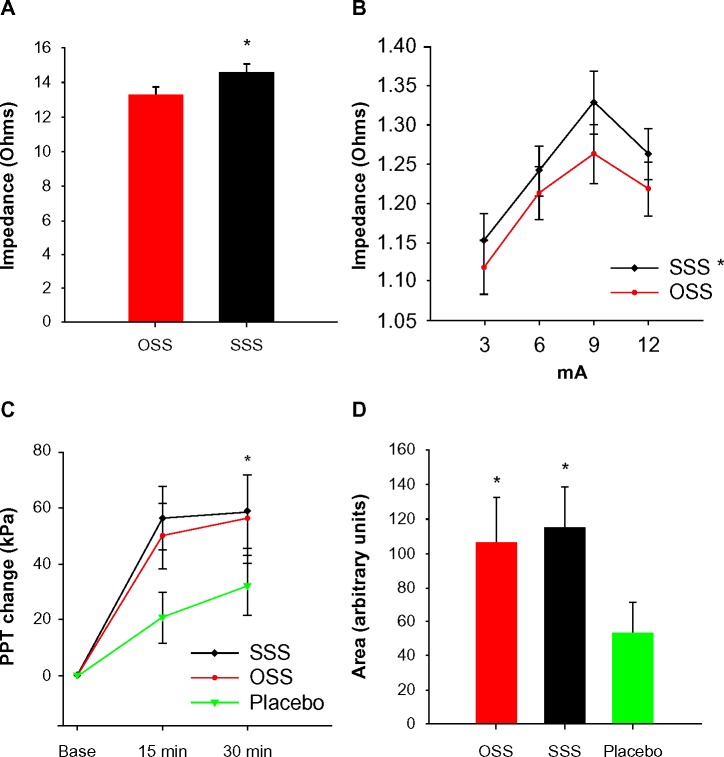
Experiment 1 results demonstrate significantly higher impedance at SSS (17.69±1.24 Ω) compared to OSS (13.53±0.57 Ω) (P=0.007). For Experiment 2, electrode site impedance was significantly higher over SSS, with both the impedance meter (P=0.001) and the TENS unit (P=0.012) compared to OSS. PPT change was significantly greater for both OSS-TENS (P=0.024) and SSS-TENS (P=0.025) when compared to P-TENS. PPT did not differ between the two active TENS treatments (P=0.81).
Skin impedance is lower at sites characterized as optimal using the described technique of electrode site selection. When TENS is applied at adequate intensities, skin impedance is not a factor in attainment of hypoalgesia of the forearm in healthy subjects. Further investigation should include testing in patients presenting with painful conditions.
经皮电刺激神经疗法(TENS)是一种使用皮肤表面电极来控制疼痛的非药物干预方法。最佳电极放置位置尚不清楚。我们假设,如果将电极放置在皮肤阻抗较低的部位,镇痛效果会更好。使用标准临床技术确定了前臂上的最佳部位选择(OSS)电极部位和假部位选择(SSS)电极部位。
实验1测量了OSS和SSS处前臂的皮肤阻抗。实验2是一项交叉设计的双盲随机对照试验,比较了OSS-TENS、SSS-TENS和安慰剂TENS(P-TENS),以确认OSS和SSS之间皮肤阻抗的差异,并测量30分钟TENS治疗后压力痛阈(PPT)的变化。招募了健康志愿者(实验1为10名[5名男性,5名女性],实验2为24名[12名男性,12名女性])。以100Hz频率、100µs脉冲持续时间和“强但无痛”的幅度施加TENS 30分钟。
实验1结果表明,与OSS(13.53±0.57Ω)相比,SSS处的阻抗显著更高(17.69±1.24Ω)(P=0.007)。对于实验2,与OSS相比,SSS上电极部位的阻抗显著更高,阻抗计(P=0.001)和TENS装置(P=0.012)均如此。与P-TENS相比,OSS-TENS(P=0.024)和SSS-TENS(P=0.025)的PPT变化均显著更大。两种主动TENS治疗之间的PPT没有差异(P=0.81)。
使用所述电极部位选择技术确定为最佳的部位皮肤阻抗较低。当以适当强度施加TENS时,皮肤阻抗不是健康受试者前臂达到痛觉减退的一个因素。进一步的研究应包括对有疼痛症状的患者进行测试。