Department of Anesthesiology Pain and Palliative Medicine, Radboud University Medical Center, Nijmegen, Netherlands.
Department of Anesthesiology, Pain Center, University Medical Center Groningen, Groningen, Netherlands.
Pain Res Manag. 2020 Jul 23;2020:1050935. doi: 10.1155/2020/1050935. eCollection 2020.
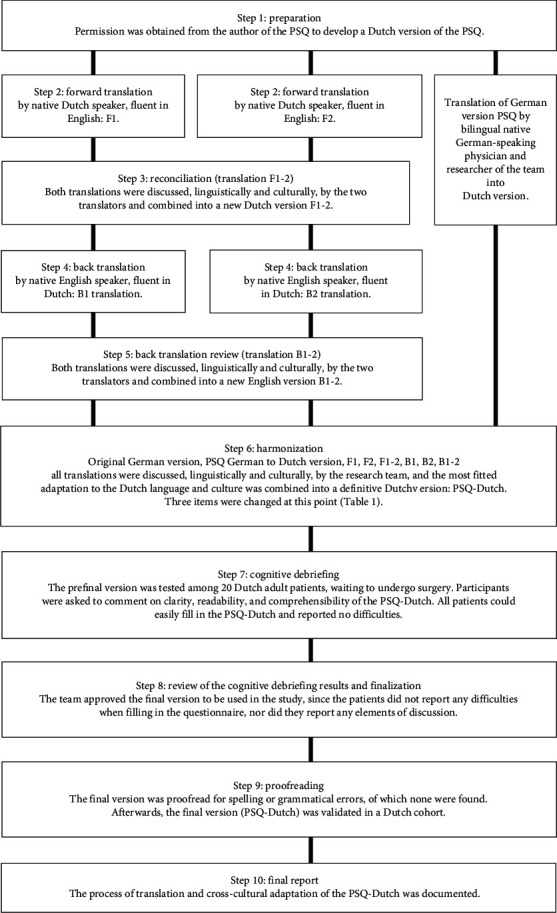
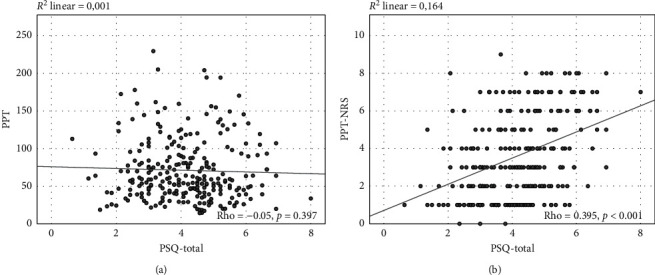
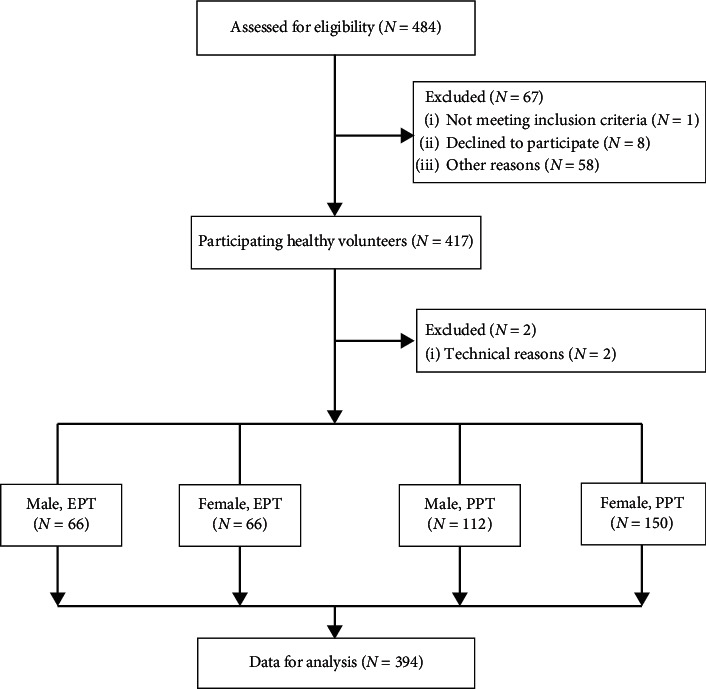
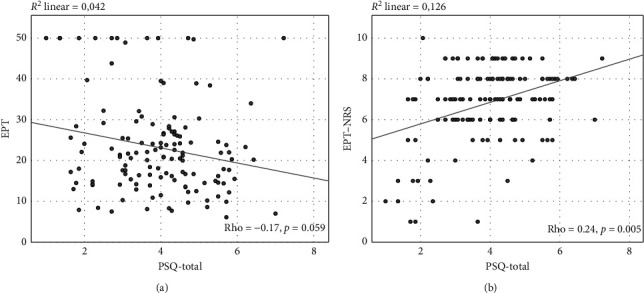
An increased sensitivity to painful stimuli has been proposed to be related to the development of chronic pain. Therefore, assessment of individual pain sensitivity is useful in clinical practice. However, experimental pain testing may be uncomfortable for patients and requires specific equipment. The Pain Sensitivity Questionnaire (PSQ) has been developed to facilitate assessment of pain sensitivity. In this study, we aimed to translate and cross-culturally adapt the PSQ from its published German and English versions into the Dutch language and to assess validity of the PSQ in healthy volunteers. After translation and cross-cultural adaptation of the PSQ following international guidelines, we validated the PSQ in 394 healthy volunteers by comparing the PSQ-values with two different experimental pain tests: electrical pain tolerance (EPT) and pressure pain threshold (PPT). In addition, ratings of pain intensity during these tests were obtained on the numerical rating scale (NRS, 0-10). We found that the reliability of the PSQ based on internal consistency was good (Cronbach's alpha 0.90). PSQ-scores, adjusted for age and sex, were statistically significant and weakly inversely correlated to EPT (PSQ-moderate: rho = -0.24, =0.007; PSQ-total: rho = -0.22, =0.016). No statistically significant correlation between PSQ-scores and PPT was found. Concerning the pain scores, PSQ-scores were weakly to moderately correlated to EPT-NRS (PSQ-minor: rho = 0.21, =0.021; PSQ-moderate: rho = 0.22, =0.016; PSQ-total: rho = 0.23, =0.009) as well as PPT-NRS (PSQ-minor: rho = 0.32, < 0.001; PSQ-moderate: rho = 0.36, < 0.001; PSQ-total: rho = 0.37, < 0.001). Therefore, we concluded that the Dutch version of the PSQ is culturally appropriate for assessing self-reported pain sensitivity in healthy volunteers.
人们提出,对疼痛刺激的敏感性增加与慢性疼痛的发展有关。因此,评估个体的疼痛敏感性在临床实践中很有用。然而,实验性疼痛测试可能会使患者感到不适,并且需要特定的设备。疼痛敏感性问卷(PSQ)的开发是为了方便评估疼痛敏感性。在这项研究中,我们旨在将 PSQ 从其已发表的德文和英文版本翻译成荷兰文,并评估 PSQ 在健康志愿者中的有效性。在遵循国际指南进行 PSQ 的翻译和跨文化适应性调整后,我们通过将 PSQ 值与两种不同的实验性疼痛测试(电痛耐量(EPT)和压痛阈值(PPT))进行比较,在 394 名健康志愿者中验证了 PSQ。此外,还在数字评定量表(NRS,0-10)上获得了这些测试期间的疼痛强度评分。我们发现,基于内部一致性的 PSQ 可靠性良好(Cronbach's alpha 为 0.90)。经年龄和性别调整的 PSQ 评分具有统计学意义,并且与 EPT 呈弱负相关(PSQ-中度:rho=-0.24,=0.007;PSQ-总分:rho=-0.22,=0.016)。PSQ 评分与 PPT 之间未发现统计学上显著的相关性。关于疼痛评分,PSQ 评分与 EPT-NRS 呈弱至中度相关(PSQ-轻度:rho=0.21,=0.021;PSQ-中度:rho=0.22,=0.016;PSQ-总分:rho=0.23,=0.009),以及 PPT-NRS(PSQ-轻度:rho=0.32,<0.001;PSQ-中度:rho=0.36,<0.001;PSQ-总分:rho=0.37,<0.001)。因此,我们得出结论,PSQ 的荷兰语版本适合评估健康志愿者的自我报告疼痛敏感性。