Nellore Jayshree, Pauline Cynthia, Amarnath Kanchana
Department of Biotechnology, Sathyabama University, Jeppiaar Nagar, Rajiv Gandhi Salai Chennai-119, Chennai, Tamilnadu, India.
Department of Biochemistry, Sathyabama University, Chennai 600119, Tamilnadu, India.
J Neurodegener Dis. 2013;2013:972391. doi: 10.1155/2013/972391. Epub 2013 Mar 4.
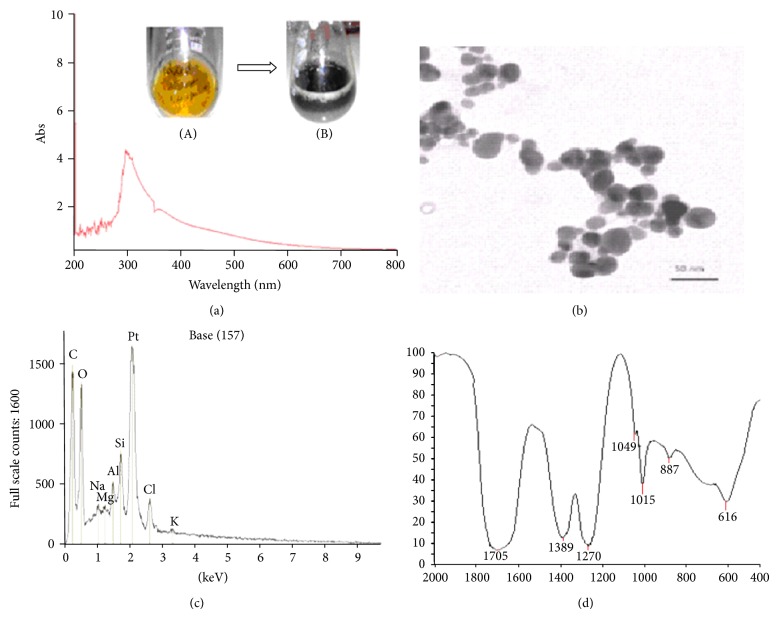
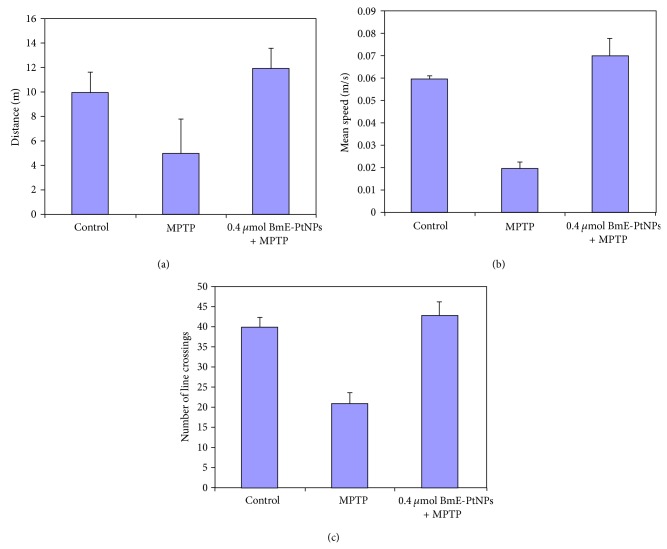
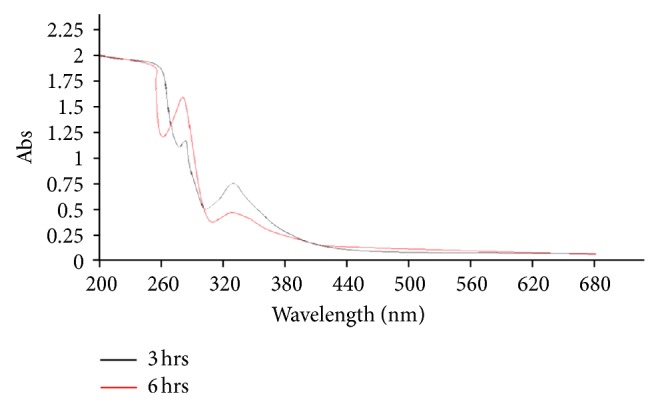
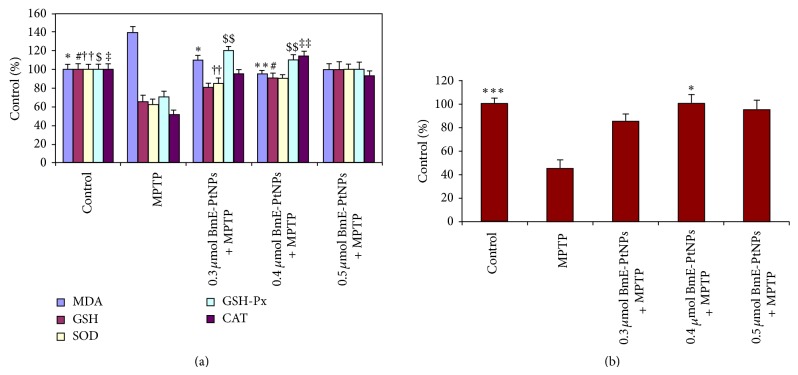
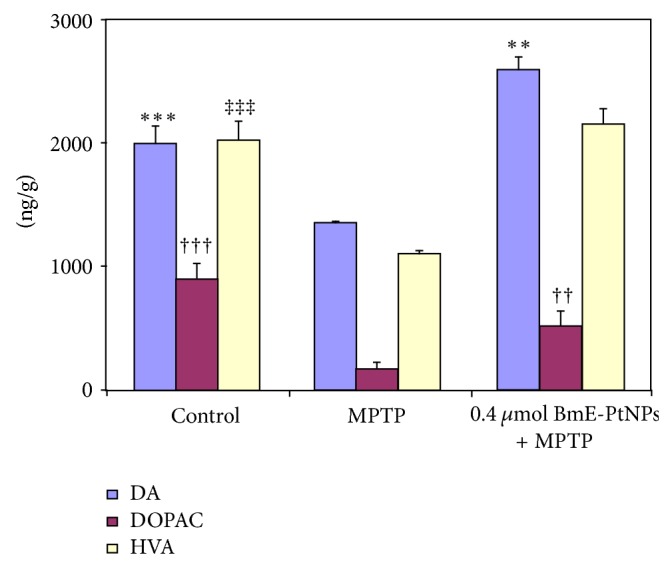
Current discovery demonstrates the rapid formation of platinum nanoparticles using leaf extract of a neurobeneficial plant, Bacopa monnieri (BmE). The nanoparticles (BmE-PtNPs) were stabilized and then coated with varied phytochemicals present within the leaf extract. These nanoparticles demonstrated the same activity of Complex I, as that of oxidizing NADH to NAD(+) using a spectrophotometric method. This suggests that BmE-PtNPs are a potential medicinal substance for oxidative stress mediated disease with suppressed mitochondrial complex I, namely, Parkinson's disease (PD). Hence, the neuroprotective potentials of the phytochemical coated nanoparticle were explored in 1-methyl 4-phenyl 1,2,3,6 tetrahydropyridine- (MPTP-)induced experimental Parkinsonism in zebrafish model. BmE-PtNPs pretreatment significantly reversed toxic effects of MPTP by increasing the levels of dopamine, its metabolites, GSH and activities of GPx, catalase, SOD and complex I, and reducing levels of MDA along with enhanced locomotor activity. Taken together, these findings suggest that BmE-PtNPs have protective effect in MPTP-induced neurotoxicity in this model of Parkinson's disease via their dual functions as mitochondrial complex I and antioxidant activity.
当前的研究发现表明,使用具有神经益处的植物水团花(Bacopa monnieri,简称BmE)的叶提取物可快速形成铂纳米颗粒。这些纳米颗粒(BmE-PtNPs)得到了稳定化处理,随后被叶提取物中存在的多种植物化学物质所包覆。使用分光光度法,这些纳米颗粒表现出与复合体I相同的活性,即将NADH氧化为NAD(+)。这表明BmE-PtNPs对于由线粒体复合体I抑制介导的氧化应激相关疾病,即帕金森病(PD),是一种潜在的药用物质。因此,在斑马鱼模型中,研究了这种植物化学物质包覆的纳米颗粒在1-甲基-4-苯基-1,2,3,6-四氢吡啶(MPTP)诱导的实验性帕金森症中的神经保护潜力。BmE-PtNPs预处理通过提高多巴胺及其代谢产物、谷胱甘肽(GSH)的水平以及谷胱甘肽过氧化物酶(GPx)、过氧化氢酶(CAT)、超氧化物歧化酶(SOD)和复合体I的活性,并降低丙二醛(MDA)水平以及增强运动活性,显著逆转了MPTP的毒性作用。综上所述,这些发现表明BmE-PtNPs在该帕金森病模型中对MPTP诱导的神经毒性具有保护作用,这是通过它们作为线粒体复合体I和抗氧化活性的双重功能实现的。